
A commercial gate has to do more than mark a boundary. It may control deliveries before 7am, protect staff parking overnight, direct visitors to the right entrance and give a site a more professional appearance. The best gates for commercial properties are therefore not simply the strongest-looking option. They are the gates that suit the traffic, layout, security needs and daily operation of the site.
For warehouses, offices, schools, trade yards, flat developments and private estates, aluminium is an increasingly practical choice. It is lightweight, strong, corrosion-resistant and does not demand the regular painting or treatment associated with timber and some steel gates. The right design can also work with automation, intercoms and access control from the outset.
Start with how the entrance is used
Before choosing a style, establish who uses the gate and how often. A gate serving occasional visitor vehicles has very different requirements from one used by delivery vans, staff cars and contractors throughout the day. Vehicle type matters too. A narrow car park entrance may be suitable for a pair of swing gates, while a busy industrial access road often benefits from a sliding gate that keeps the opening clear.
Consider the hours of use, the number of movements expected each day and whether people will need pedestrian access separately. A dedicated pedestrian gate can improve safety by keeping foot traffic away from vehicle entrances. It can also reduce unnecessary wear on an automated main gate.
Site conditions should be assessed early. Sloping ground, limited run-back space, uneven surfaces, wind exposure and underground services can all affect the right specification. This is particularly relevant when automation is planned, as foundations, posts, safety devices and power supply need to be allowed for rather than treated as an afterthought.
Best gates for commercial properties: choosing the format
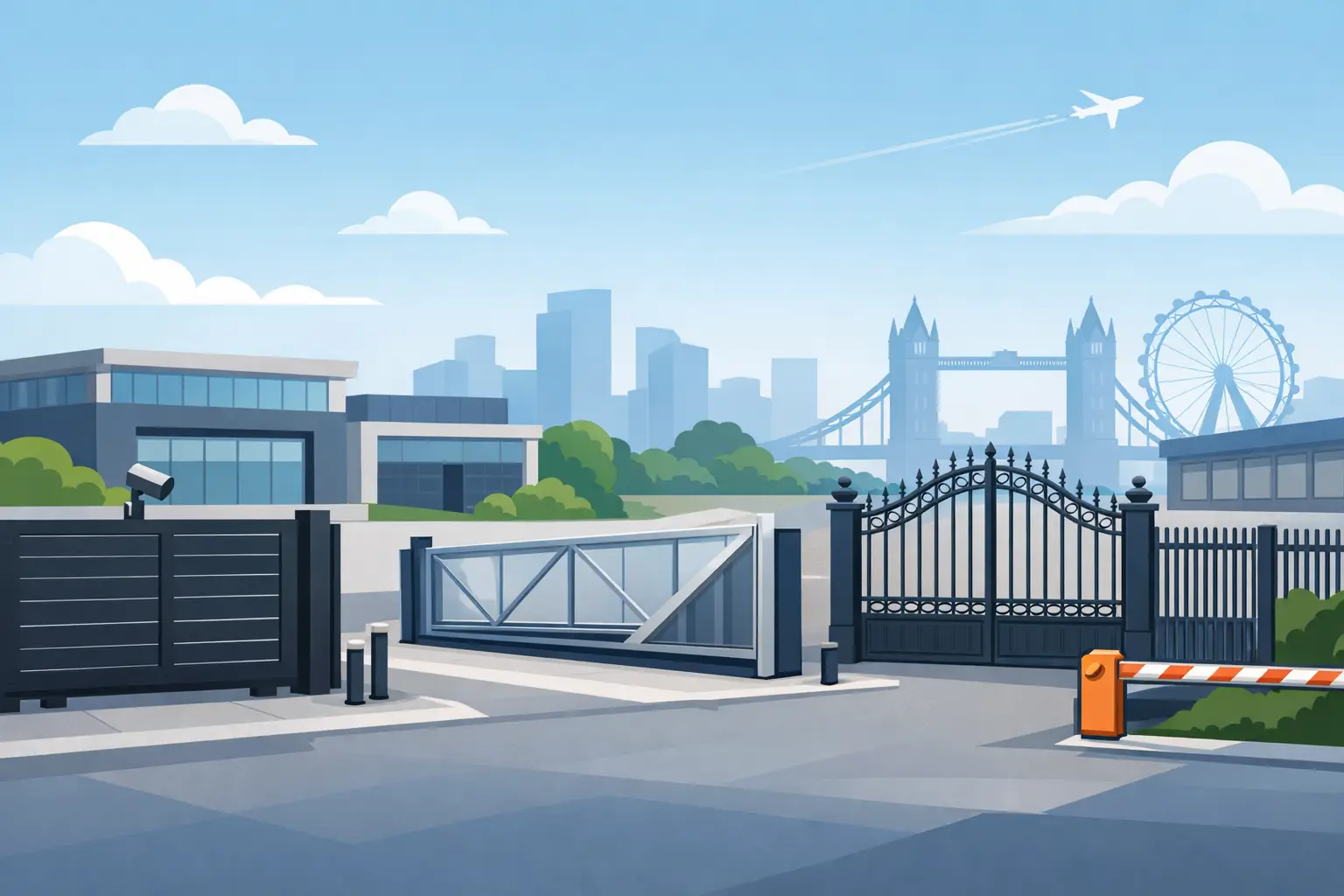
There is no single gate format that suits every commercial premises. The following options cover most projects, but the best result comes from matching the format to the site rather than forcing the site to fit a preferred design.
Sliding gates for busy or restricted entrances
Sliding gates are often the first choice for sites with frequent vehicle movements or limited space behind the entrance. Rather than swinging into the site or towards the road, the gate travels sideways along the boundary line. This can make them particularly useful for commercial yards, business parks, secure compounds and flat developments.
A tracked sliding gate needs a clear, level route for the gate to travel along. Cantilever sliding designs avoid a ground track across the entrance, which can be helpful where debris, leaves or regular vehicle traffic could cause disruption. The trade-off is that cantilever gates require additional side room and a properly engineered support structure.
For wider openings, a sliding gate may offer a cleaner and more manageable solution than very large swing leaves. It also works well with keypad, fob, GSM and intercom entry systems, allowing authorised users to enter without leaving their vehicle.
Swing gates for straightforward access points
Commercial swing gates remain a sensible option for offices, smaller car parks, managed residential sites and lower-traffic entrances. They can be supplied as single or double leaves, depending on the opening width and the available space.
Their main consideration is the clearance arc. The leaves need room to open safely, ideally inward, without obstructing a pavement, road or parked vehicles. On a sloped approach, the direction of the slope may also determine whether swing gates are practical. Where the site layout allows it, aluminium swing gates provide a smart, durable entrance with a wide choice of contemporary and traditional designs.
Pedestrian gates for controlled foot access
A pedestrian gate is not a minor detail. It may be the entrance staff and visitors use most often, and it should sit naturally within the overall perimeter design. For commercial settings, it can be specified with a reliable lock, closer, coded access or an intercom release.
Using a matching pedestrian gate alongside vehicle gates and aluminium fencing creates a more considered boundary. It also supports safer movement around the site by giving people a clear route that does not depend on the vehicle entrance being open.
Bespoke gates for unusual layouts or brand-led schemes
Standard sizes can work well for straightforward openings, particularly when time and budget are tight. However, bespoke aluminium gates are often the better investment where openings are unusually wide, ground levels are challenging or a development requires a particular architectural finish.
Bespoke design also gives project teams greater control over height, infill pattern, privacy level, colour and access points. For client-facing premises, this can help the entrance reflect the building and brand without compromising the security brief.
Security is about the whole entrance
A high gate alone does not automatically create a secure perimeter. The effectiveness of the entrance depends on the gate, posts, fencing, locking method, automation and access control working together. Gaps beneath or around a gate, weak fixing points and poor visibility of the entrance can undermine an otherwise good specification.
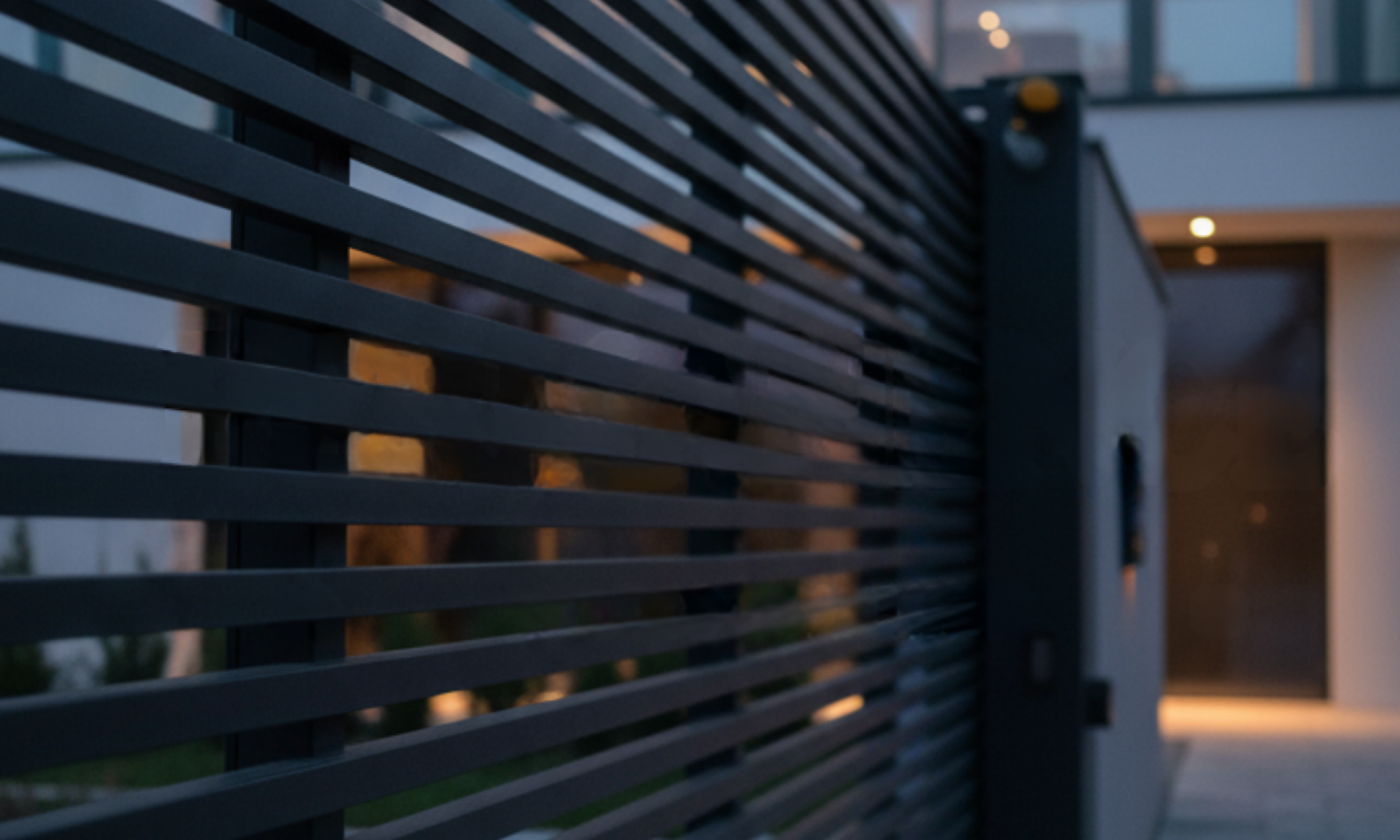
The right level of privacy depends on the site. Solid or closely spaced aluminium infills can screen parking areas, bins and storage zones, while slatted designs allow a degree of visibility without leaving the site fully exposed. Open railings may be better suited to locations where passive surveillance and a welcoming appearance are priorities.
For many commercial properties, access control is where the gate becomes most useful. A simple keypad may suit a small team, while fob access, GSM calling and video intercom systems offer greater control for multi-user sites. Akuvox intercom systems can be considered where video verification and remote visitor management are required. The most appropriate system depends on how visitors arrive, who approves access and whether reception is staffed during all operating hours.
Plan automation around safety and usage
Automation improves convenience, but it must be specified for the gate’s weight, size and expected duty cycle. A motor intended for occasional residential use may not be suitable for a commercial entrance with repeated daily movements. Selecting equipment with the correct capacity helps avoid avoidable downtime and premature wear.
Safety measures should form part of the installation plan. Depending on the gate type and site, these can include photocells, safety edges, warning lights, emergency release and suitable controls for manual operation during a power failure. A professionally planned system will also consider where vehicles wait while the gate opens, so they are not left obstructing a highway or pedestrian route.
Maintenance is still needed for any automated system, even when the gate itself is low maintenance. Moving components, motors and safety devices should be inspected and serviced at appropriate intervals. Aluminium reduces the burden of surface upkeep because it will not rot like timber or rust in the same way as untreated steel, but hinges, tracks and automation components still need attention.
Appearance, budget and long-term value
Commercial buyers are often balancing security, presentation and cost. The lowest initial price is not always the lowest lifetime cost if a gate requires frequent repainting, repairs or replacement. Aluminium offers a strong balance for many projects: it is lighter than steel, naturally resistant to corrosion and available in a broad range of powder-coated colours and styles.
That does not mean aluminium is automatically right for every application. Heavily industrial environments, specialist security requirements or exceptionally wide openings may call for a more detailed engineering assessment. Equally, a simple readymade gate may be entirely suitable for a modest staff car park where a fully bespoke system would add cost without adding meaningful benefit.
A clear brief helps suppliers provide a more accurate recommendation and price. Share the opening width and height, photographs of the entrance, ground conditions, preferred gate operation, expected traffic and whether automation or intercom access is required. This reduces uncertainty before manufacture and installation are arranged.
Get the specification right before ordering
For commercial projects, it pays to treat the gate as part of a wider access plan rather than a standalone purchase. Aluminium Gates Direct can help buyers compare readymade and bespoke options, select matching fencing or railings, and plan automation with a trusted installation partner network nationwide.
The most useful next step is a site-specific conversation: explain how the entrance is used, what needs protecting and what should happen when a visitor arrives. From there, the right gate becomes much easier to identify – and far more likely to serve the property well for years to come.