
A sliding gate can solve a problem that a swing gate cannot: it secures a driveway without needing clear space inside or outside the entrance for gate leaves to open. However, choosing the wrong sliding system can create new issues, from insufficient run-back space to awkward access or costly groundworks. Knowing how to choose sliding gates starts with the site, not the style.
For homeowners, developers and commercial buyers, the best choice balances security, appearance, daily use and the realities of the entrance. A well-specified aluminium sliding gate should look right from the road, operate reliably and require very little upkeep for years to come.
Start with the space beside the entrance
A sliding gate needs room to travel when it opens. This is the first measurement to confirm, before considering colours, infill designs or automation.
For a single sliding gate, the clear opening is the distance between the two points where vehicles pass through. The gate itself must usually be wider than that opening to provide suitable overlap and support. You also need a clear run-back area to one side of the entrance where the gate can sit fully open.
As a general guide, the available run-back should accommodate the full gate width, plus the space required for the chosen support and automation arrangement. Obstructions such as walls, planting, slopes, utility boxes, parking bays and existing fencing can all affect what is possible.
If there is limited room at either side, a telescopic sliding gate may be worth considering. This design uses two or more gate sections that slide together, reducing the length needed for the gate to open. It is a practical answer for tighter plots, although it is more mechanically involved than a standard single-leaf sliding gate and should be specified carefully.
Choose between tracked and cantilever sliding gates
The two main sliding gate formats work differently, and the right option depends largely on the driveway surface and site conditions.
Tracked sliding gates
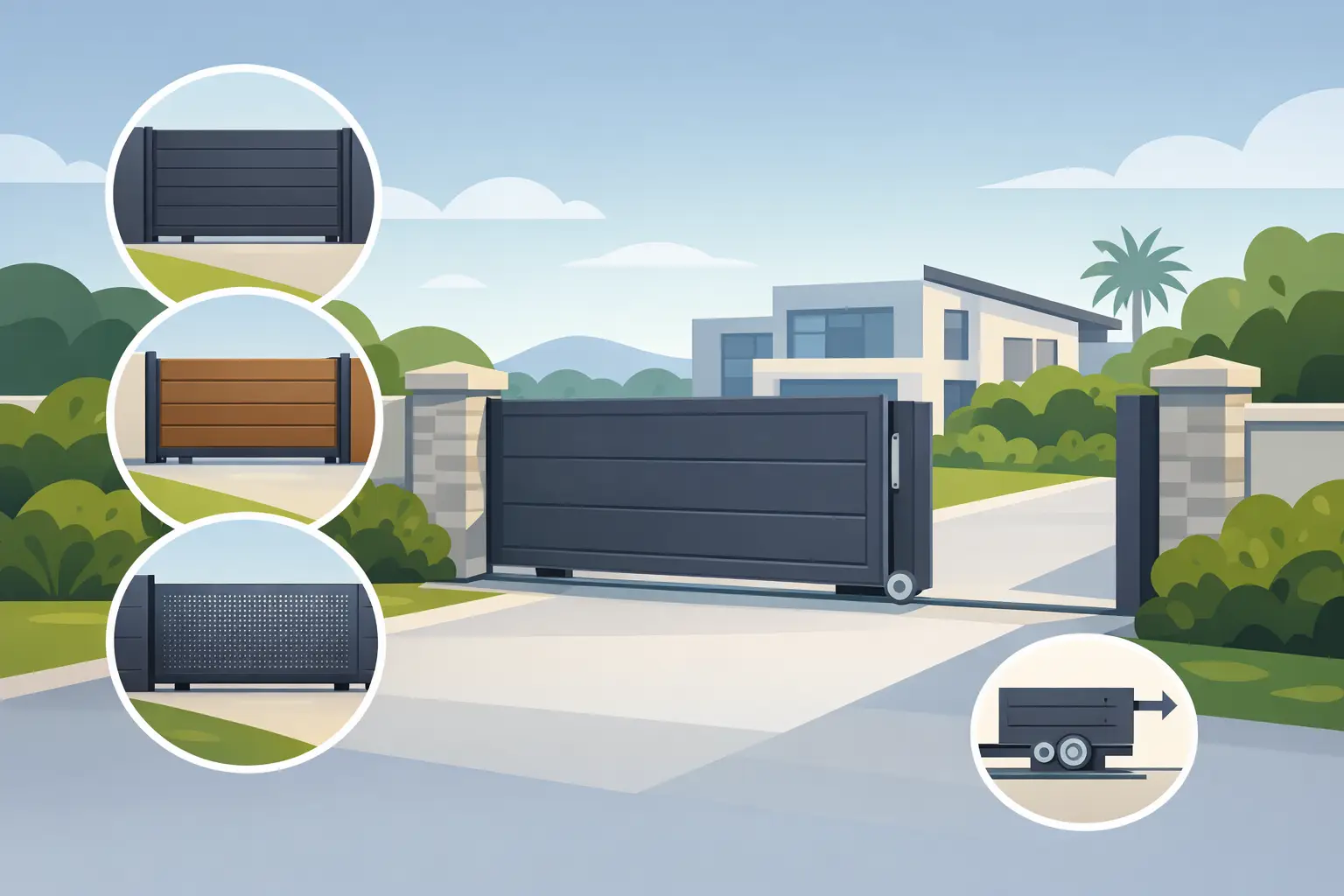
A tracked gate runs on wheels along a rail fixed into or onto the driveway. It is often a cost-effective and straightforward option where there is a level, sound surface and regular cleaning is realistic.
The rail needs to remain clear. Leaves, gravel, mud, snow and debris can interfere with smooth operation, particularly on rural properties or busy commercial entrances. A tracked system can still be an excellent choice, but it suits sites where the track can be kept clean and the ground is stable.
Cantilever sliding gates
A cantilever gate is suspended above the driveway rather than running on a ground track. It uses a counterbalance section and roller support assembly at one side of the entrance. Because there is no rail across the opening, it is particularly useful for uneven ground, gravel drives, areas affected by debris, or locations where drainage and winter conditions could make a track less practical.
Cantilever gates generally need more run-back space because of the counterbalance section. They can also involve a more substantial support structure, so the initial investment may be higher. In return, many customers value the cleaner opening and reduced dependence on a clear ground track.
Measure the driveway and vehicle use properly
The width of the entrance should reflect more than the average family car. Think about delivery vehicles, refuse lorries, tradespeople, vans, trailers and emergency access. A narrow opening may feel secure, but it can make everyday access frustrating or lead to damaged kerbs, gate posts and vehicles.
Consider where a vehicle waits while the gate opens. If the entrance leads directly onto a busy road, automated operation becomes especially valuable because drivers can remain safely off the carriageway where possible. On a deep driveway, opening speed may matter less than quiet, dependable movement and strong access control.
For commercial premises, account for peak traffic, vehicle types and whether pedestrians regularly share the access point. A gate that works for occasional car movements may not be suitable for a development, warehouse, school, managed site or business yard with frequent arrivals.
Select a material that suits long-term ownership
Steel and timber gates both have their place, but they bring ongoing maintenance requirements. Timber can weather, move and require treatment, while steel can need regular attention to protect against corrosion and maintain its finish.
Aluminium is a strong choice for sliding gates because it is lightweight, durable and resistant to rust. Lower weight can reduce strain on automation equipment when compared with heavier alternatives, while powder-coated aluminium provides a clean, consistent finish in a wide choice of colours. It also offers the low-maintenance ownership many property owners want – usually routine cleaning is all that is needed to keep the gate looking smart.
Lightweight does not mean insubstantial. The gate frame, infill, posts and supporting hardware must all be designed for the span, wind exposure and operating system. Larger or more exposed entrances require careful engineering, particularly where solid infill panels may catch the wind.
Match the design to privacy, security and kerb appeal
A sliding gate is a prominent part of the property boundary. It should complement the architecture of the home or site rather than feel like an afterthought.
Horizontal slatted designs suit many contemporary homes and offer a balance between privacy and light. Close-boarded or solid-panel styles provide greater screening, which can be useful for properties on main roads. More open designs can preserve sightlines, soften the boundary and allow better visibility at the entrance.
Security is not only about making a gate difficult to climb. It is also about the complete perimeter strategy. The height of the gate, the gap beneath it, the design of adjacent fencing, the placement of posts and the security of pedestrian access all need to work together. For commercial projects, the required level of protection may call for a more purpose-led design, controlled entry and suitable fencing or railings alongside the gate.
Bespoke aluminium gates allow the width, height, layout, colour and infill pattern to be tailored to the site. Readymade options can be a sensible route where dimensions are standard and quicker availability is the priority. The right route depends on whether the property needs a precise fit or a practical off-the-shelf solution.
Plan automation and access control early
Although a sliding gate can be manually operated, automation is usually the better choice for a driveway entrance. It adds convenience, supports controlled access and avoids the need to leave the vehicle in poor weather or on an exposed road.
The motor must be matched to the gate’s weight, length, expected usage and system type. A domestic gate used a few times each day has different demands from a commercial entrance operating throughout the day. Choosing a motor solely on headline power can be misleading – duty cycle, safety features, control options and professional installation matter just as much.
Think about how people will enter before the installation begins. Remote controls are simple and familiar, but keypad entry, fob access, GSM calling and video intercom systems may better suit the property. An Akuvox intercom system, for example, can provide video calling and controlled entry for households, flats or commercial sites where visitors need to be verified.
A separate pedestrian gate is often a worthwhile addition. It prevents people from walking through a vehicle entrance and reduces unnecessary gate cycles. This can be safer, more convenient and better for the long-term operation of the automated system.
Do not treat safety as an optional extra
Automated gates must be designed and installed with safety at the centre of the project. Moving gates create pinch points, crushing risks and other hazards that need to be assessed for the specific entrance.
A suitable system may include photocells, safety edges, force limitation, emergency release and clearly planned control positions. The exact requirements depend on the gate layout, nearby walls and posts, pedestrian routes, public access and how the gate is used. Professional installation, commissioning and handover are essential, not a final add-on.
It is also wise to plan for servicing. Even a low-maintenance aluminium gate relies on moving components, electrical equipment and safety devices that should be checked periodically. Keeping the system maintained protects its reliability and helps identify wear before it becomes a breakdown or safety concern.
Allow for foundations, power and drainage
The visible gate is only one part of the project. Posts, cantilever supports, tracks, motors and safety equipment all need secure foundations. Ground conditions can influence the size and type of concrete bases required, particularly for wide gates or exposed locations.
Power should be considered before hard landscaping is completed. Running cables after a new driveway has been laid is possible, but it is rarely the most efficient or tidy option. If an intercom, keypad, lighting or vehicle detection is planned, discuss the cabling route at the same time.
Drainage also deserves attention. Water collecting around a tracked gate can affect its operation and accelerate wear around the rail. A good installer will assess levels and surface water rather than simply fitting the gate to an unsuitable finished surface.
Get advice based on your actual entrance
The most successful sliding gate projects begin with accurate measurements, photographs and a clear conversation about how the entrance is used. Provide the opening width, available run-back, driveway surface, ground level, desired height, vehicle use and preferred method of access. This gives a supplier or installation partner the information needed to recommend a system that fits the site and budget.
At Aluminium Gates Direct, the focus is on matching customers with aluminium gate solutions that are practical as well as attractive, with support available for bespoke design, automation and nationwide installation planning. A properly chosen sliding gate should feel straightforward every time you arrive home or open up a site – secure when closed, unobtrusive when open and built around the way the property really works.