
The wrong gate choice usually shows itself on a wet Tuesday morning. A car is waiting on the drive, the entrance is tighter than it looked on paper, and suddenly the question of sliding vs swing gates stops being theoretical.
If you are planning a new entrance for a home, development or commercial site, the gate style matters just as much as the material. Both options can look smart, improve security and work well with automation, but they behave very differently once installed. The best choice depends on your space, your ground conditions, how often the gate will be used and what kind of access experience you want every day.
Sliding vs swing gates: the key difference
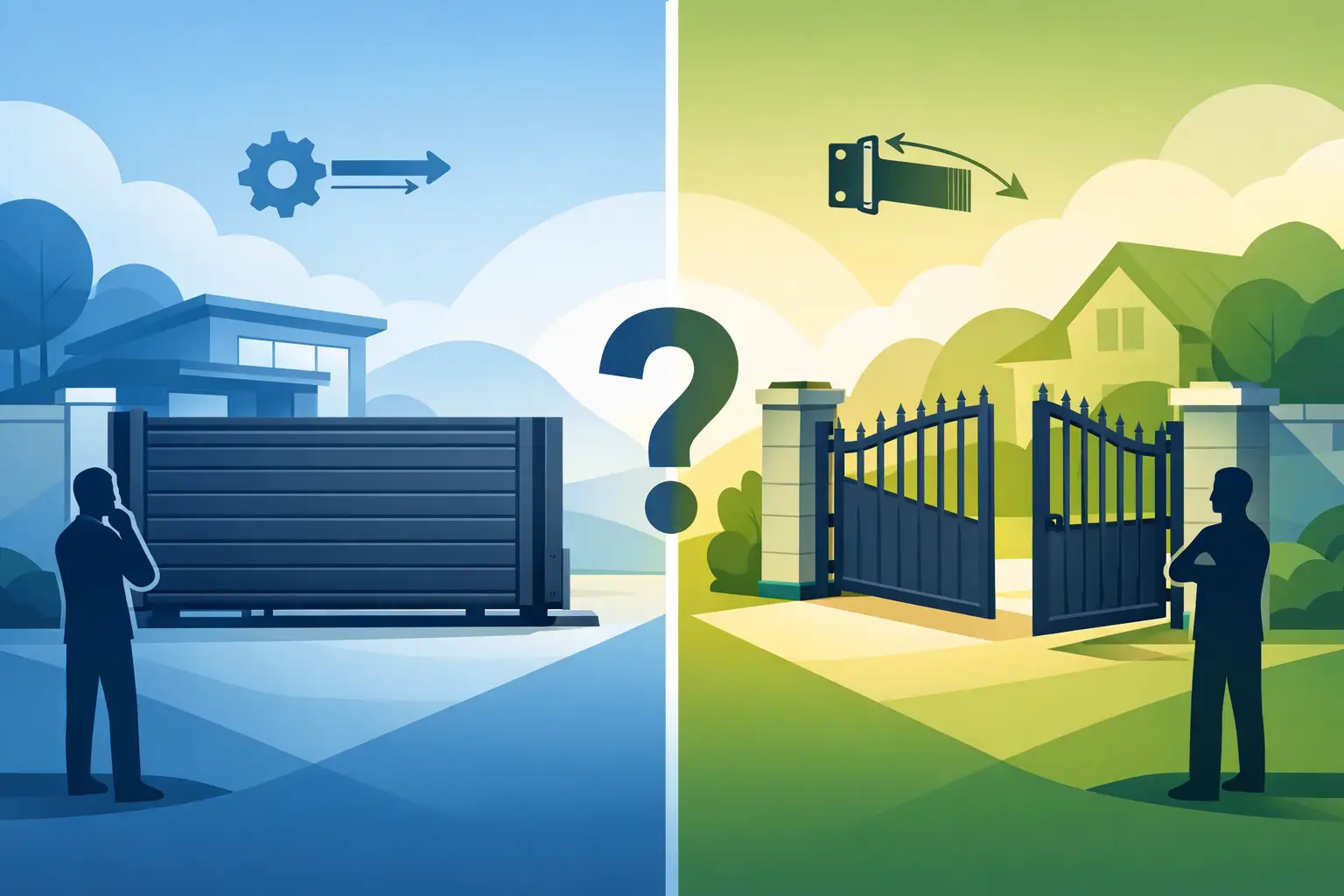
A swing gate opens inwards or outwards on hinges, much like a large door. A sliding gate moves sideways along the boundary line, usually running on a track or cantilever system depending on the design and site requirements.
That sounds simple enough, but the practical difference is significant. A swing gate needs a clear arc to open into. A sliding gate needs run-back space to one side so the gate can travel fully open. In other words, neither option is universally better. It comes down to which kind of space your entrance can realistically provide.
For many buyers, this is the first major filter. If your driveway rises sharply behind the gate opening, a swing gate can become problematic. If you have short side returns or obstructions such as walls, fencing, planting or parking spaces, a sliding gate may be harder to accommodate. Good gate selection starts with the site, not just the look.
When swing gates make more sense
Swing gates are often the natural choice for residential driveways. They offer a traditional entrance style, suit a wide range of property types and can be a very cost-effective solution where space allows.
From a design point of view, swing gates are versatile. They work well on period properties, modern homes and garden entrances, and they are available in single or double leaf layouts depending on width and appearance. For many homeowners, they also feel familiar. The operation is straightforward, and visually they create a classic driveway entrance.
Installation can also be simpler in the right setting. If the ground is level and there is enough clearance for the leaves to open safely, a swing system may involve less groundwork than a sliding alternative. That can help with budget control, particularly on straightforward domestic projects.
There are limits, though. Swing gates need space behind the opening, and that space must stay clear. If vehicles are parked too close, if the drive slopes up too quickly, or if the entrance sits close to a public highway, the opening arc can create complications. Wind exposure can also be a factor, especially with wider solid-panel designs.
When sliding gates are the better option
Sliding gates come into their own where space in front of or behind the gate is restricted. Because the gate moves sideways rather than swinging through an arc, they are often a strong solution for shorter driveways, commercial entrances and sites where vehicle positioning needs to be tightly controlled.
They can also feel more secure in operation. A sliding gate is generally harder to force than a swing gate because of the way it is supported and guided. For commercial sites, flat schemes, schools and higher-traffic entrances, that can be a real advantage.
Another benefit is consistency in tighter layouts. If vehicles stop near the entrance, a sliding system is less likely to be obstructed by the car itself. That is useful on busy driveways and access points where users may not always leave perfect clearance.
The trade-off is space at the side. A sliding gate needs enough room to retract fully when open. It also tends to involve more structural planning, particularly if a track, guide posts or cantilever hardware is required. On some sites, the extra engineering is exactly what makes the gate work well. On others, it can add complexity that a swing gate avoids.
Space and ground conditions matter more than style
Many customers start by choosing the look they prefer, then work backwards. In reality, the available space and the site levels should lead the decision.
A level driveway with generous depth often suits swing gates perfectly. A steep incline from the entrance can make them impractical unless design adjustments are made. Sliding gates are often better on rising driveways because they do not need floor clearance in the same way while opening through an arc.
Ground conditions also affect long-term reliability. A tracked sliding gate depends on a clean, correctly installed running surface. Debris, poor drainage or movement in the ground can create issues if the system is not specified properly. Swing gates place more emphasis on strong posts, hinge alignment and sufficient clearance. Neither type is difficult when properly planned, but both need the right foundation.
Automation and day-to-day use
Both swing and sliding gates can be automated successfully, and both can be paired with access control such as intercoms, keypads and remote entry. The better option depends on how the entrance will be used.
For lower to moderate domestic use, automated swing gates are often a very practical answer. They open smoothly, can look elegant and usually suit private driveways well. For higher-traffic sites or entrances where vehicles may queue close to the gate, sliding gates can be more predictable in operation.
Safety is part of this conversation too. Automated gates must be specified and installed correctly, with suitable safety devices and controls. That is especially important on family homes, shared developments and commercial premises. A well-made aluminium gate helps here because the material is lightweight without compromising strength, reducing strain on automation and supporting smoother operation over time.
Cost: the honest answer
If you are comparing sliding vs swing gates on price alone, swing gates are often the lower-cost option at the outset. They can require less specialist hardware and, on straightforward sites, installation may be less involved.
Sliding gates often cost more because the system itself is more complex. There may be additional groundwork, track installation, support structures or more advanced automation requirements. That does not mean they are poor value. In the right setting, they can solve access problems that a swing gate cannot.
The more useful way to look at cost is total suitability. A cheaper gate that is awkward to use, vulnerable to site conditions or expensive to alter later is not really the economical choice. The right gate is the one that works properly for the setting and continues to do so with minimal fuss.
Appearance and kerb appeal
Visually, both styles can be impressive. The difference is more about character than quality.
Swing gates often create a more traditional entrance presence. They can feel balanced and formal, particularly as a pair of driveway gates. Sliding gates tend to look more contemporary and can suit modern architecture and clean-lined perimeter designs very well.
Material choice has a big influence here. Aluminium offers a strong advantage for both styles because it combines durability with low maintenance. It will not rot like timber and it avoids many of the upkeep issues associated with mild steel. For homeowners and site managers who want a gate that keeps its appearance without regular treatment, that makes a genuine difference.
So which should you choose?
If your entrance has enough depth, level ground and room for leaves to open comfortably, a swing gate is often an excellent option. It is practical, attractive and frequently more budget-friendly.
If your driveway is tighter, the ground rises behind the opening, or the site sees frequent use and needs controlled access, a sliding gate may be the stronger choice. It can make better use of limited space and offer a very secure, efficient entrance solution.
For some projects, the answer becomes obvious after a site survey. For others, there is a genuine choice, and that is where expert guidance matters. A gate should not only fit the opening. It should suit the way the property works, the level of traffic, the design brief and the budget.
At Aluminium Gates Direct, that is usually where the best decisions are made – not by pushing one gate type over another, but by matching the product to the property.
If you are weighing up your options, start with the practical questions first: how much space do you really have, how will the gate be used every day, and what will make access easier five years from now, not just on installation day.