
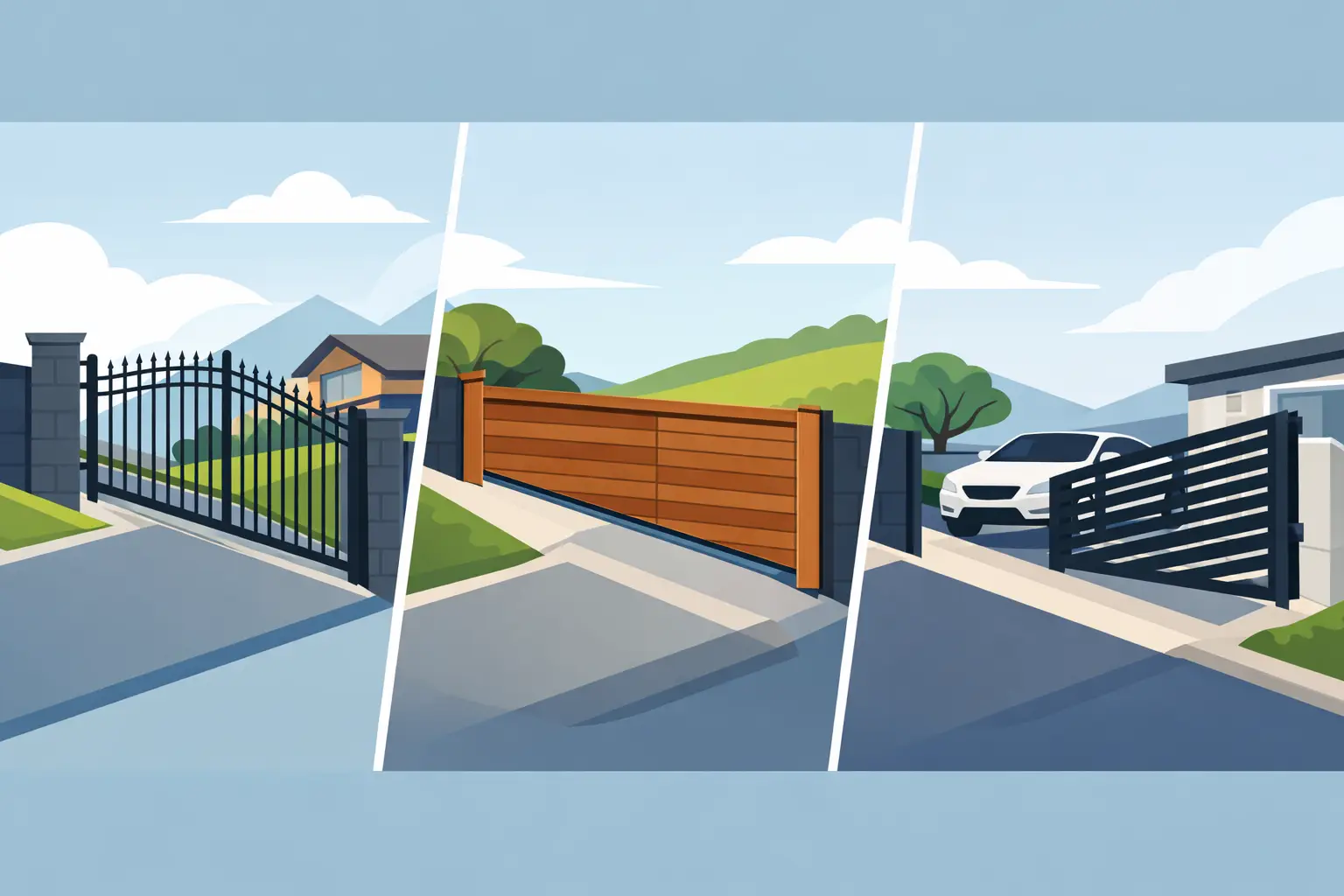
A driveway that rises or falls across its opening changes the whole gate decision. Gates for sloped driveways need more than the right look – they need the right opening method, clearances, hinge setup and automation plan, otherwise a smart entrance can become awkward to use very quickly.
For many property owners, the main concern is simple: will the gate actually open properly without catching the ground, leaving large gaps or creating problems for vehicles and pedestrians? The answer depends on the direction and degree of the slope, the available space and whether you want manual or automated operation. Get those details right at the start and the finished result can look clean, work reliably and add genuine value to the property.
What makes gates for sloped driveways different?
On a level driveway, most gate styles are straightforward to specify. On a slope, the geometry changes. A standard pair of swing gates opening across a rising drive may need significant ground clearance at the lower edge, which can leave an uneven gap underneath. That affects both appearance and security.
The steeper the incline, the more careful the design needs to be. A mild slope may still allow a conventional swing arrangement with adjusted hinge positions or a reduced gate height at the lower end. A more pronounced slope often points towards a tracked sliding gate, cantilever sliding gate or a specially designed rising hinge setup.
This is why there is rarely a one-size-fits-all answer. The best option is the one that suits the site conditions first, then matches the style of the property and the intended budget.
Swing or sliding gates for sloped driveways?
This is usually the first major choice, and in many cases the slope itself narrows the options.
Swing gates on a slope
Swing gates can work well on sloped driveways, but only in the right circumstances. If the drive slopes upwards away from the road, inward-opening gates may foul the ground unless enough clearance is built in. That can create a visible gap beneath the gate, particularly at one end. On a shallow incline, this may be acceptable. On a steeper one, it can look unbalanced and reduce privacy.
Outward-opening gates are sometimes considered, but they are not always practical or compliant where the gate would encroach onto a pavement or public highway. For many homes, that rules them out immediately.
There are technical ways to improve swing gate performance on a slope. Rising hinges can lift the gate slightly as it opens, and split gate designs can reduce the swing arc. Even so, swing gates tend to be best where the slope is modest and the driveway layout gives enough room to work with.
Sliding gates on a slope
Sliding gates are often the cleaner solution for sloped driveways because they move sideways rather than swinging into the incline. That avoids the issue of the gate bottom catching the drive surface. For properties with a noticeable rise, this can make sliding gates the more practical and more polished choice.
There are two common approaches. A tracked sliding gate runs along a ground track, while a cantilever gate is supported without a track across the opening. Tracked systems can be cost-effective, but the track must be kept clear of debris. Cantilever systems avoid that issue and are popular where reliability and lower ground interference matter, though they usually need more run-back space and can carry a higher initial cost.
If the site allows lateral space for the gate to travel, sliding designs are often the strongest contender.
Why aluminium is well suited to sloping entrances
Material choice matters on any gate project, but it matters even more on a slope. Heavier gates place more demand on hinges, posts, motors and structural supports. That is one reason aluminium is such a good fit.
Aluminium gates combine strength with relatively low weight, which helps with smoother operation and reduces strain on moving parts. On a sloped driveway, that can be a real advantage whether the gate is manual or automated. It also makes bespoke sizing and design adjustments more manageable, especially where a gate needs to be tailored to awkward site dimensions.
There is also the maintenance factor. Timber can move over time, and steel may need more attention to protect against corrosion. Aluminium is resistant to rust and requires very little ongoing upkeep, which appeals to homeowners and commercial buyers alike. For anyone investing in a gate system on a challenging entrance, low maintenance and long-term reliability are not small benefits.
Measuring the slope properly
A surprising number of gate problems begin with inaccurate site assumptions. A driveway can look only slightly sloped, yet the change in level across the gate opening may be enough to affect operation.
The important point is not just that there is a slope, but how much fall or rise occurs across the width of the opening and how quickly it changes. A gentle, consistent incline is very different from a driveway that dips near the threshold and then levels out. The second case may allow more flexibility than the first.
This is where expert advice makes a difference. Proper measuring should account for opening width, gate height, hinge side levels, vehicle clearance, post positioning and the available space for gate travel. If automation is planned, the motor position and safety equipment also need to be considered early rather than added as an afterthought.
Design choices that affect appearance and performance
A practical gate does not need to look compromised. In fact, some of the best solutions for sloped driveways are the ones where the engineering has been considered carefully enough that the result looks deliberate rather than adapted.
One choice is whether the bottom of the gate follows the line of the slope or stays level. A gate with a raked bottom edge can reduce the visual gap and create a neater fit to the driveway. That is often attractive on residential properties where appearance is just as important as function. A level-bottom design may still be suitable in some settings, particularly where the slope is slight or the style of the entrance is more contemporary and minimal.
The gate infill also plays a part. Solid or semi-solid designs offer privacy but make any bottom gap more noticeable. Open-board or railed styles can be more forgiving visually. For developers and commercial sites, this can become a balance between presentation, privacy and security.
Colour, finish and surrounding fencing should also be considered as part of the whole entrance scheme. A gate on a slope already has a technical challenge to solve, so the design should feel cohesive rather than pieced together.
Automation on sloped driveways
Automation can work very well on sloped driveways, but the gate type and motor setup need to match the site. This is not an area where a generic kit should simply be applied.
For swing gates, slope affects ram geometry, opening angles and safety zones. For sliding gates, the track, support structure and run-back area all need to be right. In either case, reliable automation depends on sound groundwork and accurate specification.
Safety is especially important. Photocells, obstacle detection and controlled force settings all need to be planned around the movement path of the gate. If pedestrians use the same entrance, access control should be arranged with that in mind. Intercom systems and smart entry options can be integrated neatly, but only if they are considered as part of the full project.
For many customers, the most cost-effective route is not the cheapest gate at the start, but the gate that is designed correctly for the slope and therefore avoids later remedial work.
When bespoke is the better option
Readymade gates can be excellent value where the opening is straightforward and the slope is minimal. Once the site becomes more complex, bespoke often becomes the smarter choice.
A made-to-order gate can be sized precisely, designed with the correct bottom rake, matched to the required opening method and prepared for automation from the outset. That level of accuracy tends to produce a better fit and a better finish, especially on properties where kerb appeal matters.
For trade buyers, developers and architects, bespoke specification also helps avoid site delays. A gate that has been designed around the actual conditions is far less likely to need awkward adjustments during installation.
This is where a specialist supplier such as Aluminium Gates Direct can add real value – not simply by supplying the gate, but by helping customers choose a solution that suits the slope, the style of the property and the practical demands of day-to-day use.
The right question is not just what gate you like
It is natural to start with appearance. Most people have a preferred style in mind before they ask about hinges, tracks or clearances. But with sloped driveways, the better starting point is how the gate will operate on the site you have.
Once that is clear, the design options become much easier to narrow down. In many cases, the best result comes from balancing three things: the shape of the driveway, the level of privacy or security you want and the amount of maintenance you are prepared to take on over time.
If your driveway slopes, that does not limit you to an unattractive or compromised entrance. It simply means the gate needs to be chosen with more care. A well-specified aluminium gate can handle the technical demands, look right on the property and stay easy to live with for years to come.
The simplest next step is to treat the slope as the starting point, not a problem to work around later.