

A commercial gate is rarely just a boundary feature. It may control vehicle movements at a depot, protect stock at a trade yard, manage visitor access at offices, or create a smarter first impression at a new development. The right choice needs to balance security, daily use, safety, appearance and budget from the outset.
This commercial gate buying guide explains the questions worth answering before you order. Getting the specification right early can prevent costly changes later, particularly where automation, access control, groundworks and installation all need to work together.
Start with how the site operates
Before choosing a gate style or finish, look closely at how people and vehicles use the entrance. A gate serving a small private car park has very different demands from one at a busy industrial site with delivery vehicles, shift workers and regular visitors.
Consider the width and height of the opening, the type of vehicles using it, and how often the gate will open each day. Think about turning space too. A large rigid vehicle may need a wider clear opening than a standard car, while a sliding gate needs sufficient run-back space alongside the entrance.
Traffic flow matters as much as gate size. If vehicles enter and leave at the same time, you may need a wider opening, separate entry and exit points, or a layout that prevents queues forming on the public road. For pedestrian access, a separate pedestrian gate is usually safer and more practical than asking staff or visitors to pass through a vehicle entrance.
It is also worth deciding who needs access. Employees, tenants, contractors, deliveries and emergency services may all require different methods of entry. This is where a gate becomes part of a wider access-control plan rather than a stand-alone product.
Choose between sliding and swing gates
The best opening method depends on the site layout, available space and operating requirements.
Sliding gates for busy or restricted entrances
Sliding gates are often the preferred option for commercial premises where space behind the entrance is limited or where a wider opening is required. They travel sideways along the fence line, so they do not swing into the driveway or towards the highway. This can make them a strong choice for industrial estates, commercial yards, flat developments and managed car parks.
A tracked sliding gate runs on a ground rail, while a cantilever gate is supported above ground and does not require a track across the entrance. Cantilever systems are particularly useful where loose gravel, leaves, standing water or frequent vehicle movements could make a ground track harder to maintain. They do, however, require additional space for the counterbalance section and supporting structure.
Swing gates for simpler layouts
Swing gates can suit commercial entrances with adequate space inside the boundary. A pair of gates may create a traditional, substantial appearance for offices, private estates, schools or smaller compounds. Single-leaf options can work well for narrower entrances.
The key question is whether the leaves can open safely without obstructing parking spaces, vehicle routes or pedestrian areas. Gates should generally open inwards, not out towards a public pavement or road. On sloping sites, the direction and clearance of the swing must be assessed carefully before a final design is agreed.
Specify the right material and design
Commercial gates must look the part, but appearance should support the practical needs of the site. Aluminium is a popular choice because it is lightweight, strong and highly resistant to corrosion. Unlike timber, it will not rot, warp or need regular staining. Unlike untreated steel, it does not rust, making it well suited to exposed UK weather conditions.
The lower weight of aluminium can also reduce strain on hinges, posts and automation equipment when compared with heavier alternatives. That said, gate construction, width, infill design and wind loading still need proper consideration. A large solid-panel gate catches more wind than an open rail design, for example, and may require stronger posts, foundations and appropriately rated automation.
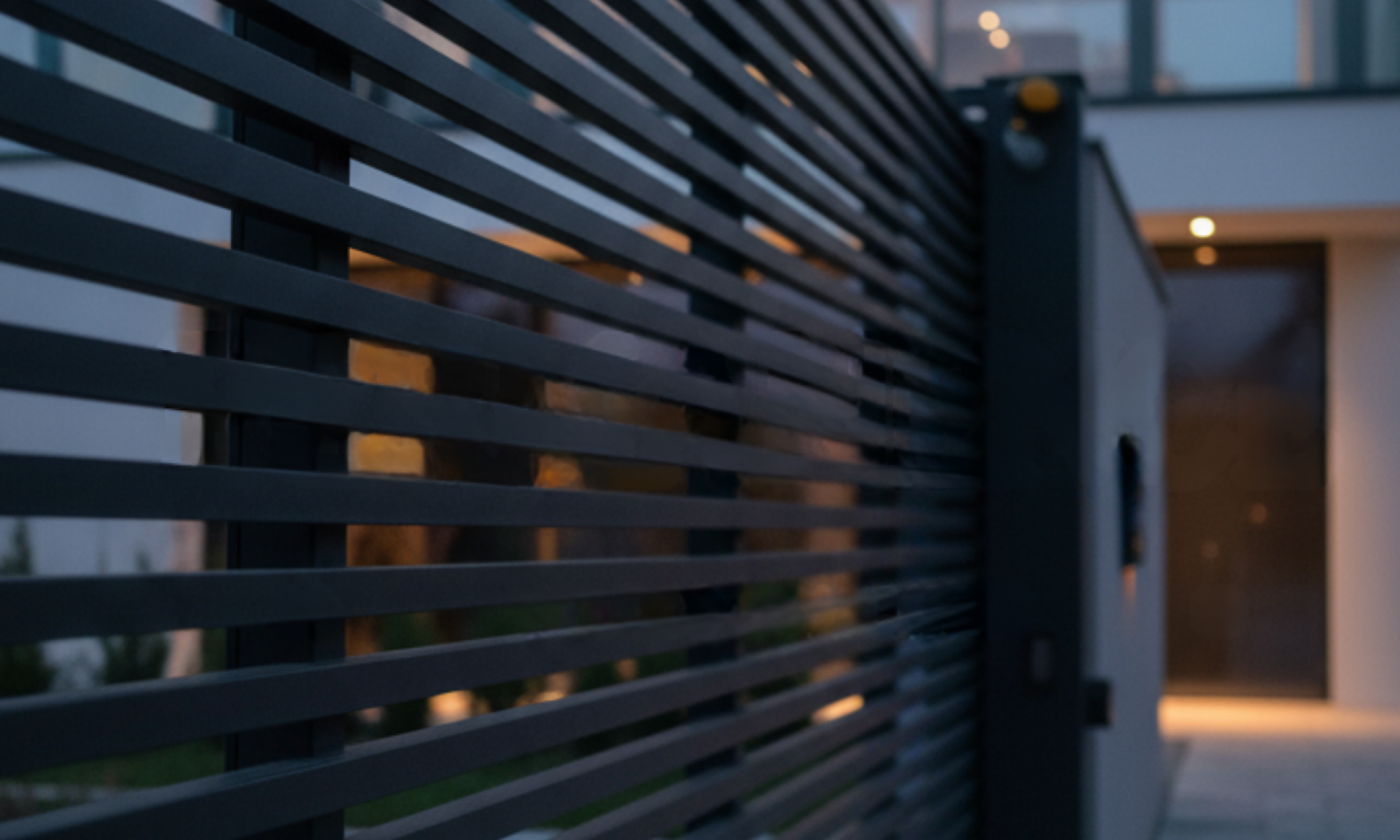
For high-security or privacy-led sites, closeboard-style aluminium infills, solid panels or vertical slats can reduce visibility into the premises. Where sightlines are useful for staff safety, vehicle movement or a more open frontage, horizontal rails or spaced slats may be a better fit. Decorative details can soften the appearance of a residential-style development or office entrance, while a cleaner, more functional design may suit warehouses and trade premises.
Powder-coated aluminium also gives you flexibility on colour. Black, anthracite grey and darker architectural shades remain popular, but the finish can be selected to complement existing fencing, cladding, signage or building details.
Do not treat automation as an add-on
For many commercial sites, automation is essential. It improves convenience, helps control access and reduces the risk of gates being left open. However, automation should be specified alongside the gate, not selected afterwards.
The operator needs to match the gate type, leaf weight, opening width, duty cycle and expected level of daily use. A system designed for occasional use at a small site may not be suitable for an entrance operating throughout the day. Choosing equipment with the appropriate capacity helps support reliable performance and avoids premature wear.
Safety is equally important. Automated gates need a properly designed safety system, which may include photocells, safety edges, warning signage, emergency release arrangements and controls positioned away from moving parts. The precise requirements depend on the installation and risk assessment, but commercial buyers should expect safety to be addressed as part of the overall specification.
Power supply is another early consideration. Establish where power will come from, whether cable runs are needed, and who is responsible for any trenching or electrical work. If the entrance is remote, solar-powered automation may be possible in some cases, although performance depends on usage levels, location and available daylight.
Plan access control around real users
A keypad may be sufficient for a small staff-only yard, but it is not always the most manageable option for a larger site. Codes can be shared, forgotten or need changing when staff leave. Fob and card systems offer more control, while GSM entry systems allow authorised users to open the gate from a mobile phone.
For premises receiving visitors, an intercom adds a useful level of communication and control. Video intercoms, including systems such as Akuvox, allow staff to see and speak to callers before granting access. This can be particularly valuable at offices, residential developments, gated commercial units and sites where reception is not located beside the entrance.
Where there are several users or tenants, ask how access permissions will be managed. A well-planned system should make it straightforward to add or remove users without replacing locks or circulating new codes. For higher-security premises, access control may need to integrate with existing building management, CCTV or security arrangements.
Allow for foundations, posts and installation
The gate itself is only one part of the project. Posts, foundations, drainage, cable routes and the condition of the entrance all affect the finished result. A gate can only operate as intended when the supporting structure is correctly installed and aligned.
An on-site assessment is particularly valuable where the ground slopes, the opening is uneven, there are existing walls or fencing, or services may run beneath the driveway. It is better to identify these details before manufacturing begins, especially with made-to-measure aluminium gates.
You should also clarify the division of responsibilities. Some projects require a builder to complete groundwork before installation, while others can be managed through an installation partner. For nationwide projects, Aluminium Gates Direct can help customers coordinate the right gate, automation and installation support for the site.
Set a budget that covers the complete system
A low headline gate price can be misleading if it excludes the elements needed to make the entrance secure and operational. Build your budget around the full scope: gate leaves, posts, hardware, automation, access control, safety devices, groundwork, electrical supply, installation and any required fencing or railings.
Bespoke gates can cost more than readymade options, but they may reduce compromises around awkward openings, matching finishes and site-specific layouts. Conversely, a standard-size gate can be a sensible, cost-effective choice where the opening and design requirements are straightforward.
Ask for clear pricing and check what is included. It is also sensible to consider the cost of ownership over time. Aluminium may have a higher initial cost than some timber alternatives, but its low-maintenance finish can reduce ongoing painting, repair and replacement work.
Questions to answer before placing an order
A confident specification usually comes down to a few practical details: the exact opening size, preferred gate type, direction of travel, required clear width, daily usage, access-control method, power availability, ground conditions and desired level of privacy or security. Photographs, measurements and a simple site plan can help your supplier identify potential issues early.
If you are managing a larger project, involve the relevant trades before the order is finalised. The installer, electrician, groundworker and security provider may each need to coordinate their work, especially where automation and intercom systems are involved.
A commercial gate should make the entrance easier to manage, not create another operational problem. Take the time to match the design and equipment to the way your site genuinely works, and you will have a durable, attractive solution that supports security and day-to-day access for years to come.