
A driveway gate has to work with the entrance you already have, not an idealised picture of one. A narrow suburban opening, a sloping drive or a wide rural approach each calls for a different solution. These driveway gate project examples show how aluminium gates can be specified around access, security, appearance and everyday use.
Aluminium is a practical choice across all of these settings. It is lightweight enough to suit automated systems, strong enough for regular use and does not require the ongoing painting, staining or rust treatment associated with many timber and steel gates. The best result comes from deciding how the gate needs to operate before choosing its design.
Driveway gate project examples by property type
1. The compact suburban driveway
For a terraced or detached home with a short driveway, the main challenge is often space. There may be limited room for gates to swing inwards, while an outward-opening gate can obstruct a pavement or highway and is usually unsuitable. In this situation, a pair of aluminium swing gates that opens into the property can work well where the drive has enough depth.
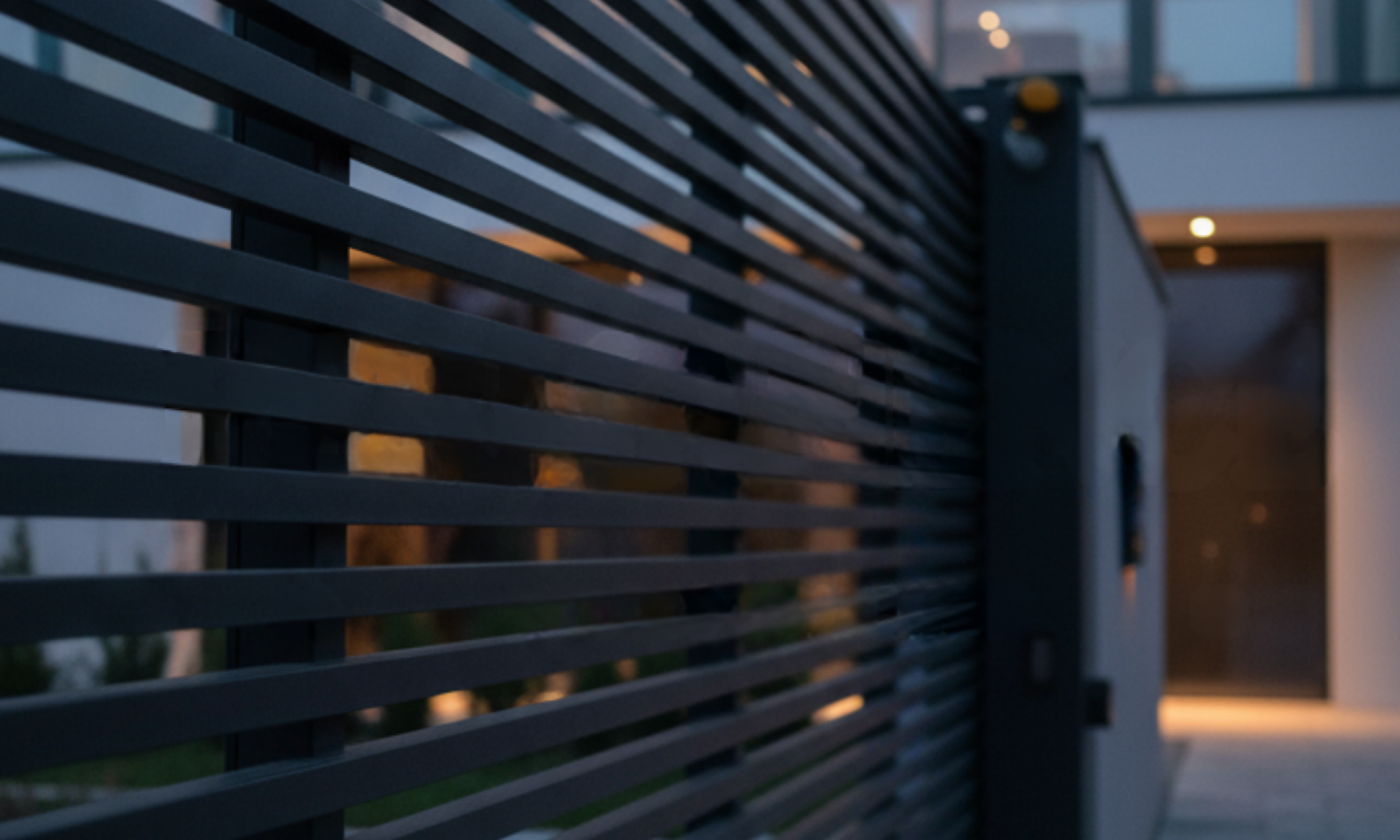
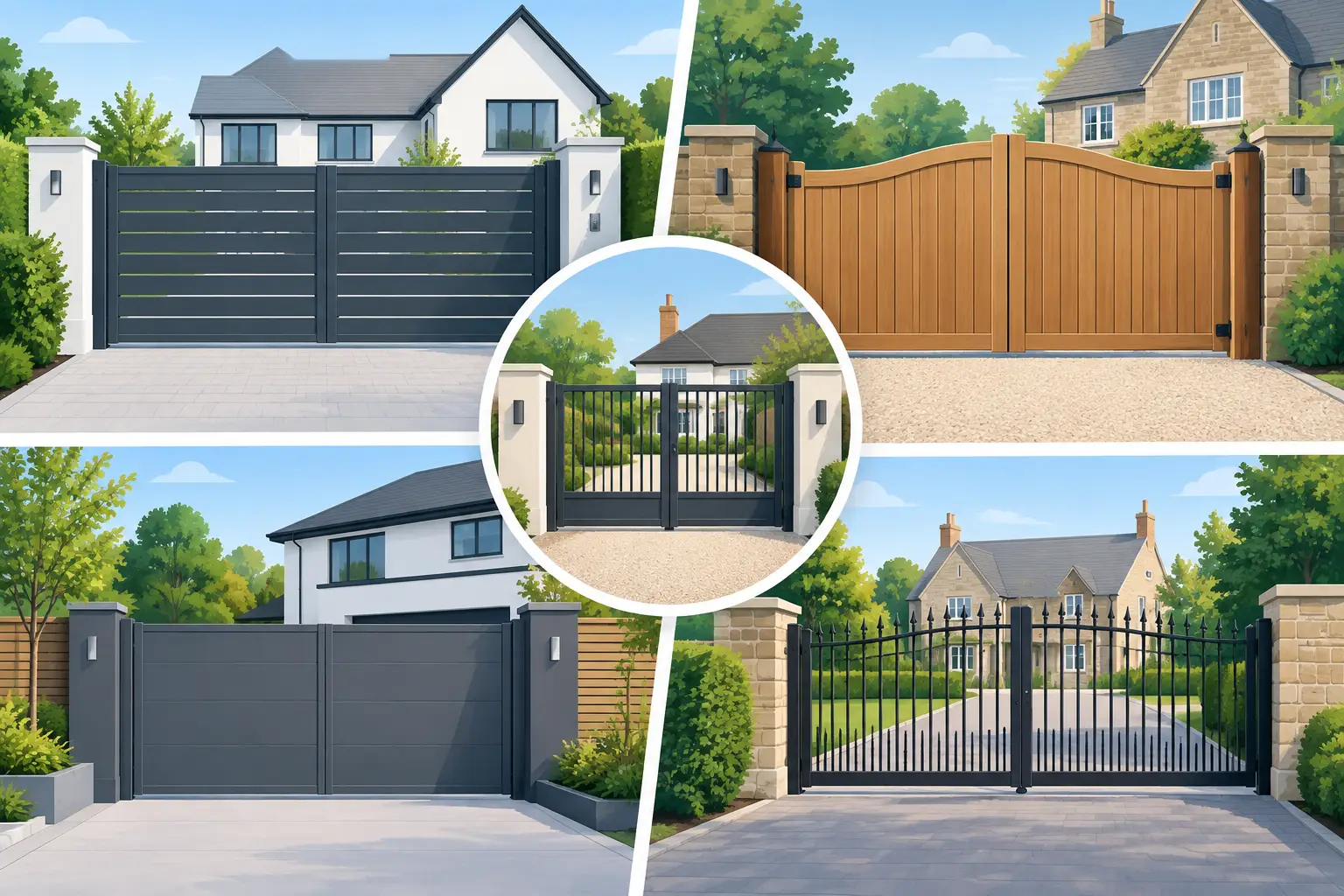
A horizontal slatted design is a popular fit for modern brick homes because it gives the entrance a clean, private finish without making it feel closed in. A darker colour, such as anthracite grey or black, can complement window frames, front doors and garage doors. Where visibility is useful for leaving the drive, a design with modest gaps between slats may be preferable to a fully solid gate.
Automation is particularly useful on busy residential roads. Residents can enter without stopping to open the gates by hand, while safety controls help manage closing. Before specifying automation, measurements must allow for the gates’ opening arc, hinge positions and the equipment needed to operate them.
2. The wide detached-home entrance
A broad driveway creates an opportunity for a more substantial entrance, but it also places greater demands on the gate, posts and foundations. Two wide swing leaves may look impressive, yet they need sufficient clear space behind them when open. On a deep drive, this can be a strong choice. On a shallower site, a sliding gate is often more practical.
For this type of project, bespoke aluminium driveway gates give greater freedom over width, height, infill pattern and colour. Vertical bars, decorative panels or a mixed solid-and-open design can be used to match the character of the property. The gate can also be coordinated with aluminium fencing, railings and a pedestrian gate, creating a considered perimeter rather than an entrance that looks added as an afterthought.
A video intercom is worth considering where the house sits some distance from the road. It allows the homeowner to speak to visitors and control access without walking to the entrance. The cable routes, power supply and position of the control equipment should be discussed early, especially on a new-build or landscaping project.
3. The rural home with a long approach
A country property may need a gate that provides a clear boundary without appearing too formal or urban. An ornate aluminium gate can suit period homes, farmhouses and properties with stone walls or traditional brick piers. Aluminium gives the decorative look associated with wrought iron while avoiding the regular repainting needed to keep steel gates protected.
Long drives often benefit from automated operation and an intercom because the entrance is well away from the house. Solar-powered options may also be considered where mains power is difficult or costly to bring to the gate, although suitability depends on the site, available light and anticipated usage. A professional assessment is valuable here, as an unreliable power arrangement defeats the purpose of automation.
The ground conditions matter as much as the gate style. Rural entrances can be exposed to wind, standing water and uneven surfaces. Gate posts and foundations must be designed for the size of gate, local conditions and automation equipment. A gate that looks right but is poorly supported will not deliver reliable long-term performance.
4. The sloping driveway
Slopes are one of the most common reasons standard gate solutions do not fit. A conventional swing gate follows an arc as it opens, so it can catch on rising ground. Depending on the direction and severity of the slope, there are several possible approaches: changing the gate’s opening direction, creating a level area behind the entrance, using a tracked or cantilever sliding gate, or specifying a design made to work with the site geometry.
A sliding gate avoids the opening arc across the drive, making it an effective option for many sloped or restricted sites. It does, however, require clear run-back space alongside the opening. A cantilever sliding gate also needs additional room for its counterbalance section, while a tracked system relies on a suitable level track area. Neither arrangement is automatically better – the right choice depends on the available side space, finish of the drive and drainage.
This is a project type where accurate site measurements are essential. Width alone is not enough. The gradient, level changes, surface material, pier dimensions and the location of any walls, hedges or services all affect what can be installed.
5. The new-build development entrance
For developers and self-builders, driveway gates are often part of a wider external specification. The gate needs to reflect the architecture, meet the buyer’s expectations and remain practical after handover. Aluminium is well suited to this role because powder-coated finishes provide a consistent appearance with low maintenance requirements.
A contemporary development may use matching pedestrian gates, fencing and railings in the same colour and profile. This creates a coherent frontage across several plots without relying on timber that will weather differently over time. Readymade gate options can be useful where standard openings and programme deadlines are the priority, while bespoke gates offer more flexibility for feature plots or non-standard entrance widths.
Access planning should happen before the final landscaping stage. Installing a gate after paving, planting and drainage are complete can create avoidable disruption. Allowing for foundations, cabling and the chosen opening method at an early stage usually results in a cleaner installation and more controlled costs.
6. The commercial or shared-access driveway
A commercial yard, flat development or shared private road has different priorities from a single dwelling. Security, frequency of use and controlled access often lead the specification. Sliding gates are commonly chosen for wider openings because they do not need open space within the entrance, but swing gates can still be suitable where traffic levels are modest and the site layout allows.
For higher-use locations, consider how visitors, delivery drivers and emergency access will be managed. Keypads, fob access, intercom systems and timed opening functions can all form part of the solution. The gate should be matched to the expected traffic pattern, rather than simply chosen for its appearance. A lightweight aluminium gate can reduce the load on automation equipment, but the system must still be correctly specified for its size, duty cycle and operating environment.
Choosing between swing and sliding gates
Most driveway gate projects come down to one practical question: where can the gate go when it opens? Swing gates are often the more economical and visually traditional option when there is room to open into the property. They suit entrances with a level approach and sufficient driveway depth.
Sliding gates are useful for short drives, slopes and wide openings, provided there is enough clear space to one side. They can offer a neat, controlled entrance, but installation requirements can be more involved. Posts, groundworks, run-back space and power all need careful consideration.
The finish is the final layer, not the starting point. Start with dimensions, levels, access needs and operating method, then choose a design that gives the property the right level of privacy and character.
What to establish before requesting a quotation
A helpful quotation starts with clear information. Provide the opening width and height, photographs from inside and outside the entrance, the direction of any slope and details of existing walls or posts. It is also useful to say whether you want manual operation now, automation from the outset or the option to automate later.
Think about who will use the gate. A family returning home several times each day has different needs from a rarely used country entrance or a commercial site receiving deliveries. If pedestrian access is frequent, a separate pedestrian gate can prevent unnecessary use of the main driveway gates and improve convenience.
Aluminium Gates Direct can help customers assess whether a readymade or bespoke gate is the better fit, with nationwide support and access to installation partners. A well-planned gate project should feel straightforward every time you arrive home, not become another item on the maintenance list.