
Gate Safety Regulations for UK Properties
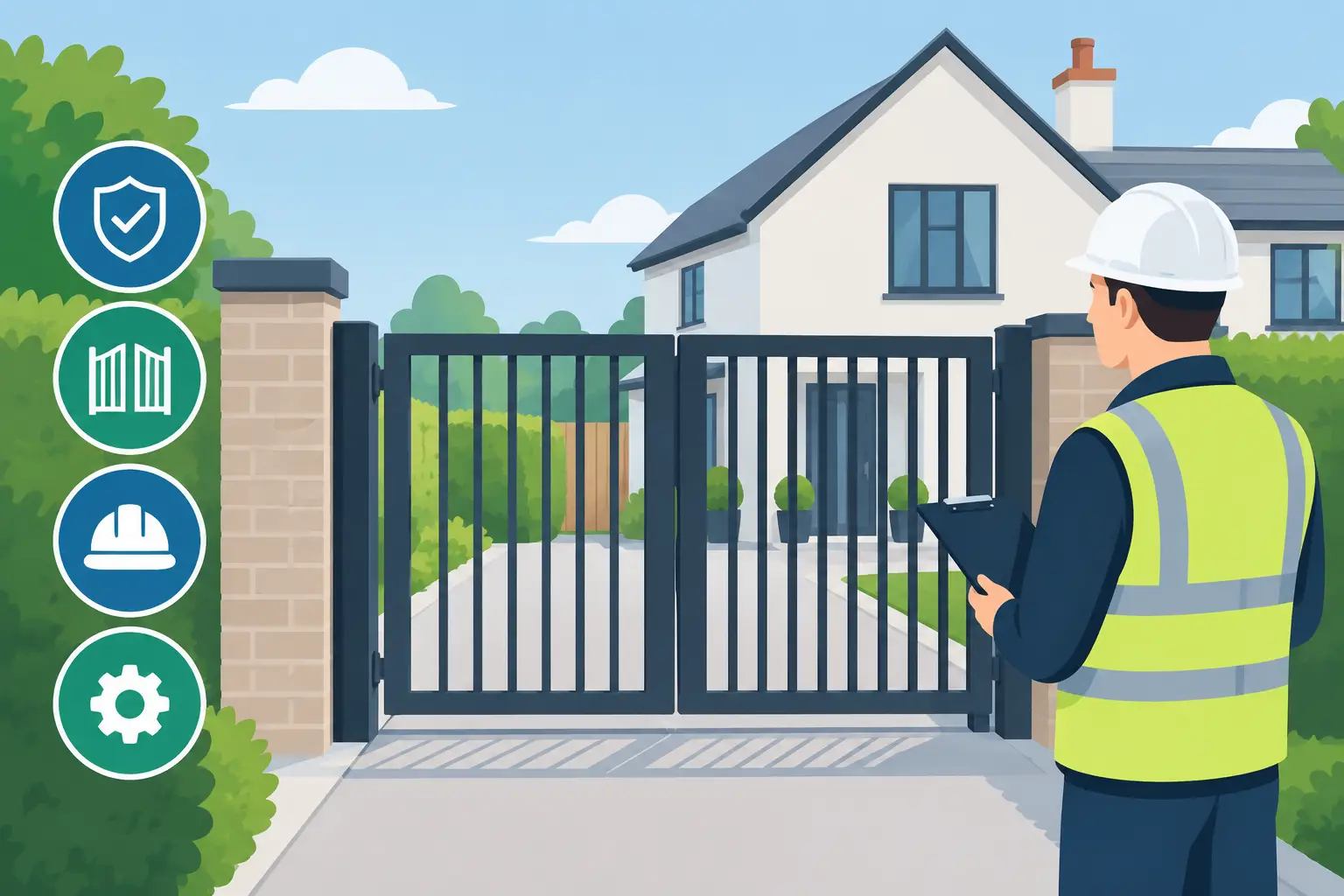
A gate should make a property feel secure, not create a hidden risk at the entrance. That is why gate safety regulations matter well beyond the point of purchase, particularly where a swing or sliding gate is automated. A well-specified system considers the gate’s weight, movement, control equipment, users and surroundings together – not as separate items fitted at different stages.
For homeowners, developers and site managers, the practical question is simple: can the gate operate safely every time, including when children, visitors, delivery drivers or staff are nearby? The answer depends on correct design, installation, testing and ongoing maintenance.
What UK gate safety regulations require
There is no single document headed “gate safety regulations” that covers every domestic and commercial installation. Instead, legal responsibilities and technical standards overlap. The level of duty also changes according to where the gate is installed and who may use it.
A powered gate is machinery. When it is supplied and installed, it must be safe for its intended use and supported by the appropriate technical documentation, risk assessment and conformity process. In Great Britain, this is generally considered under the Supply of Machinery (Safety) Regulations 2008. The installer or party placing the completed automated gate system on the market has significant responsibilities, because the gate, motors, safety devices and controls form one machine once combined.
For workplaces, shared premises and commercial sites, the Provision and Use of Work Equipment Regulations 1998, commonly called PUWER, can also apply. Duty holders must ensure equipment is suitable, maintained and used safely. That makes routine inspection and recorded servicing particularly relevant at managed developments, schools, warehouses and business premises.
Technical standards help demonstrate a safe approach. BS EN 12453 and BS EN 12445 are widely used for the safety in use and testing of power-operated gates. They are not a substitute for a site-specific assessment. A gate on an open rural driveway faces different risks from one beside a public pavement or serving a busy commercial yard.
The risk assessment comes before automation
The gate’s appearance and opening style matter, but safety starts with a proper survey. This should identify every potential trapping, crushing, shearing, drawing-in and impact point as the gate moves.
A sliding gate may create a hazardous gap between the moving leaf and a fixed post, wall or fence. A swing gate can trap someone between its leading edge and a wall, vehicle or opposing gate leaf. Hinges, rollers, racks and exposed drive mechanisms also need attention. The aim is not simply to fit a pair of photocells and assume the job is complete. Protection must address the actual hazards present at that property.
The assessment should consider who uses the entrance. Is it a private driveway used by informed adults, or a communal access point where pedestrians, children and contractors may approach from either side? Is there room for a vehicle to wait safely off the road while the gate opens? Can a person on foot reach the controls without standing in the path of the gate?
Gate size, infill design and wind loading all affect the choice of automation. Aluminium gates are a practical option because they are lightweight, strong and resistant to corrosion. Their lower operating weight can reduce demand on the automation compared with a heavier steel or timber design. However, lightweight does not remove the need for correctly selected safety equipment, secure foundations and suitable posts.
Safety devices should match the hazard
Most automated gates need more than one layer of protection. The precise arrangement depends on the risk assessment, gate type and operating environment, but devices commonly include photocells, safety edges, force limitation and emergency release mechanisms.
Photocells use an infrared beam to detect a person, vehicle or object in the gate’s path. They are useful, but a single beam cannot protect every pinch point or detect every person, particularly a small child close to the gate. Safety edges are pressure-sensitive strips fitted where contact could otherwise cause injury. If compressed, they signal the operator to stop or reverse.
Force limitation monitors the resistance encountered during movement. It can help reduce impact risk, but it should not be relied upon as the sole measure where a person could be trapped or crushed. Physical guarding may be needed around hinges, rollers, racks and gaps that cannot be made safe by controls alone.
Controls also need careful placement. A key switch, keypad or intercom should allow users to operate the gate from a safe position with a clear view of the entrance. A hold-to-run control may be appropriate in certain higher-risk situations because the gate moves only while the control is actively held. Remote controls are convenient, yet they do not provide the same direct view of the gate area.
Manual release and emergency access
Every automated gate needs a reliable manual release so it can be operated during a power failure or fault. The release should be accessible to authorised users, explained at handover and tested as part of servicing. On commercial sites, managers should also consider how emergency services gain access and whether a failure could obstruct an evacuation route.
Installation details that affect safety
A safe gate is not created by the operator alone. Posts, hinges, track systems, foundations, stops and fixings must be designed for the gate’s dimensions and expected loads. Poor alignment can lead to excessive force, unreliable operation and premature wear.
Sliding gates require a stable, clear travel path and appropriate protection at both ends of travel. Cantilever designs avoid a ground track, which can be useful where debris, leaves or uneven surfaces would otherwise interfere with movement. They still need suitable end supports and guarded areas around moving parts.
For swing gates, the direction of travel is critical. Gates should not open outwards across a public footway or carriageway. Where space is limited, an inward-opening swing gate or a sliding gate may be the safer and more practical choice. This is one reason a site survey should happen before a design is finalised.
The electrical installation also matters. Outdoor equipment must be installed appropriately for its environment, with cabling protected from damage and work completed by a competent person. An automated gate should be fully tested before handover, including the safety functions, limits, obstacle detection and manual override.
Documentation is part of a safe handover
A completed automated gate installation should not be handed over with only a remote control and a quick demonstration. The customer should receive clear operating instructions, safety information, maintenance guidance and details of what to do if the gate fails.
For machinery compliance, the completed system should be supported by a declaration of conformity or declaration of incorporation where applicable, along with relevant technical records. The exact documents depend on the equipment and installation arrangement, but the principle is consistent: the person responsible for the completed machine must be able to show that safety has been considered and verified.
Keep these documents with service records. They are useful when selling a property, managing a commercial estate or arranging future repairs. They also help a new maintenance provider understand how the gate was intended to operate.
Maintenance is not optional
Weather, ground movement, accidental knocks and everyday use can all alter how a gate performs. A photocell can become misaligned, a safety edge can be damaged, and a track can collect debris. A gate that was safe at commissioning may no longer be safe if faults are ignored.
Homeowners should carry out simple visual checks and stop using an automated gate if it behaves unexpectedly. Warning signs include jerky travel, unusual noise, failure to stop or reverse, visible damage, loose fixings, damaged cables or a gate that no longer closes squarely. Do not bypass safety devices to keep the gate running.
Commercial and shared-use locations usually need a more formal maintenance plan, with inspection frequency based on traffic levels, environment and risk. High-use gates may require more frequent professional attention than a private driveway gate used a few times a day. Records should show what was checked, what faults were found and how they were resolved.
Choosing the right route for your project
A ready-made aluminium gate can suit a straightforward opening where dimensions and access are predictable. Bespoke gates are often the better option when there is a slope, unusual opening width, existing walls, an integrated pedestrian gate or a specific automation requirement. Neither route is automatically safer – the best choice is the one that allows the gate, structure and safety measures to work together properly.
For a new driveway or commercial entrance, involve the gate supplier and installer early. Aluminium Gates Direct can help customers consider gate style, dimensions, automation and access control as one planned system, with installation support available through its partner network nationwide.
The safest gate is usually the one that has been designed around the property rather than forced to fit it. A careful survey and competent installation may cost more than a basic fit-out at first, but it gives owners something far more valuable: an entrance that looks right, works reliably and protects everyone who passes through it.
Apartment Gate Installation for Secure Access
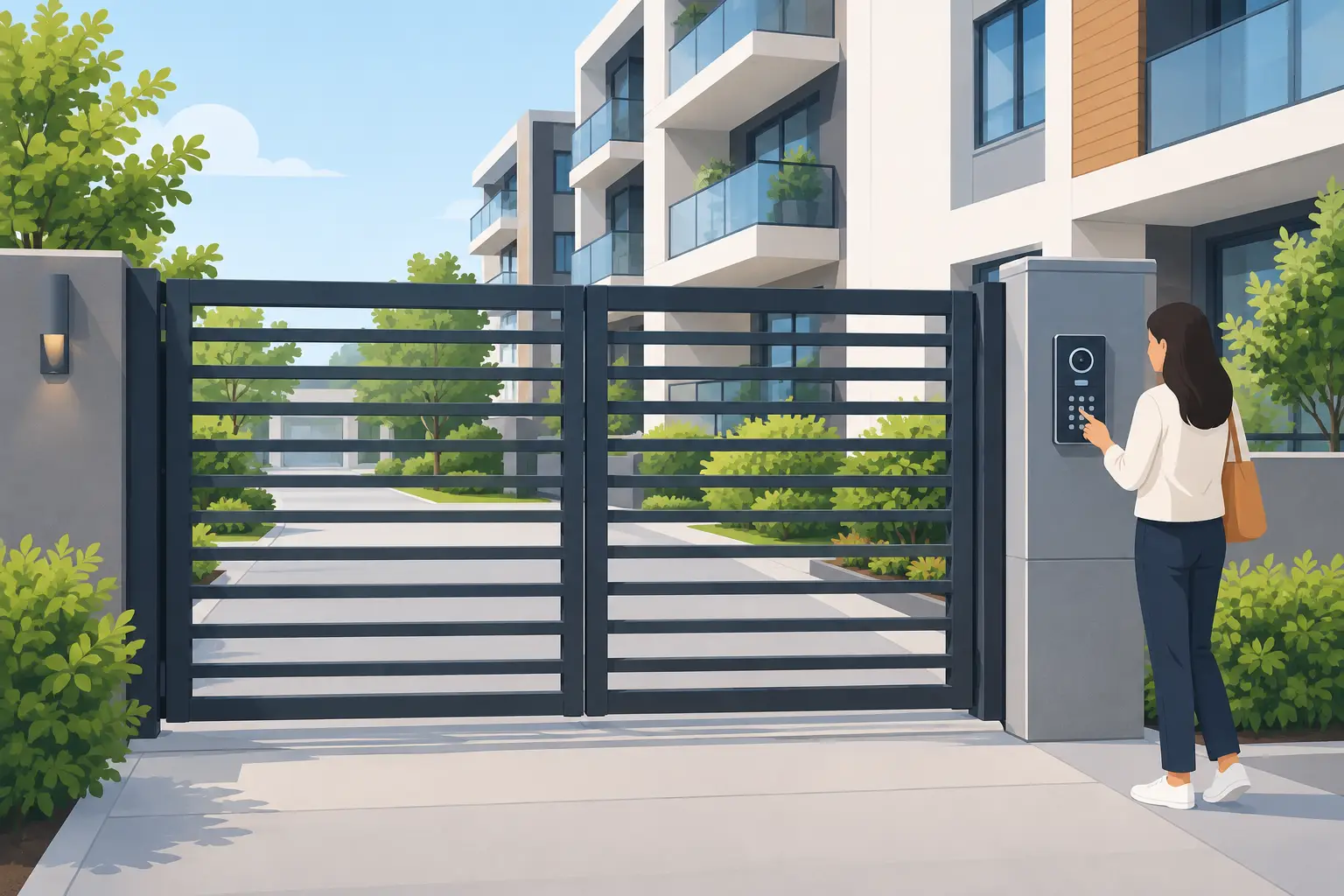
A gate at a flat entrance has to work harder than a typical domestic driveway gate. It may control access for dozens of residents, welcome delivery drivers and visitors, support emergency access, and contribute to the first impression of the whole development. A successful flat gate installation therefore starts with the way people use the site, not simply the style of gate.
For landlords, managing agents, developers and block owners, the right solution balances security, safety, appearance and day-to-day reliability. Aluminium is often a practical choice because it is lightweight, strong, corrosion-resistant and requires very little upkeep compared with timber or untreated steel.
Start flat gate installation with the access plan
Before choosing a sliding or swing gate, establish who needs to enter, how often, and by which route. Vehicle access, pedestrian access and service access should be considered separately. A gate that works well for resident cars may create unnecessary delays or safety issues for pedestrians if there is no clearly planned side entrance.
Consider the peak periods at the property. A small residential block may only need occasional vehicle access, while a larger flat development may have regular arrivals, deliveries, contractors and refuse collections. If vehicles queue on a public road while waiting for the gate to open, the entrance layout and operating speed need particular attention.
Emergency access must also be agreed early. Fire and ambulance services may need a reliable means of entry, while residents need to be able to leave safely if there is a power failure. The required approach depends on the site and local requirements, but it should never be left as an afterthought once gates, posts and cabling have been specified.
Sliding or swing gates?
Sliding gates are often well suited to flat entrances with frequent use. They do not swing into the driveway or pavement, and they can be a sensible answer where space behind the entrance is limited. However, they require enough clear run-back space along the fence line for the gate leaf and any required safety zones.
Swing gates can provide a more traditional appearance and suit entrances with adequate internal space. A pair of automated swing gates may be appropriate for a lower-traffic development, but the opening arc must remain clear of parked cars, slopes, pedestrian routes and landscaping. Gates should not open outwards across a public footpath or highway.
The choice is not only about preference. Ground levels, available space, traffic volume, wind exposure and the width of the entrance all influence the most suitable design. A site survey is the point at which these practical constraints become clear.
Permissions, boundaries and site preparation
Flat buildings can have more complicated ownership arrangements than a single home. Check the title plan, lease conditions and management responsibilities before work begins. The entrance may sit within communal land, be shared with neighbouring properties or be subject to access rights that affect the position and operation of the gate.
Planning permission is not automatically required for every installation, but height, location, conservation areas, listed buildings and proximity to a highway can all change the position. New developments may also have planning conditions that set out expectations for boundary treatments and access. Where there is any uncertainty, obtain advice before ordering a made-to-measure gate.
A durable gate relies on sound groundwork. Posts, tracks, foundations and stop points need to be designed for the gate size, weight and local ground conditions. Drainage matters too. Standing water, loose surfaces and poorly finished levels can affect sliding gate tracks, foundations and the lifespan of automated components.
It is also sensible to plan services at this stage. Automation, lighting, intercoms and access controls require power and suitable cable routes. Installing ducts before surfaces are finished is usually cleaner and more cost-effective than lifting block paving or tarmac later.
Make safety part of the specification
Automated gates are machinery, not just a boundary feature. Their design, installation and ongoing operation must account for pinch points, crushing zones, entrapment risks and the possibility of people moving through the entrance unexpectedly.
This is particularly relevant at flat sites, where children, dog walkers, visitors and delivery drivers may not understand the access system or be familiar with the gate movement. Appropriate safety devices can include photocells, safety edges, warning signage and controlled pedestrian routes. The right combination depends on the gate layout and risk assessment.
A separate pedestrian gate is often the safest and most convenient option. It avoids residents attempting to pass around or through a moving vehicle gate, and can be integrated with the same access credentials where required. For accessible use, consider clear opening widths, thresholds, path surfaces and the height and position of entry controls.
A competent installation partner should assess site-specific risks rather than fitting a standard automation package to every entrance. Ask who will commission the system, provide operating information and explain the planned maintenance requirements. These details matter as much as the gate’s finish.
Choose access control around residents, not assumptions
A keypad may be enough for a small private car park, but it can become frustrating where residents change regularly or codes are frequently shared. Key fobs, proximity tags, telephone entry and video intercom systems each offer different levels of convenience, administration and oversight.
For a managed block, an intercom system can give residents control over visitor entry without leaving their flat. Akuvox intercom options, for example, can be considered where video calling and more flexible access management are needed. The best system is one the building manager can update easily when residents move in or out.
Think beyond the main residents too. Delivery drivers, cleaners, maintenance contractors and refuse teams may require different forms of access. A timed code or managed credential can be preferable to circulating a permanent code. For commercial or mixed-use flat schemes, access records and controlled permissions may be especially valuable.
Reliability should guide the specification. A more advanced system is only worthwhile if the responsible person can manage it confidently and residents understand how to use it. Clear handover information and a named point of contact prevent minor access issues becoming daily inconvenience.
Why aluminium suits flat entrances
A flat entrance is visible every day, so appearance has a practical value as well as an aesthetic one. Aluminium gates are available in contemporary slatted, solid-panel and more decorative designs, allowing the gate to complement railings, fencing, cladding or brickwork.
The material is particularly useful where a wide gate or automated operation is required. Aluminium is lighter than many steel alternatives, which can reduce demand on hinges, motors and supporting structures while still providing a strong, substantial result. Its resistance to rust also makes it well suited to exposed UK conditions.
Low maintenance is another advantage for management companies and owners. Aluminium does not need routine staining, painting or treatment in the way timber often does. Occasional cleaning and inspection are still worthwhile, especially around moving parts, tracks and safety equipment, but ongoing care is generally straightforward.
Bespoke gates allow dimensions, infill style, colour and privacy levels to be matched to the site. Readymade options can be a sensible route where the opening is standard and programme or budget is the priority. The right choice depends on whether speed, exact fit or a distinctive architectural finish carries most weight.
Plan for maintenance from day one
A maintenance-free gate material does not mean a maintenance-free entrance system. Automated gates need periodic checks to confirm that safety devices, controls, hinges, rollers, locks and motors continue to operate correctly. The frequency should reflect the gate type, usage level and manufacturer guidance.
The management team should know how to release the gate manually in an emergency, who can authorise changes to access credentials, and whom to contact if a fault occurs. Keep records of installation details, remote controls, access permissions and service visits in one accessible place.
A gate is most effective when it feels effortless to residents and difficult for unauthorised visitors to bypass. At Aluminium Gates Direct, project support can help property teams match aluminium gates, automation and access control to the layout, budget and practical demands of a flat site. The best time to solve access challenges is before the ground is prepared, when the right design can still be built into the entrance rather than added around it.
Best Gate Security Features for UK Properties
A gate that looks substantial but can be climbed, forced or left open does little for a property’s security. The best gate security features work together: a strong gate structure, controlled entry, reliable automation and a layout that does not create weak points around the perimeter. The right combination will differ between a family driveway, a rural home, a development entrance and a commercial site.
Start with the gate’s strength and design
Security begins with the physical gate, not the keypad or intercom fitted later. A well-made aluminium gate offers a strong, lightweight barrier without the ongoing corrosion concerns associated with untreated steel or the regular painting and repair often needed with timber. Aluminium is particularly well suited to UK conditions because it will not rust, making it a practical long-term choice for exposed driveways and commercial entrances.
The frame, infill panels, hinges and fixings all matter. A gate should be manufactured to suit its opening and usage, rather than simply selected by appearance. Wide driveway gates, for example, need adequate structural support to avoid movement over time. Frequent commercial use may call for a more substantial specification than a domestic garden gate.
The visual design also affects security. Closely spaced vertical slats, solid panels or privacy-focused infills make climbing more difficult and limit views into the property. Horizontal rails can provide potential footholds, so they need careful consideration where climbing is a concern. Privacy is not always the priority, however. Some homes and sites benefit from a more open design that allows clear sightlines from the house, road or reception area.
Best gate security features for controlled access
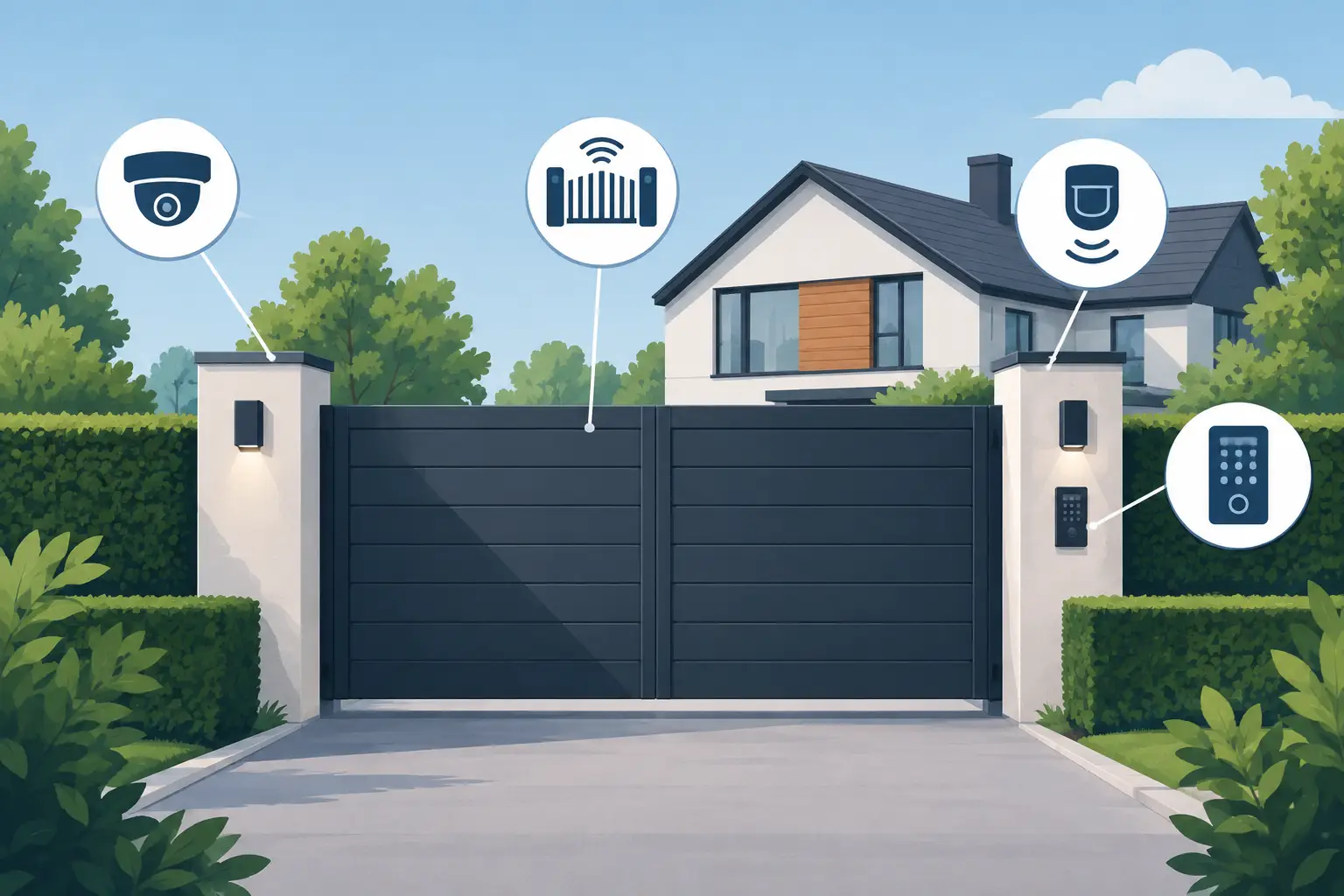
A secure perimeter should make entry straightforward for authorised users and inconvenient for everyone else. These are the features most often worth discussing at the specification stage:
- Automated opening keeps drivers inside their vehicle while entering or leaving, which is particularly useful on busy roads, dark rural approaches and commercial premises.
- A quality locking system provides physical resistance when the gate is closed. Manual gates may use keyed locks, while automated gates should have secure locking arrangements appropriate to the operator and gate type.
- Intercom and video entry systems let occupants verify a visitor before releasing the gate. Video systems can be especially useful where the entrance is some distance from the property.
- Keypads, fobs and access cards provide controlled access without issuing physical keys to every family member, contractor or member of staff.
- Vehicle detection and exit controls allow authorised vehicles to leave safely without leaving gates open for longer than necessary.
No individual feature is a complete answer. A keypad offers convenience, but its code can be shared. A video intercom adds verification, but only if someone is able to respond. For many homes, a combination of automated gates, video entry and remote controls offers a sensible balance between daily convenience and security. Commercial sites may need individual access credentials, timed access permissions and a record of entry activity.
Choose swing or sliding gates around the site
The opening method has a direct effect on security, safety and reliability. Swing gates are a popular choice for residential driveways and can create an impressive entrance. They need sufficient clear space to open inward, and the ground must be suitable for dependable operation. Outward-opening gates can create issues where they move towards a public footway or carriageway, so this should be assessed early.
Sliding gates are often preferred where driveway depth is limited or where a wide opening is required. A sliding design can be highly effective for commercial yards, flat developments and properties on sloping approaches, provided there is enough room along the fence line for the gate to travel. Cantilever sliding gates avoid a track across the driveway, which can be useful where debris, uneven surfaces or frequent vehicle movements would make a ground track less practical.
The best choice is not simply the one that appears most secure. A gate that cannot operate consistently is likely to be left open or bypassed. Site measurements, gradients, drainage, wind exposure and the position of existing walls, fencing and services should all be considered before ordering.
Do not overlook posts, fencing and side access
An automated driveway gate can be the strongest part of a perimeter while a poorly secured side gate provides an easy route around it. Effective security planning looks at the entire boundary: gates, posts, fencing, railings, walls and pedestrian access points.
Posts and foundations must be designed for the gate’s size, weight and operating forces. This is especially relevant for large swing gates and gates installed in exposed locations. Loose posts, undersized foundations or unsuitable hinges can compromise alignment and put strain on automation equipment.
Pedestrian gates deserve the same attention as vehicle entrances. A self-closing pedestrian gate with a secure latch or access-controlled lock can help prevent it being accidentally left open. For shared developments and commercial premises, separating pedestrian and vehicle access may also reduce the need to open the main gate for every visitor.
Where fencing or railings meet the gate, avoid gaps that allow a person to squeeze through or reach the release mechanism. The rear of the gate and automation controls should not be easily accessible from the public side. Good perimeter design is about removing these simple opportunities, not adding unnecessary complexity.
Safety features are part of gate security
Automation must be safe as well as secure. A professionally specified automated gate requires appropriate safety devices to reduce the risk of trapping, crushing or impact. Photocells, safety edges, force limitation and emergency release arrangements may all form part of the system, depending on the gate type and installation.
A gate that reverses when it detects an obstruction helps protect children, pedestrians, pets and vehicles. Safety photocells should be positioned and maintained correctly, rather than treated as an optional extra. The same applies to manual release systems: they need to allow access during a power cut, but should not be easily exploited from outside the property.
Maintenance is also a security issue. Dirt on photocells, damaged hinges, worn rollers or a poorly adjusted operator can cause unreliable operation. When gates become troublesome, people often disable automation, prop them open or rely on temporary fixes. Regular checks help protect the investment and keep the entrance functioning as intended.
Match access control to how the property is used
For a private home, convenience often shapes the final specification. Remote controls, a video intercom and smartphone-compatible entry can make a driveway gate easy to use without reducing control over who enters. Consider how deliveries, tradespeople, relatives and emergency services will be managed. A separate pedestrian gate may be a better solution than repeatedly opening a large vehicle gate.
For managed developments, access needs can change frequently as residents, tenants and contractors come and go. A system that allows credentials to be added or removed easily is more practical than relying on a shared code. Developers should also consider visitor access, refuse collections and long-term management responsibilities before deciding on the equipment.
Commercial sites often need a more structured approach. Opening times, staff access, delivery vehicles and visitor procedures should be mapped out before choosing automation and controls. A gate designed for occasional domestic use may not be suitable for a busy yard with repeated daily movements. The right equipment should match the duty cycle, vehicle type and level of supervision on site.
Get the specification right before installation
The most effective security feature is careful planning. Measure the opening accurately, identify underground services, confirm where power will come from and decide where controls will be placed. Think about what a driver sees when approaching, where vehicles will wait, and whether the gate can open without obstructing the road or pavement.
At Aluminium Gates Direct, customers can discuss gate style, bespoke sizing, automation and access control as one joined-up project, with installation support available through a trusted partner network. This approach helps avoid the common problem of choosing a gate first and discovering later that the layout or automation requirements have been overlooked.
A secure gate should feel uncomplicated to use every day. By choosing durable aluminium construction, appropriate access controls and a design tailored to the site, you can create an entrance that protects the property while still looking right for it. If you are comparing options, speak to a specialist with your measurements, photographs and a clear idea of how the entrance will be used – the best solution is the one that works reliably long after installation day.
Aluminium Gate Automation Systems Review
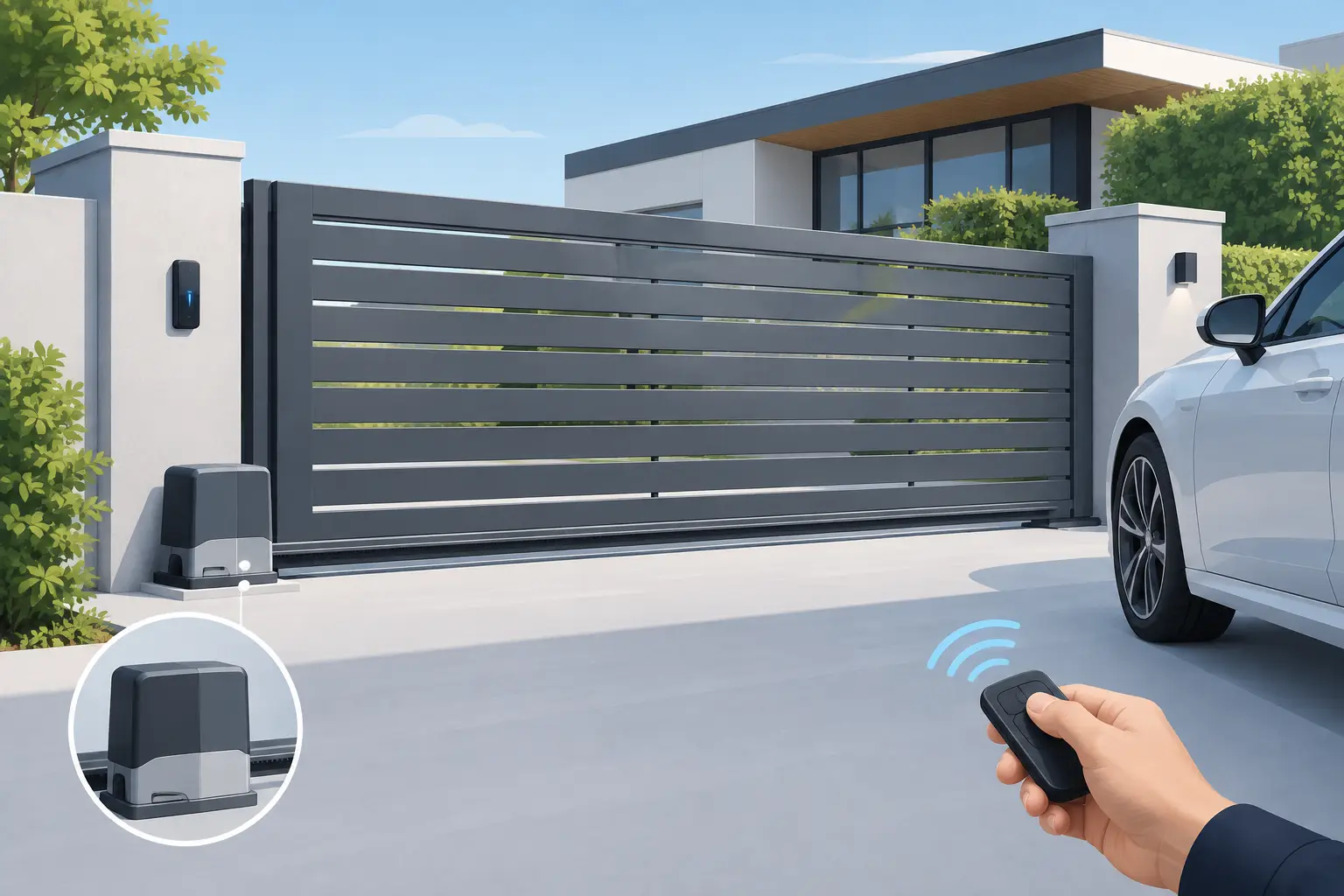
A gate that looks right but opens reluctantly, stops short or leaves the driveway inaccessible during a power cut soon becomes a daily frustration. This aluminium gate automation systems review looks at what makes a dependable setup, from the right motor type to safety devices, controls and installation planning. The best system is not necessarily the most powerful or expensive one. It is the one properly matched to the gate, the entrance and how the property is used.
For aluminium gates, automation is particularly attractive. Aluminium is strong but lighter than many steel or timber alternatives, which can reduce the strain placed on motors and supporting hardware. However, lightweight does not remove the need for careful specification. Gate size, wind exposure, opening frequency and ground conditions all affect the result.
What an aluminium gate automation system includes
Automation is more than a motor fixed to a gate post. A complete system normally includes the operating motor or motors, a control panel, remote controls, safety photocells and mechanical stops. Depending on the site, it may also include an intercom, keypad, vehicle loop, GSM calling unit, warning light, battery backup or access control linked to a commercial building.
The motor supplies movement, but the controls and safety equipment determine how practical the gate is to live with. A well-planned system should open reliably, stop when an obstruction is detected and allow authorised visitors to gain entry without compromising security.
For residential driveways, a handset and video intercom may be all that is needed. For a development, farm entrance or commercial premises, timed access, multiple users, fobs, keypads and vehicle detection may be more appropriate. Choosing those requirements early prevents an otherwise good installation from feeling limited after a few months.
Swing gate automation systems reviewed
Swing gates remain a popular choice for residential properties because they offer a traditional driveway appearance and work well with many aluminium gate designs. The automation options vary according to post depth, hinge position, gate weight and the available space behind the gates.
Above-ground arm and ram motors
Articulated arm motors use a folding arm to move each leaf. They are often a practical option where gate posts are substantial or hinge geometry does not suit a linear system. Their movement is visible, and the units are generally straightforward for an engineer to inspect and service.
Linear ram motors use a compact extending arm. They create a cleaner appearance and are commonly selected for modern aluminium swing gates. They do, however, need the correct mounting dimensions. If the hinge line, post size or opening angle is wrong, the gate may not travel smoothly or achieve the desired opening width.
Neither option is automatically better. An arm motor can be the sensible answer for awkward existing pillars, while a ram motor may suit a new installation with purpose-built metal posts. The site should decide the equipment, not the other way round.
Underground motors
Underground automation is the discreet choice, with the motor housed below ground near the hinge point. It preserves the uncluttered look of an ornate, bespoke or premium aluminium gate and can be an excellent solution where appearance is the priority.
The trade-off is groundwork. The motor boxes need correct drainage and access for future maintenance. Poor drainage is one of the most avoidable causes of problems with underground systems in the UK. A lower-profile installation is worthwhile when it is designed properly, but it should not be chosen simply because it is less visible.
What swing gates need to operate well
Swing gates need a clear and level arc across their full opening path. Sloping driveways can require specially designed hinges, rising systems or a revised gate arrangement. They also need positive closed stops and, in many cases, centre stops to prevent the leaves from being pushed beyond their intended position.
Wind is another consideration. Solid-panel aluminium gates can catch more wind than open railings or slatted designs. A suitably specified motor, strong posts and secure hinges are essential on exposed sites. This is not a reason to avoid a solid gate, but it is a reason to assess the location honestly.
Sliding gate automation systems reviewed
Sliding gates are often the better answer where there is limited room for a swing gate to open into the drive, or where a longer, wider entrance needs controlled access. They can also be useful on sloping approaches because the gate moves sideways rather than sweeping across the ground.
A tracked sliding gate runs on a ground track, usually with guide rollers and a toothed rack connected to the motor. It is a proven, cost-effective format, but the track must be kept clear of leaves, grit, ice and debris. On busy sites, this simple maintenance task matters.
Cantilever sliding gates run above ground without a track across the driveway. They are particularly useful where debris, uneven surfaces or frequent vehicle movements would make a track impractical. They require more space to one side for the counterbalance section and need a carefully engineered structure, so the initial cost can be higher.
For both designs, the motor must suit the gate’s weight and expected duty cycle. A gate opened a handful of times each day has very different requirements from an entrance used continuously by staff, residents, deliveries and visitors. Specifying a domestic motor for a high-use commercial entrance is a false economy.
Safety should shape the specification
An automated gate is a moving machine, not simply a convenience feature. Safety provision needs to be considered from the first survey, particularly where children, pedestrians, visitors or delivery drivers may use the entrance.
Photocells create an invisible beam across the opening. If the beam is interrupted, the gate should stop or reverse according to its set-up. Additional photocells may be needed where the gate creates more than one risk area, such as the rear travel zone of a sliding gate or the closing path of a pair of swing gates.
Safety edges provide another layer of protection by detecting contact with an obstacle. Force settings, warning signage, manual release arrangements and correctly positioned controls all matter too. A professional installation should include commissioning and testing, rather than treating safety devices as optional extras added at the end.
Controls, intercoms and everyday convenience
Remote handsets remain simple and effective, but they are only one option. Keypads suit households that want to provide a code for family members, tradespeople or short-term visitors. GSM systems allow a gate to be opened by a phone call or app, subject to signal and system choice. Video intercoms offer the reassurance of seeing and speaking to a visitor before granting access.
Akuvox intercom systems can be a strong fit for properties requiring modern video entry, multi-user access or integration with wider access control. For commercial sites and flat-style developments, the ability to manage users and monitor entry points can be as valuable as the gate itself.
It is worth considering how visitors will leave as well as how they enter. Exit loops, push-to-exit buttons, free-exit photocells and timed opening functions all have a place, depending on the site. A driveway should not rely on somebody reversing close to a closed gate and hoping a remote is to hand.
Costs and the factors that change them
There is no useful single price for gate automation because installation requirements vary so widely. The main cost drivers are the gate design and size, motor type, distance to the electrical supply, groundwork, access controls, safety equipment and whether existing posts and foundations are suitable.
Underground swing automation and cantilever sliding systems usually involve more groundwork than above-ground motors or tracked sliding gates. Long cable runs, difficult access and drainage work can also affect the budget. On the other hand, investing in the right foundations, posts and cabling at the outset can avoid expensive alterations later.
When comparing quotations, check that they cover the same scope. One price may include motors only, while another includes installation, safety devices, remotes, intercom equipment, electrical works and commissioning. Clear scope is more valuable than a low headline figure that leaves essential items to be added later.
Choosing the right system for your property
Start with the practical facts: the gate opening width, the available opening space, driveway gradient, surface condition, exposure to wind and likely daily use. Then consider the experience you want. A private home may prioritise quiet operation and a video intercom, while a commercial entrance may need frequent operation, controlled access and an arrangement that continues to work efficiently throughout the day.
Aluminium Gates Direct can help customers assess aluminium gate styles alongside automation requirements, whether the project calls for a readymade driveway gate or a bespoke design. Working with an experienced installation partner is especially valuable where groundwork, electrics and access control need to come together as one project.
Before committing, ask how the gate will be released during a power cut, who will maintain the system, where water will drain and whether the controls can be expanded later. Those answers will do more for long-term satisfaction than choosing a motor by appearance alone.
A well-specified automated aluminium gate should feel quiet, secure and uncomplicated from the first use. Take the time to match the system to the site, and it will support your property’s security and kerb appeal for years rather than becoming another item on the maintenance list.
Planning a Warehouse Security Upgrade That Works
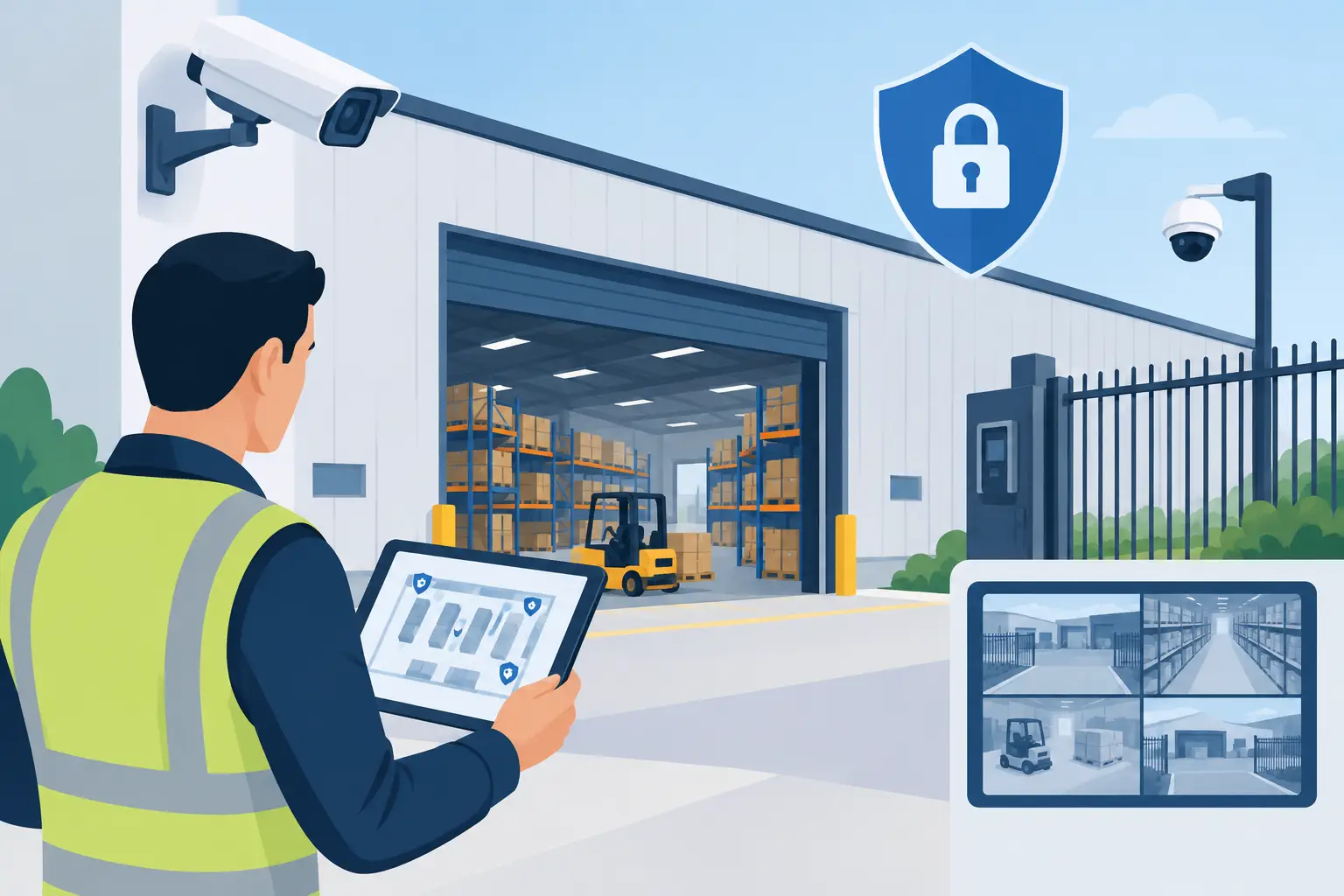
A warehouse security upgrade should begin at the perimeter, not at the office door. If vehicles, contractors or unauthorised visitors can reach loading areas without challenge, cameras and alarms are left reacting to a problem rather than helping prevent it. The right combination of fencing, gates and controlled access gives site managers a clearer view of who enters, where they go and when they leave.
For UK warehouses, the best solution is rarely a single product. Security needs to account for the layout of the site, vehicle movements, operating hours, neighbouring properties and the value of stock held inside. A well-planned perimeter should protect the premises while keeping deliveries, staff access and emergency procedures practical.
Start with the risks on your site
Every site has weak points. A warehouse beside a public road may need stronger frontage control, while a unit on an industrial estate may be more exposed at the rear boundary or around a service yard. Before choosing a gate or access system, look at how the site is actually used throughout the day and after closing.
Consider where lorries wait, where staff park, whether pedestrians share a vehicle entrance and how often the gate must open. A gate that looks substantial but creates queues at a busy loading bay can encourage unsafe workarounds. Equally, an entrance that is convenient for regular deliveries but open to anyone outside working hours leaves a clear gap in the perimeter.
It is also worth reviewing the condition of existing fencing, posts, walls and gate foundations. Replacing a gate without addressing a damaged boundary simply moves the weak point a few metres along. A site survey helps establish the opening size, ground levels, drainage, power availability and the clear space needed for the gate to operate safely.
Choose commercial gates for traffic and space
The choice between a sliding gate and a swing gate often comes down to available space and the type of traffic using the entrance. Both can form part of an effective warehouse security upgrade when specified correctly.
A sliding gate is usually a practical choice for wider entrances, frequent vehicle movements and sites where the gate must remain within the line of the boundary. It does not swing into a road or yard, which can be useful where space is tight. Cantilever sliding systems can also avoid a track across the driveway, reducing disruption from dirt, grit and standing water. However, they need sufficient run-back space beside the opening.
Swing gates can suit narrower openings or premises with adequate space inside the boundary. They offer a smart, clear entrance and can be a cost-effective option for lower-traffic sites. The ground must be level enough for reliable operation, and the gate leaves need room to open without obstructing parking bays, footpaths or delivery routes.
Aluminium commercial gates offer a strong, low-maintenance alternative to traditional timber and many steel designs. They do not rust, are lighter to automate and can be manufactured in a range of solid, slatted or decorative styles. For a warehouse, a more closed design can limit views into the yard, while a slatted arrangement may provide security without making the frontage feel overly enclosed. The appropriate specification depends on the security requirement, wind exposure and the desired site appearance.
Make access control part of the gate design
A gate only improves security when access is managed consistently. Manual keys can be suitable for a small site with a limited number of authorised users, but they become difficult to control when staff change, contractors attend or multiple shifts operate. Lost keys and copied keys can leave uncertainty long after they have gone missing.
Automated gates allow access rules to be set around the way a warehouse operates. Staff may use remote controls, keypads, fobs or mobile-enabled systems, while regular delivery drivers can be admitted by a member of staff. An intercom provides a direct point of contact for visitors and gives the person responsible for access the opportunity to verify who is at the entrance before opening it.
Akuvox intercom systems can be particularly useful where staff are not stationed at the gate. Video calling allows a receptionist, manager or authorised team member to identify a visitor and release the entrance where appropriate. This is more practical than leaving gates open during the day simply because nobody is available to walk across the yard.
Access control should be matched to the level of risk. A smaller warehouse with daytime operations may need a straightforward automated gate and video intercom. A high-value storage facility, multi-tenant site or premises operating overnight may require separate pedestrian access, time-based permissions and a process for recording visitors. Technology helps, but staff need clear procedures for using it.
Do not overlook pedestrian routes
Many warehouses focus on vehicle gates and forget that a side path, staff entrance or gap beside the loading area may offer an easier route onto the premises. A dedicated pedestrian gate helps keep people separate from moving vehicles and avoids the unsafe practice of staff walking through an automated vehicle entrance.
Pedestrian gates can be integrated with the same fencing and gate style to create a consistent perimeter. They can also carry their own keypad, fob reader or intercom. On sites with frequent visitors, clear signage and a defined route from the entrance to reception reduce confusion and make it easier to spot anyone who is where they should not be.
Emergency access must remain part of the design. Gates should be installed with appropriate safety equipment, release arrangements and controls that suit the site’s fire and evacuation procedures. These details should be considered before installation, not added as an afterthought when the system is already in place.
Specify for reliability, not just first cost
The cheapest gate is not always the lowest-cost option over its working life. Warehouse entrances are exposed to rain, frost, vehicle fumes, daily use and occasional impact. A poorly matched gate or automation system can soon require repairs, create downtime and frustrate staff who depend on it.
Aluminium is valued for being lightweight, durable and low maintenance. It will not require the regular painting and treatment associated with timber, and it avoids the corrosion concerns that can affect untreated or damaged steel. That said, no gate is maintenance-free in the sense that it can be ignored. Hinges, tracks, safety devices, motors and control equipment should be inspected and serviced in line with usage and manufacturer guidance.
Automation should be selected for the size, weight and expected duty cycle of the gate. A warehouse gate opening a few times each day has different demands from one serving a busy distribution yard. Allowing for future growth is sensible too. If deliveries are expected to increase, choose a system capable of supporting the likely level of use rather than replacing the operator prematurely.
Plan installation around the working site
Security improvements must be installed without creating unnecessary disruption. For warehouses with daily deliveries, timing matters. A phased installation or a planned temporary access arrangement can keep the site operating while foundations, posts, gates and automation are completed.
Professional installation also matters for safety and long-term performance. Gate alignment, post stability, electrical work and safety features all affect how reliably the system works. A gate that is correctly manufactured but poorly installed may drag, fail to close properly or put strain on the automation.
At Aluminium Gates Direct, commercial customers can choose from made-to-order and readymade gate options, with guidance on the most suitable design, automation and access control arrangement. Installation support through a trusted partner network can make it easier to coordinate the project wherever the site is located in the UK.
A better perimeter supports a better-run warehouse
The aim is not to make a warehouse feel inaccessible to legitimate staff, drivers and visitors. It is to make entry controlled, visible and reliable. When the perimeter reflects how the site genuinely operates, security becomes part of the daily routine rather than an obstacle to it.
Before committing to a design, gather accurate opening measurements, photographs of the entrance and details of the traffic using it. A short conversation with a gate specialist can then turn those practical details into a warehouse security upgrade that protects the premises, suits the budget and continues to work well as the business grows.
Do You Need Planning Permission for Gates?
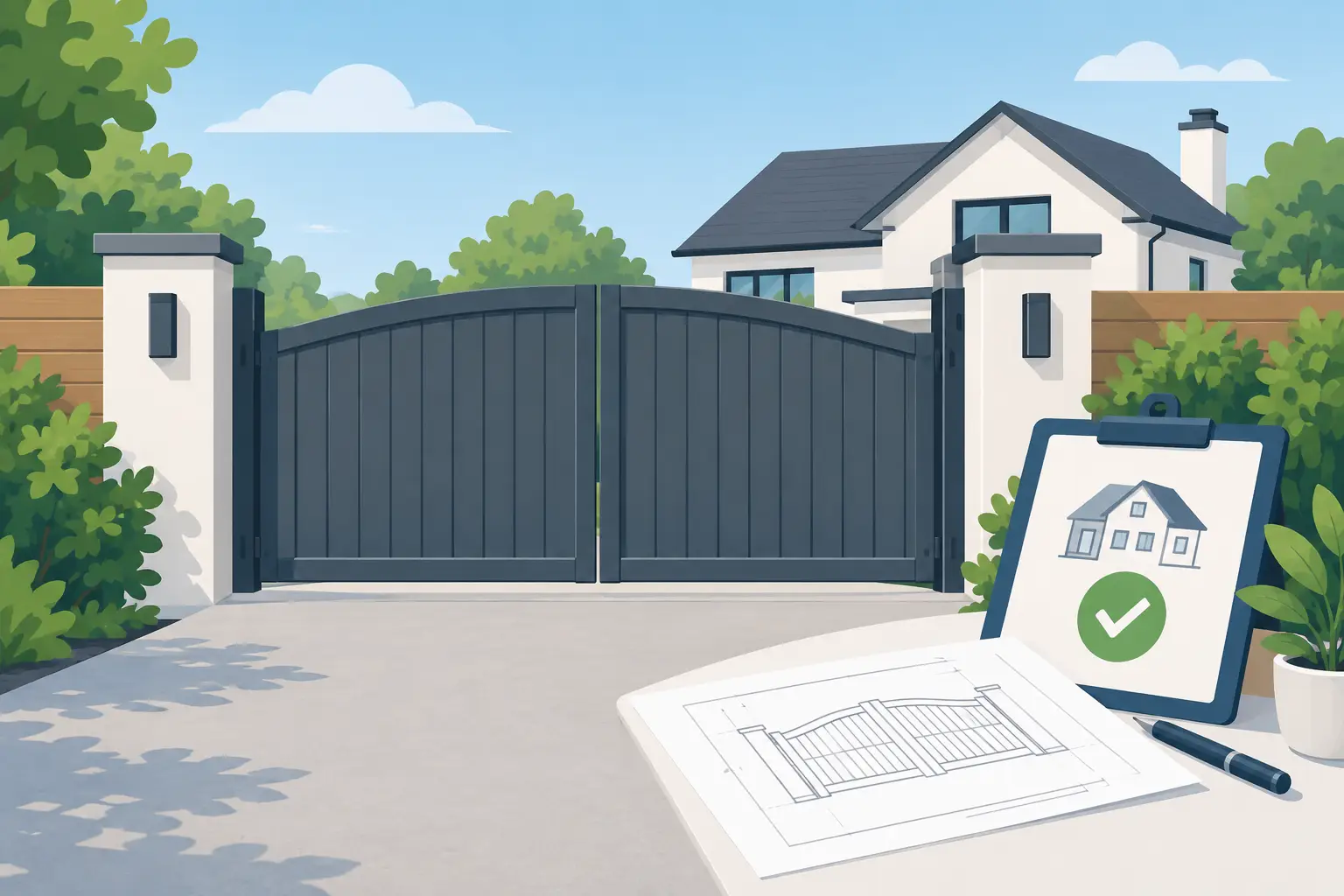
A new driveway gate can transform the front of a property, improve privacy and make access control far more practical. Before placing an order or arranging an installer, it is sensible to check whether planning permission for gates is required. The answer is often no, but height, location and the status of the property can change the position quickly.
For most straightforward homes in England, a gate can be installed under permitted development rights. However, those rights have limits, and they are not the same in every part of the UK. A quick check before work begins is far easier than changing a finished entrance later.
When is planning permission for gates needed?
Planning permission is more likely to be needed where a proposed gate, fence, wall or other enclosure is higher than the permitted limit. The key measurements generally used for homes in England are:
- Up to 1 metre high where it is next to a highway used by vehicles, such as a road.
- Up to 2 metres high elsewhere.
The 1-metre limit is particularly relevant to driveway entrances facing a road. It applies not only to the gate leaf itself, but can also affect the accompanying posts, pillars, fencing and walls. A taller gate set back from the road may still need careful consideration if the boundary treatment remains adjacent to the highway.
There are exceptions and local factors, so height is not the only question. Planning permission may also be required if the property is listed, sits within restricted land, or has planning conditions that remove or limit permitted development rights. New gates forming part of a larger development, such as a housing scheme or commercial site, may be considered within the wider planning application rather than separately.
Rules in Scotland, Wales and Northern Ireland are governed by their own planning systems. If your property is outside England, speak to the relevant planning authority before relying on the English height thresholds.
The road position matters as much as the gate height
A gate next to a road needs to be assessed with safety in mind. Tall solid panels can reduce visibility for drivers leaving a driveway, particularly near junctions, bends or pavements used by children and pedestrians. Even where a proposal falls within a height limit, the local authority may have concerns if the layout creates a poor sightline.
The direction of travel matters too. A driveway gate should not open outwards across a public highway, footway or cycle route. This is both a practical safety issue and something that can cause problems during installation or enforcement. Sliding gates are often a useful option where driveway depth is limited, while inward-opening swing gates need enough clear space to operate safely.
Automation should be planned at the same stage. Vehicle detection, safety edges, photocells and appropriate controls all need to work with the site layout. A gate that is visually suitable but leaves no safe space for a vehicle to wait off the road may not be the right long-term solution.
Listed buildings, conservation areas and restricted locations
Listed buildings require special care. Installing a gate, altering historic gate piers or changing a boundary wall may need listed building consent, even when planning permission would not normally be required. Consent is concerned with protecting the building’s special architectural or historic interest, so the material, design, fixings and impact on original features can all matter.
Conservation areas also need a more cautious approach. There may be restrictions on removing or altering walls, fences and gates, and a local planning authority may have an Article 4 Direction that removes some permitted development rights. Similar restrictions can apply to certain new developments, properties on designated land, flats, maisonettes and sites where a previous consent included specific boundary-treatment conditions.
Do not assume an existing gate proves that a replacement is automatically acceptable. The existing structure may be lawful, but a larger, higher or differently positioned replacement can create a new planning issue. Equally, replacing a tired timber gate with an aluminium design of a similar size and location may be more straightforward, provided other restrictions do not apply.
Check the full entrance, not just the gate
It is easy to focus on the gate style and overlook the rest of the entrance. Planning officers and installers will consider the combined effect of gate leaves, posts, brick piers, retaining walls, fencing, access tracks and any raised ground levels. A 1-metre gate mounted on a substantial wall or raised bank may have a greater apparent height than expected.
Measure from the correct ground level and be honest about slopes. A driveway that rises sharply from the pavement can make a gate look much taller from the road than it does from within the property. Clear photographs, a simple site plan and accurate dimensions make it easier to get useful advice from the council.
For commercial premises, there can be further considerations. Security gates at warehouses, schools, offices and managed developments may be subject to conditions relating to operating hours, noise, lighting, access or highway safety. If an automated sliding gate is part of a new access arrangement, the planning authority may ask for visibility information and details of vehicle movements.
A practical way to check before you buy
Start by confirming the boundary line and where the gate will sit. Then record the proposed overall height, including posts or piers, and note whether the entrance is next to a road used by vehicles. Check the property’s planning history for conditions and establish whether it is listed, in a conservation area or covered by an Article 4 Direction.
If the position is unclear, ask the local planning authority for written guidance or apply for a lawful development certificate where appropriate. This is not always necessary, but it can provide valuable certainty for higher-value projects, properties being prepared for sale, or installations close to a road. A planning professional can also help where the proposal involves structural work, new access points or complicated site levels.
It is worth doing this before ordering a made-to-measure gate. Bespoke aluminium gates can be manufactured to suit almost any opening, height and design brief, but the best specification is one that suits the property and its planning constraints from the outset. A lower, open-slatted design may be appropriate where visibility is needed, while a more private arrangement may work better on a garden boundary away from the highway.
Choosing a gate that works within the rules
Planning constraints do not have to mean compromising on appearance or security. Aluminium offers useful flexibility because it is lightweight, strong and available in a wide choice of colours, panel styles and configurations. It will not rust like untreated steel or require the regular staining and painting associated with many timber gates.
For a restricted entrance, consider proportions before adding height. Wider horizontal sections, carefully spaced vertical bars or partial privacy panels can create a substantial appearance without an unnecessarily imposing boundary. Where a gate needs to stay within a 1-metre limit, matching low-level fencing and neatly designed posts can produce a considered finish rather than an afterthought.
For larger residential and commercial entrances, the choice between swing and sliding operation should reflect available space, gradient, traffic flow and safe waiting areas. Automation, keypads and intercoms should be specified around how the site is used, not added as a last-minute extra.
Common mistakes to avoid
The most frequent issue is assuming that a gate is treated separately from its posts, walls and surrounding fence line. In practice, the whole boundary arrangement matters. Another is measuring only from the inside of the property, rather than from the relevant external ground level.
Customers also sometimes order a gate before confirming whether an existing entrance can be widened. Creating a new vehicular access or materially changing an access onto a classified road can require separate consent, even if the gate itself is within a permitted height. Drainage, dropped kerbs and underground services may need attention as well.
Finally, do not rely solely on a neighbour’s gate as a precedent. Their permission, property history, road classification and installation date may all be different from yours.
A well-planned gate should look right, operate safely and remain a practical investment for years. If you are unsure about the rules, obtain clarity from your local authority first, then choose a gate design that meets the brief without creating avoidable delays. Aluminium Gates Direct can help you assess suitable gate styles, sizes and automation options once your site requirements are clear.
Akuvox Intercom Systems for Secure Gate Access
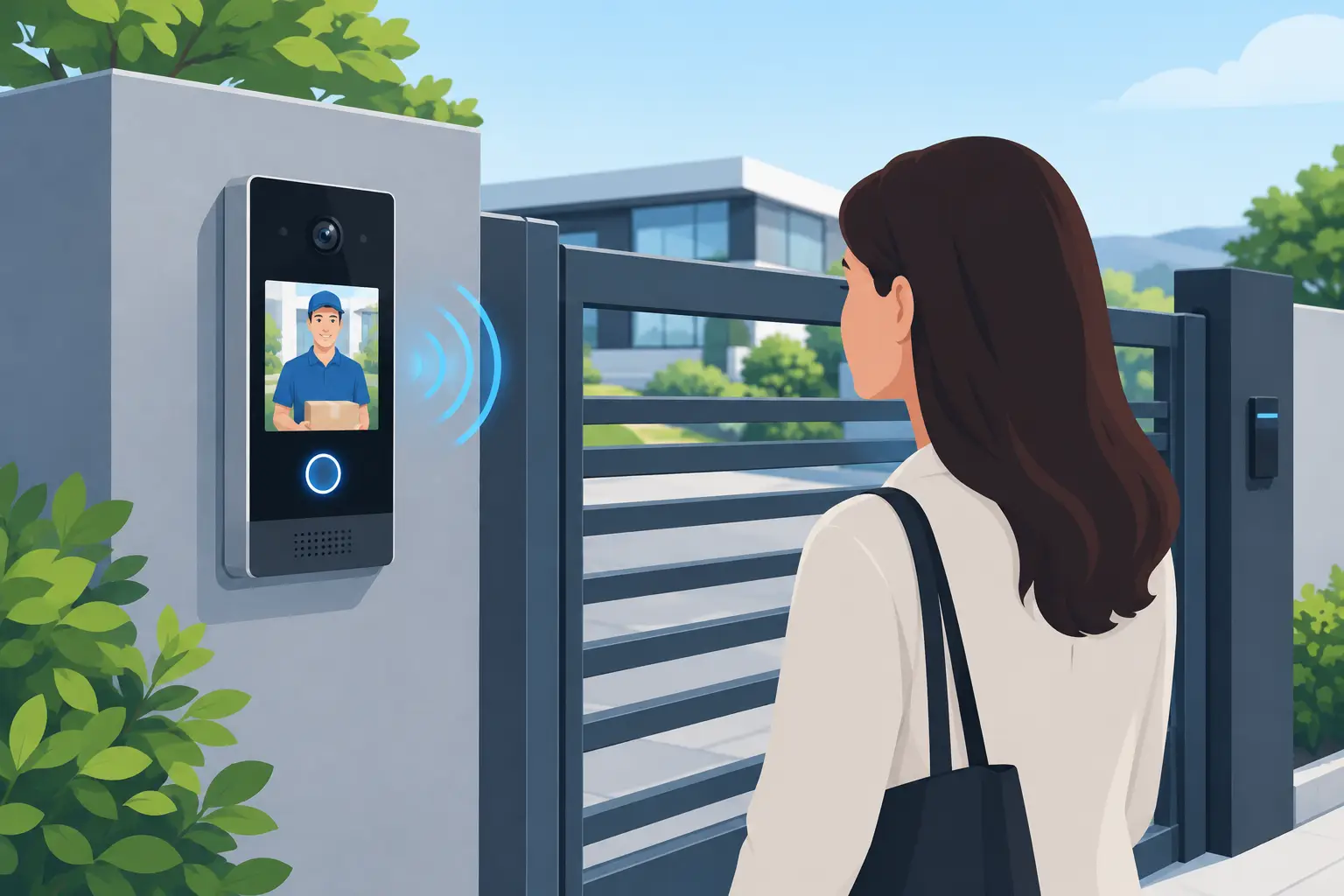
A gate is only as convenient as the way people are allowed through it. Akuvox intercom systems bring visitor communication, access control and gate release together, helping homeowners and site managers see who has arrived before opening a driveway, pedestrian or commercial entrance.
For a new aluminium gate project, the intercom should not be treated as an afterthought. Its location, cabling, power supply and connection to the gate automation all need considering early. A well-planned system makes daily access easier for residents, deliveries and authorised contractors, while presenting a more controlled and professional entrance.
What Akuvox Intercom Systems Can Do
Akuvox is a range of IP-based door entry and access-control equipment designed for residential and commercial settings. Depending on the model and specification, an outdoor call panel can provide video calling, two-way audio, keypad access, proximity card or fob entry, PIN codes and app-based control.
When a visitor presses the call button, the system can ring an indoor monitor, a compatible mobile device or both. The person receiving the call can speak to the visitor, view live video where fitted, and release the gate without walking to the entrance. This is particularly useful where a driveway gate sits some distance from the property.
For commercial premises, flat developments and shared private access roads, access can be managed for more people and in more ways. Individual residents or staff can have assigned credentials, while delivery drivers and contractors can be issued a time-limited code where the selected system supports it. The right setup depends on how the entrance is used, rather than simply choosing the panel with the longest feature list.
Choosing the Right Akuvox Intercom System
The starting point is to decide who needs access and how they will use it. A single-family home may need a straightforward video intercom with a gate-release function and a clean, discreet appearance. A multi-occupancy development may need several call buttons, directory functions and separate user permissions. A commercial site may place greater value on credentials, visitor management and integration with wider access-control arrangements.
Video or audio-only entry
Video gives an additional level of reassurance. It allows the caller to be identified before the gate is opened, which can be valuable at entrances that are not visible from the house or office. Good image quality and sensible panel positioning matter as much as the camera itself. If the panel faces low winter sun, vehicle headlights or a poorly lit access road, the installation should account for that.
Audio-only entry can still be a sensible choice for simpler applications or tighter budgets. It provides direct communication and remote release without adding a screen or camera. However, it does not offer the visual confirmation many customers now expect from a driveway entrance.
Indoor screen, mobile app or both
An indoor monitor offers a fixed, simple point of control within the property. It suits households where not every user wants to rely on a mobile phone, and it can be especially practical in larger homes, offices or managed buildings.
Mobile calling adds flexibility, allowing calls to be answered while someone is in the garden, elsewhere on site or away from the property. It does rely on a stable network connection and users keeping their devices charged and configured. For many projects, using an indoor monitor alongside mobile access gives the most dependable day-to-day arrangement.
Codes, cards and fobs
Keypads are useful where regular visitors, tradespeople or staff need entry without a physical key. Codes should be managed carefully and changed when circumstances change, particularly after building works or staff turnover. Cards and fobs can be more convenient for frequent users and are easy to issue or withdraw when the system has been correctly set up.
There is no single best method. A family home may be well served by a keypad and app access, while a commercial entrance may benefit from fobs for staff, separate visitor credentials and a call function for unannounced arrivals.
Planning the Intercom With Your Gate Automation
An intercom must work with the gate operator, not merely sit beside it. The release command is normally connected to the automation controls so that an authorised user can trigger the opening cycle. Safety devices, such as photocells, safety edges and the gate operator’s control logic, remain responsible for ensuring the gate moves safely.
This distinction is important. An intercom provides permission to open the gate. It does not replace a properly specified automation system or the safety measures required for a powered gate. The gate type, weight, width, usage level and site conditions should all be assessed before automation is selected.
Swing and sliding gates can both be paired with an intercom, but their entrance layouts differ. A pedestrian gate beside a vehicle gate may require its own electric lock or strike, allowing people to enter without operating the main driveway gate. On busy commercial sites, separating pedestrian and vehicle access can improve traffic flow and reduce unnecessary gate cycles.
Cabling should also be considered before surfaces are finished. Hard-wired connections are often the preferred solution for new installations because they provide a reliable route for power, communication and gate release. Wireless options can suit certain retrofit projects, but their performance depends on distance, obstructions and the available network signal. Choosing wireless simply to avoid groundwork can create limitations later.
Positioning the Outdoor Call Panel
The call panel should be easy for visitors to find and use from both a practical and security perspective. It is normally installed near the pedestrian entrance or at a point where a driver can reach it safely without blocking the road. For vehicle entrances, consider whether a driver needs to leave the car to use the panel and whether that is acceptable for the property.
Mounting height should suit expected users and allow the camera to capture a useful view. The panel should not be hidden behind planting, set too close to a moving gate leaf or exposed to damage from vehicles. A protective post, pedestal or integrated gate-side panel can provide a tidy, durable result.
Lighting deserves attention too. Even systems with low-light capability benefit from sensible entrance illumination. Well-placed lighting improves video identification and helps visitors use the keypad safely after dark. It should illuminate faces and the access point without shining directly into the camera.
Network Reliability and Ongoing Use
Because many Akuvox products use network connectivity, the quality of the local network affects the experience. A reliable broadband connection and suitable Wi-Fi coverage are particularly relevant where mobile app calling is expected. At larger properties, the gate may be too far from the main router for a dependable signal, making a wired network connection or properly planned external access point the better answer.
It is also worth deciding who will administer the system once installed. Someone should be able to add and remove users, update codes, review permissions and keep records of important settings. This is straightforward for a homeowner with a small number of users, but it becomes more important for managing agents, developers and business owners.
Avoid giving every user the same code or relying on an old shared fob that cannot be traced. A system is most useful when access can be adjusted without replacing locks or collecting keys from every former user.
A Better Fit for the Entrance You Have
The appearance of the intercom should complement the gate and surrounding boundary, but performance should lead the decision. A slim panel may suit a contemporary aluminium gate, while a larger directory-style unit may be necessary for a shared development. The most attractive installation is one where the equipment is positioned neatly, functions reliably and does not complicate entry for legitimate visitors.
At Aluminium Gates Direct, intercom options can be considered alongside aluminium gates, automation and pedestrian access from the outset. This helps avoid mismatched components, late changes to groundwork or a call panel that has nowhere practical to sit.
Before ordering, think through a typical week at the property: family arrivals, deliveries, cleaners, contractors, staff, residents and out-of-hours visitors. That simple exercise usually makes the right Akuvox specification clearer. A well-chosen system should make the entrance feel controlled without making everyday access difficult.
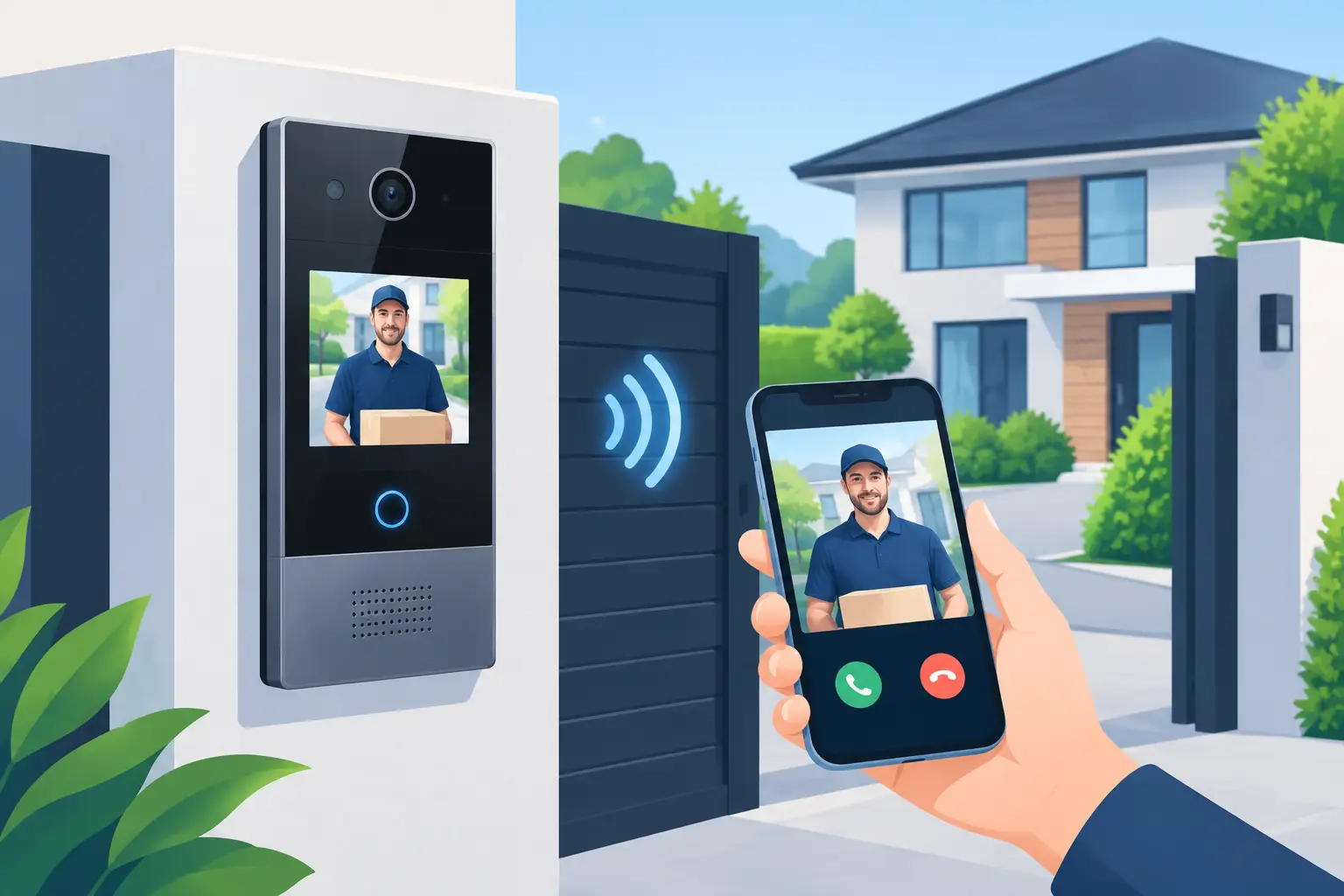
Akuvox Intercom Reviews for UK Gate Buyers
A gate intercom is often the part of an automated entrance system that people use most, yet it is easy to treat it as an afterthought. Reading Akuvox intercom reviews can help, but a useful review should look beyond whether a unit looks smart on a gate post. It should consider call quality, video performance, access options, compatibility with automation and the standard of installation.
For homeowners, developers and commercial site managers, Akuvox is a well-known name in IP-based door entry and access control. Its range includes video intercoms, audio units, indoor monitors and access devices designed to work across domestic and commercial settings. The right system can provide a clear way to speak to visitors, see who is at the entrance and release a gate without walking to it. The wrong specification can leave an otherwise excellent gate system less convenient than it ought to be.
What Akuvox intercom reviews tend to highlight
The strongest feedback around Akuvox systems usually centres on flexibility. Depending on the equipment selected, visitors can call an internal screen, a smartphone or more than one location. This is particularly useful on long driveways, larger homes, multi-occupancy developments and business premises where a gate needs to be answered from different areas.
Video capability is another major reason buyers consider Akuvox. A camera at the entrance gives more confidence than an audio-only call, especially after dark or where deliveries are frequent. However, image quality alone is not the whole story. The camera needs to be positioned at an appropriate height and angle, with the entrance properly lit where necessary. A high-specification unit cannot compensate for poor placement on a post, pier or wall.
Buyers also value the available entry methods. A system may be configured for a call button and video verification, while some options can support PIN codes, cards, fobs or other credential-based access. This can make daily arrivals easier for family members, staff, contractors or regular visitors. The most suitable method depends on who uses the site and how closely access needs to be controlled.
For a private driveway, a simple video call with gate release may be all that is needed. For a managed development or commercial entrance, a more structured approach to credentials, multiple users and call routing could be worthwhile. Reviews are most useful when the reviewer’s setting resembles your own.
The benefits for automated gates
An intercom should work as part of the entrance, not as a separate gadget attached at the end of the project. When correctly specified, an Akuvox system can send a release command to the gate automation controls after the occupant has verified the visitor. This gives the property owner control without requiring anyone to leave the house, office or reception point.
That convenience matters in everyday use. A pedestrian at a side gate may need a different release arrangement from a vehicle entering through a sliding or swing driveway gate. A delivery driver may need to speak to someone and be admitted only to a safe drop-off area. A commercial site may require staff access at set times but visitor verification throughout the day.
There is also a presentational benefit. An aluminium gate is chosen for clean lines, durability and low maintenance, so the intercom should complement the overall design. A carefully selected panel can sit neatly within a gate post, masonry pier or dedicated pedestal, keeping the entrance purposeful rather than cluttered. Bespoke gate projects offer more scope to plan this from the outset, including cable routes and mounting positions.
Where buyer expectations need managing
No intercom system is completely plug-and-play once it becomes part of an automated gate installation. Connectivity, power supply, cabling, network coverage and automation interfaces all need consideration. This is where short online reviews can be misleading. A customer may praise or criticise a product when the real issue is the quality of the installation or the conditions at the site.
Wi-Fi-only planning can be tempting, particularly where a gate is some distance from the house. Yet a stable wired network connection is often preferable where it is practical, as it avoids relying on wireless signal strength through walls, across driveways or over larger plots. Where a wired connection is not possible, the solution should be assessed properly rather than assumed.
Smartphone calling is useful, but it also depends on the resident having data coverage and notifications correctly enabled. An indoor monitor can provide a dependable fixed point for answering calls, while a mobile app adds flexibility when occupants are away from the property. Many customers choose both rather than treating one as a replacement for the other.
It is also worth checking exactly what is included. The outdoor intercom panel, indoor screen, power equipment, network hardware, access credentials and installation work may be separate elements. Clear quotations make it easier to compare like for like and avoid making a decision on headline equipment price alone.
Choosing the right Akuvox intercom for your property
When comparing Akuvox intercom reviews, begin with the entrance rather than the product catalogue. Consider how many gates or doors need to be controlled, who needs access and what a visitor should be able to do when they arrive. A domestic driveway with one call point is different from a block entrance, yard gate or commercial perimeter.
A few practical questions will help define the right specification:
- Do you need audio only, or is video verification essential?
- Will calls be answered on an internal monitor, a mobile phone, or both?
- Is the gate location suitable for hard-wired power and network cabling?
- Do family members, staff or tenants need cards, fobs or codes?
- Should pedestrians and vehicles have separate access points and release controls?
- Is there sufficient lighting for visitors to be identified clearly in the evening?
For properties with an existing automated gate, compatibility should be checked before equipment is ordered. Most gate automation systems use a relay input for a trigger command, but each project should be reviewed on its own merits. Safety devices, photocells, keypad access and exit controls must continue to operate correctly after an intercom has been added.
For new gates, planning everything together is normally the cleaner route. Cabling can be concealed, the intercom position can be agreed before fabrication or groundwork begins, and the system can be commissioned as one coordinated installation. This is especially valuable with aluminium gates, where a tidy, integrated finish helps preserve the contemporary appearance customers expect.
Installation has a major effect on the experience
A well-made intercom can still disappoint if it is installed too low, exposed to avoidable weathering or placed where visitors stand outside the camera frame. The call button should be accessible from a vehicle where required, yet the unit also needs to work for pedestrians. On shared or commercial sites, accessibility and visitor flow need even more careful thought.
The installer should also allow for future servicing. Equipment should be secure, but not impossible to access for configuration or maintenance. External cable entries need appropriate protection, and gate movement must never place strain on wiring. At a sliding gate, for example, the preferred intercom location is often a fixed post or pier rather than the moving gate leaf.
Before handover, the system should be tested in realistic conditions. Make calls from the gate, answer them at every intended device, check the release function and confirm that the gate operates safely. Test it after dark as well as during daylight. This is the point at which an installation partner’s experience can make a noticeable difference.
Is Akuvox a good choice for a gate intercom?
For buyers who want video entry, flexible calling and the option to build access control around an automated entrance, Akuvox can be a strong choice. Its appeal is not simply the intercom panel itself, but the range of ways a system can be configured to suit a home, development or business.
The trade-off is that greater flexibility requires clearer planning. A basic domestic installation may be straightforward, while a multi-user or multi-entrance system needs a more detailed specification. Do not select solely on the basis of the most feature-rich model. Choose the system that supports the way the property is genuinely used, without adding unnecessary complexity.
At Aluminium Gates Direct, gate, automation and intercom choices can be considered together, helping customers plan an entrance that is practical as well as visually consistent. A short conversation about the site, users and preferred access methods can prevent costly changes later.
The best result is an entrance that feels simple every day: visitors can call clearly, authorised people can enter easily, and the gate remains under your control. That is the standard worth looking for when weighing up any intercom review.
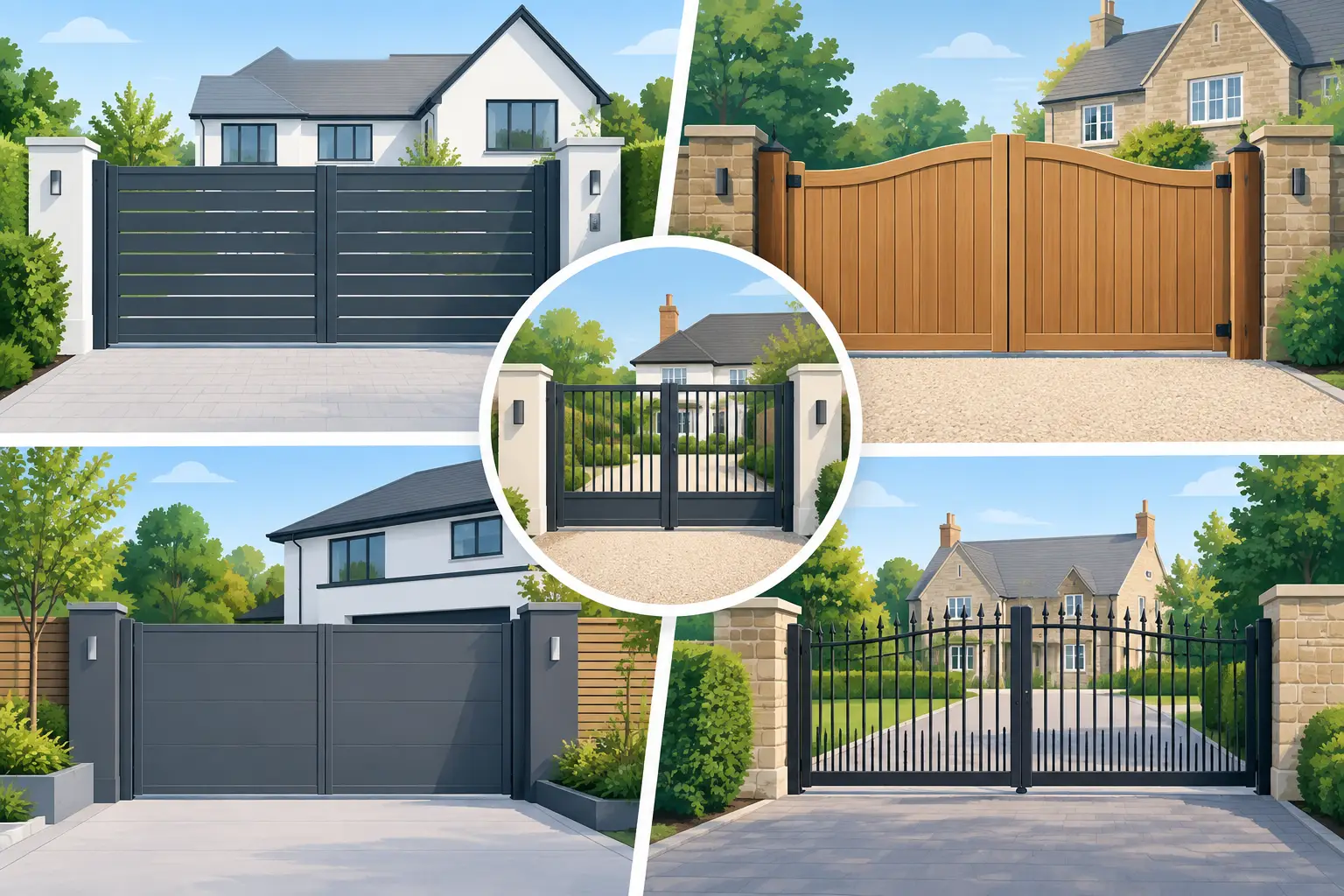
Driveway Gate Project Examples for UK Homes
A driveway gate has to work with the entrance you already have, not an idealised picture of one. A narrow suburban opening, a sloping drive or a wide rural approach each calls for a different solution. These driveway gate project examples show how aluminium gates can be specified around access, security, appearance and everyday use.
Aluminium is a practical choice across all of these settings. It is lightweight enough to suit automated systems, strong enough for regular use and does not require the ongoing painting, staining or rust treatment associated with many timber and steel gates. The best result comes from deciding how the gate needs to operate before choosing its design.
Driveway gate project examples by property type
1. The compact suburban driveway
For a terraced or detached home with a short driveway, the main challenge is often space. There may be limited room for gates to swing inwards, while an outward-opening gate can obstruct a pavement or highway and is usually unsuitable. In this situation, a pair of aluminium swing gates that opens into the property can work well where the drive has enough depth.
A horizontal slatted design is a popular fit for modern brick homes because it gives the entrance a clean, private finish without making it feel closed in. A darker colour, such as anthracite grey or black, can complement window frames, front doors and garage doors. Where visibility is useful for leaving the drive, a design with modest gaps between slats may be preferable to a fully solid gate.
Automation is particularly useful on busy residential roads. Residents can enter without stopping to open the gates by hand, while safety controls help manage closing. Before specifying automation, measurements must allow for the gates’ opening arc, hinge positions and the equipment needed to operate them.
2. The wide detached-home entrance
A broad driveway creates an opportunity for a more substantial entrance, but it also places greater demands on the gate, posts and foundations. Two wide swing leaves may look impressive, yet they need sufficient clear space behind them when open. On a deep drive, this can be a strong choice. On a shallower site, a sliding gate is often more practical.
For this type of project, bespoke aluminium driveway gates give greater freedom over width, height, infill pattern and colour. Vertical bars, decorative panels or a mixed solid-and-open design can be used to match the character of the property. The gate can also be coordinated with aluminium fencing, railings and a pedestrian gate, creating a considered perimeter rather than an entrance that looks added as an afterthought.
A video intercom is worth considering where the house sits some distance from the road. It allows the homeowner to speak to visitors and control access without walking to the entrance. The cable routes, power supply and position of the control equipment should be discussed early, especially on a new-build or landscaping project.
3. The rural home with a long approach
A country property may need a gate that provides a clear boundary without appearing too formal or urban. An ornate aluminium gate can suit period homes, farmhouses and properties with stone walls or traditional brick piers. Aluminium gives the decorative look associated with wrought iron while avoiding the regular repainting needed to keep steel gates protected.
Long drives often benefit from automated operation and an intercom because the entrance is well away from the house. Solar-powered options may also be considered where mains power is difficult or costly to bring to the gate, although suitability depends on the site, available light and anticipated usage. A professional assessment is valuable here, as an unreliable power arrangement defeats the purpose of automation.
The ground conditions matter as much as the gate style. Rural entrances can be exposed to wind, standing water and uneven surfaces. Gate posts and foundations must be designed for the size of gate, local conditions and automation equipment. A gate that looks right but is poorly supported will not deliver reliable long-term performance.
4. The sloping driveway
Slopes are one of the most common reasons standard gate solutions do not fit. A conventional swing gate follows an arc as it opens, so it can catch on rising ground. Depending on the direction and severity of the slope, there are several possible approaches: changing the gate’s opening direction, creating a level area behind the entrance, using a tracked or cantilever sliding gate, or specifying a design made to work with the site geometry.
A sliding gate avoids the opening arc across the drive, making it an effective option for many sloped or restricted sites. It does, however, require clear run-back space alongside the opening. A cantilever sliding gate also needs additional room for its counterbalance section, while a tracked system relies on a suitable level track area. Neither arrangement is automatically better – the right choice depends on the available side space, finish of the drive and drainage.
This is a project type where accurate site measurements are essential. Width alone is not enough. The gradient, level changes, surface material, pier dimensions and the location of any walls, hedges or services all affect what can be installed.
5. The new-build development entrance
For developers and self-builders, driveway gates are often part of a wider external specification. The gate needs to reflect the architecture, meet the buyer’s expectations and remain practical after handover. Aluminium is well suited to this role because powder-coated finishes provide a consistent appearance with low maintenance requirements.
A contemporary development may use matching pedestrian gates, fencing and railings in the same colour and profile. This creates a coherent frontage across several plots without relying on timber that will weather differently over time. Readymade gate options can be useful where standard openings and programme deadlines are the priority, while bespoke gates offer more flexibility for feature plots or non-standard entrance widths.
Access planning should happen before the final landscaping stage. Installing a gate after paving, planting and drainage are complete can create avoidable disruption. Allowing for foundations, cabling and the chosen opening method at an early stage usually results in a cleaner installation and more controlled costs.
6. The commercial or shared-access driveway
A commercial yard, flat development or shared private road has different priorities from a single dwelling. Security, frequency of use and controlled access often lead the specification. Sliding gates are commonly chosen for wider openings because they do not need open space within the entrance, but swing gates can still be suitable where traffic levels are modest and the site layout allows.
For higher-use locations, consider how visitors, delivery drivers and emergency access will be managed. Keypads, fob access, intercom systems and timed opening functions can all form part of the solution. The gate should be matched to the expected traffic pattern, rather than simply chosen for its appearance. A lightweight aluminium gate can reduce the load on automation equipment, but the system must still be correctly specified for its size, duty cycle and operating environment.
Choosing between swing and sliding gates
Most driveway gate projects come down to one practical question: where can the gate go when it opens? Swing gates are often the more economical and visually traditional option when there is room to open into the property. They suit entrances with a level approach and sufficient driveway depth.
Sliding gates are useful for short drives, slopes and wide openings, provided there is enough clear space to one side. They can offer a neat, controlled entrance, but installation requirements can be more involved. Posts, groundworks, run-back space and power all need careful consideration.
The finish is the final layer, not the starting point. Start with dimensions, levels, access needs and operating method, then choose a design that gives the property the right level of privacy and character.
What to establish before requesting a quotation
A helpful quotation starts with clear information. Provide the opening width and height, photographs from inside and outside the entrance, the direction of any slope and details of existing walls or posts. It is also useful to say whether you want manual operation now, automation from the outset or the option to automate later.
Think about who will use the gate. A family returning home several times each day has different needs from a rarely used country entrance or a commercial site receiving deliveries. If pedestrian access is frequent, a separate pedestrian gate can prevent unnecessary use of the main driveway gates and improve convenience.
Aluminium Gates Direct can help customers assess whether a readymade or bespoke gate is the better fit, with nationwide support and access to installation partners. A well-planned gate project should feel straightforward every time you arrive home, not become another item on the maintenance list.
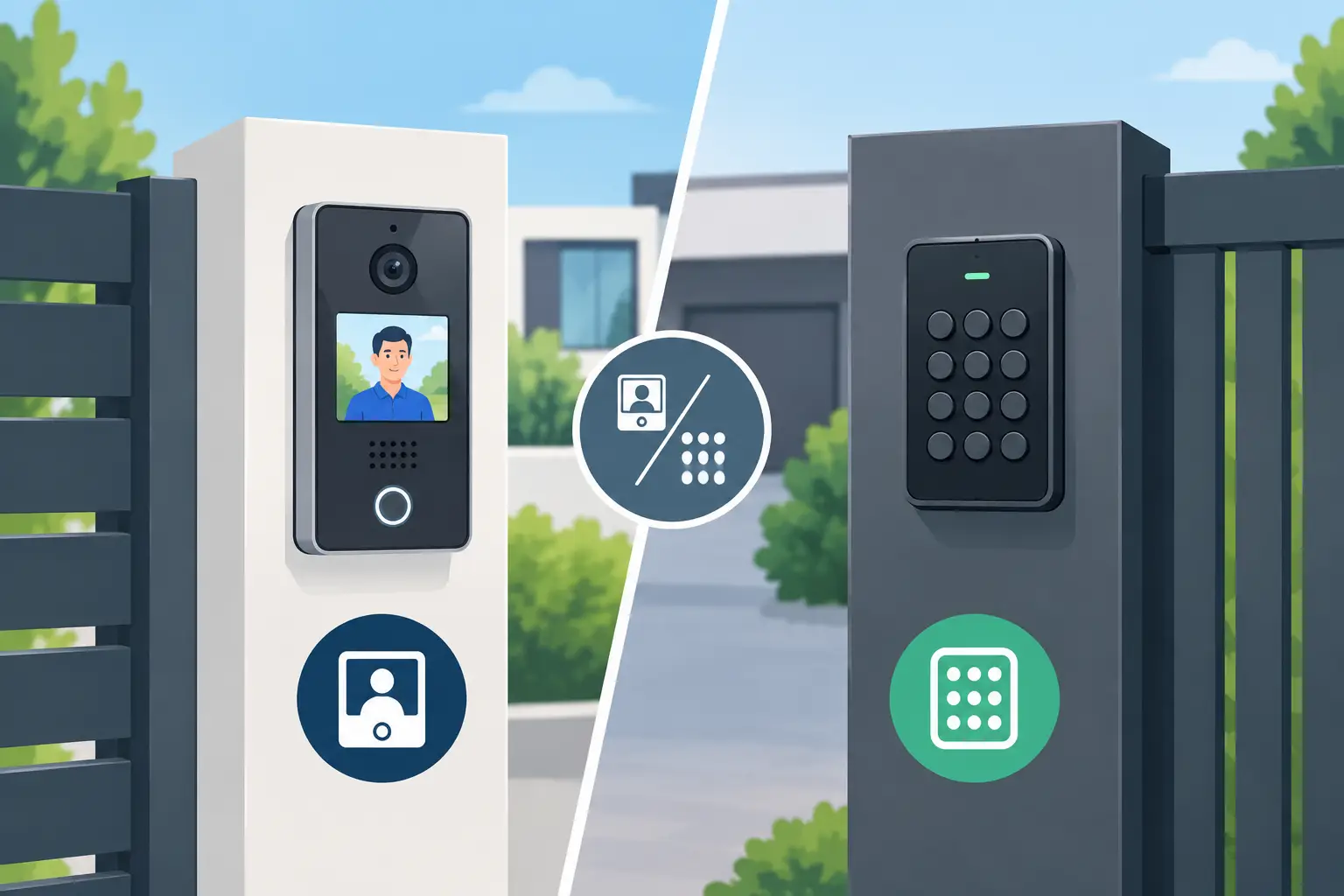
Intercom vs Keypad Entry for Your Gate
A driveway gate can look exactly right and still cause frustration if access is awkward. The decision between intercom vs keypad entry affects how your household, visitors, deliveries and tradespeople use the gate every day. The best option is not always the most feature-rich one. It is the system that suits the property, the people using it and the level of control required.
For many homes, a keypad is a straightforward, dependable answer. For properties where visitors need to be checked before entry, an intercom adds a valuable layer of control. Commercial sites may benefit from using both.
Intercom vs keypad entry: the key difference
A keypad opens an automated gate when the user enters the correct PIN code. It is designed primarily for authorised people who already have permission to enter, such as residents, staff, regular contractors or family members.
An intercom allows a visitor to call someone inside the property before the gate is opened. Depending on the system selected, this may be an audio call, a video call or a call diverted to a mobile phone. The person receiving the call can identify the visitor and release the gate remotely.
Put simply, a keypad provides access through a code, while an intercom provides a way to screen visitors. Both can be fitted to swing and sliding gate systems, and both work particularly well when planned alongside gate automation rather than treated as an afterthought.
When keypad entry is the practical choice
Keypad entry is often the right fit where convenience is the main priority. A homeowner can give a code to close family, a gardener or a cleaner without handing out additional remote controls. On a shared private drive, codes can be issued to regular users and changed when access needs to be removed.
A keypad also keeps the gate operation simple. There is no need for someone to answer a call, and visitors who have permission can let themselves in even if the property is empty. This can be useful for homes with frequent service visits, holiday lets, yards and smaller commercial premises.
The main consideration is code management. A PIN can be passed on, written down or forgotten, particularly if one code is shared by too many people. Changing the code periodically is sensible, and systems with separate user codes make it easier to remove access for an individual without disrupting everyone else.
For a keypad to remain effective, it should be installed at a comfortable height and position for drivers and pedestrians. On a driveway, think about the distance from the road and the space a vehicle needs to pull clear while the gate opens. A poorly placed keypad can lead to users stretching from the car window or stopping where they obstruct the pavement or road.
Keypad entry suits properties with regular authorised users
A keypad is generally a strong choice when most users are known and visit regularly. It is affordable, unobtrusive and easy to understand. It can be an especially sensible starting point for a readymade or bespoke aluminium gate where the customer wants controlled access without adding more technology than they need.
When an intercom is worth the extra investment
An intercom is better suited to properties where visitors need to request access. This may include family homes set back from the road, larger driveways, blocks of flats, offices, schools, depots and gated commercial sites.
With an audio intercom, the occupier can speak to a caller before releasing the gate. A video intercom adds visual confirmation, helping the user check who is at the entrance. This is useful when a delivery driver, unfamiliar contractor or unexpected visitor arrives, particularly where the front door is some distance from the gate.
Modern systems can offer mobile app calling, which means calls can be answered when the occupier is elsewhere on the property or away from it. This can be helpful, but it should not be the only factor in the decision. App-based functions rely on suitable network coverage, a reliable internet connection and confident day-to-day use of a smartphone.
For households wanting a clearer view of who is calling, or businesses with a reception team that needs to approve arrivals, a quality video intercom such as an Akuvox system can provide a more controlled approach to entry. The right specification depends on whether calls need to reach one handset, several users or a managed access point.
Intercoms offer better visitor control, not automatic security
An intercom allows you to make a decision before opening the gate, but the result still depends on how it is used. If anyone can press the release button without checking the caller, the extra control is lost. Video helps with identification, but it should be installed with a clear sightline, suitable lighting and a camera angle that captures the person at the entrance.
It is also worth considering how visitors use the system. A clear call button, readable name plate and straightforward instructions make a noticeable difference. Access equipment should make a property feel welcoming while still protecting it.
Using an intercom and keypad together
For many installations, the most useful answer is not intercom or keypad entry, but both. The intercom manages unknown visitors while the keypad gives trusted users a quick way in. Residents may use remote controls or a keypad code, while deliveries and new visitors call through the intercom.
This combination works well at busy family homes and commercial sites. It avoids the need to share a visitor access code widely, while ensuring regular users are not dependent on someone being available to answer an intercom call.
There are other access methods to consider too. Key fobs, vehicle-mounted remote controls, proximity readers and exit buttons can all be incorporated into an automated gate design. For commercial premises, the access strategy may need to account for staff turnover, delivery schedules, pedestrian access and emergency procedures.
Installation considerations before choosing
The access system should be selected as part of the wider gate project. Cable routes, power supplies, gate automation, pedestrian entry points and the position of the control panel all need to be considered early. Retrofitting is possible in many cases, but planning it from the start usually produces a cleaner installation and can reduce unnecessary disruption later.
Wireless options can help where running cables is difficult, although wired equipment is often preferred for permanent installations because it avoids battery changes and potential signal issues. The most suitable approach depends on the distance between the gate and property, ground conditions and whether excavation is practical.
The gate itself matters too. Aluminium gates are lightweight yet strong, which makes them well suited to automated operation. Their low-maintenance finish means the access equipment can be paired with a gate solution that does not demand regular painting or treatment. Whether you choose a sliding gate for limited driveway depth or a swing gate for a more traditional entrance, the access control should be designed around safe operation and convenient use.
Safety should always be part of the specification. Automated gates require suitable safety devices, including photocells and force controls, to reduce the risk of trapping or impact. A professional installer can assess the layout, opening direction, public-facing risks and manual release arrangements before recommending the appropriate equipment.
Cost, maintenance and long-term use
A basic keypad is usually the lower-cost option because it has fewer components and a simpler function. An intercom, particularly video or mobile-connected equipment, involves a greater initial outlay and may require more careful setup. That does not make it unnecessary. If screening callers is a priority, it can be money well spent.
Neither system should be selected on purchase price alone. Think about who will use it in three or five years, whether the property may be rented or sold, and how easy it will be to update access. For example, a business with changing staff may place greater value on individual user codes, while a homeowner may prioritise a video call to a phone.
Keep keypads clean and check that buttons remain responsive. Review codes after a contractor finishes work or a tenant changes. For intercoms, periodically test audio, video, gate release and any app notifications. A simple check can identify an issue before a visitor is left outside or access is needed urgently.
The right access control should make your gate easier to live with, not more complicated. If you are weighing up keypad convenience against intercom screening, Aluminium Gates Direct can help you match the equipment, gate design and automation arrangement to your property and budget before installation begins.