
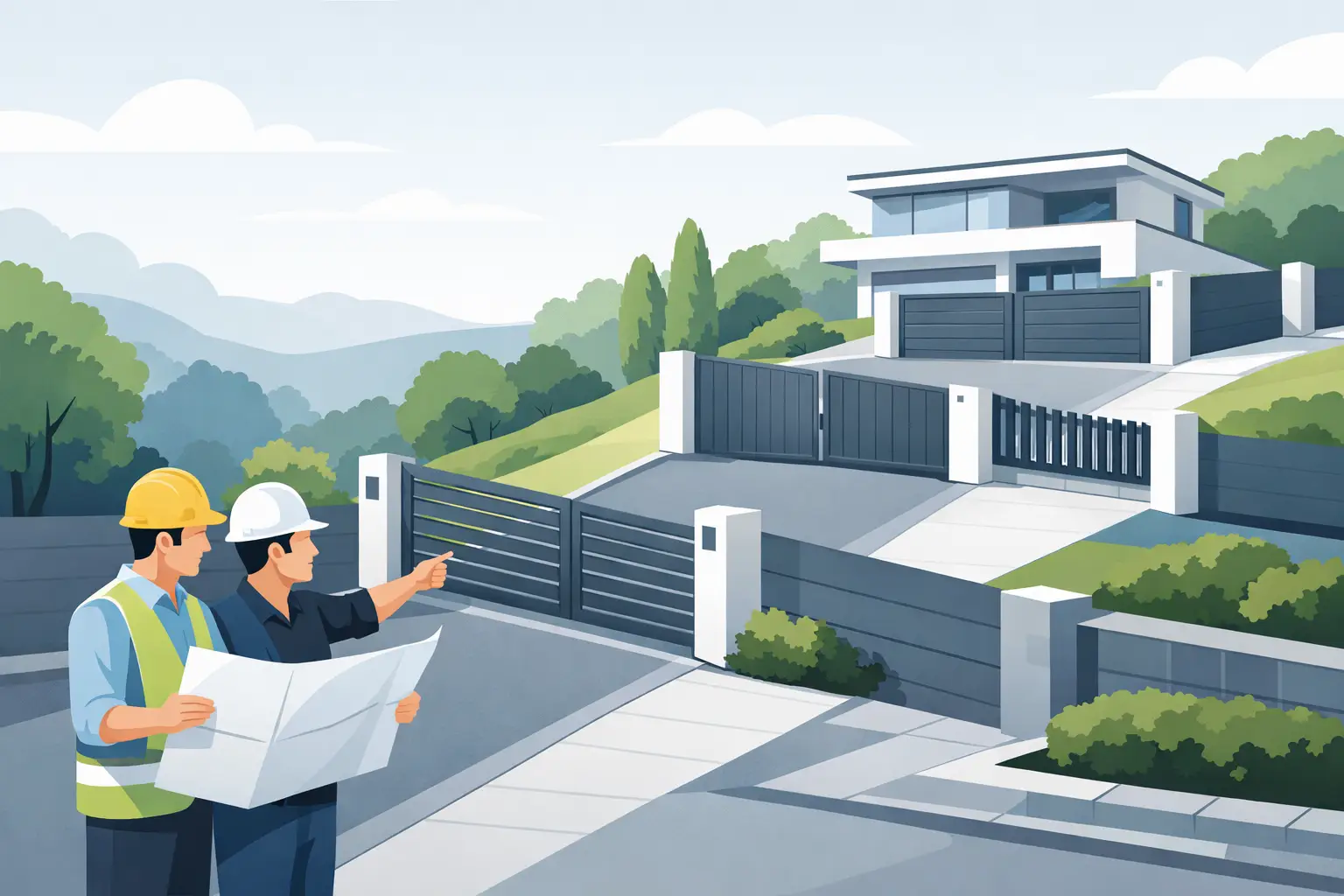
A sloping driveway can make an otherwise straightforward gate project far more technical. Aluminium gates for slopes need more than attractive panels and correctly sized posts: the direction of the gradient, opening space and gate type all affect whether the finished entrance works safely every day.
The good news is that a slope does not rule out a smart, low-maintenance aluminium gate. It simply means the gate should be designed around the site rather than treated as a standard opening. A proper survey at the outset will prevent problems such as leaves catching the ground, uneven gaps, difficult operation or an automation system working harder than it should.
Start with the direction of the slope
Not all slopes create the same challenge. The key question is whether the drive rises or falls in the direction the gate will open, or whether it slopes across the width of the entrance.
A driveway that slopes up or down away from the gate line affects the clearance beneath a swinging leaf. As the gate travels through its arc, its bottom edge may strike the surface on the uphill side. On a falling drive, a large gap can appear beneath the gate when it is closed. Both situations can affect appearance, privacy, security and the suitability of the gate for children or pets.
A gradient running across the entrance creates a different set of decisions. One side of the opening sits higher than the other, so the gate, posts and infill need to be set out carefully to avoid awkward-looking gaps. A made-to-measure design can use raked rails, stepped sections or adjusted ground levels to give a deliberate, well-finished result.
Before choosing a style, measure the gradient over the full gate opening and along the route where the gate will travel. Photographs are useful, but accurate levels give a gate supplier and installer the information needed to recommend a workable arrangement.
Choosing aluminium gates for slopes
The right opening method usually has the greatest influence on the final design. Swing gates, sliding gates and pedestrian gates can all work on sloping sites, but each has limitations worth understanding before an order is placed.
Swing gates on a rising or falling driveway
A pair of swing gates is often the preferred choice for a residential driveway because it creates a traditional entrance and does not require a long run-back area. However, swing leaves need sufficient clearance from the ground throughout their movement.
Where the drive rises towards the property, gates may be arranged to open towards the lower side, provided there is enough space and this does not create an issue with the road or pavement. In some cases, changing the level immediately inside the entrance is the cleanest solution. This may involve creating a flatter apron, regrading a small section of driveway or using carefully planned thresholds.
If the ground cannot be altered, a bespoke gate may be made with a higher bottom rail or a raked profile. This can preserve clearance, although it may leave a greater gap beneath part of the gate. It is a trade-off between ground clearance and the degree of enclosure required.
For a double-leaf driveway gate, it is also vital to allow for the central meeting point, hinges and any drop bolts. A minor difference in ground level can become obvious once two leaves meet in the middle, particularly with horizontal slatted designs where lines need to remain visually consistent.
Sliding gates and sloping sites
Sliding gates avoid the swinging arc that causes clearance problems on steep drives. They can be an excellent option when there is limited room behind the gates or when the driveway rises immediately inside the boundary.
That said, a sliding gate needs a suitable route alongside the opening. A tracked gate requires a level, stable track area, while a cantilever sliding gate needs a longer clear run-back zone and substantial support structure. A slope along this route may need groundwork and levelling before installation.
Sliding systems can offer a tidy, modern finish and work particularly well with automation, but they are not automatically the answer to every incline. The available side space, surface condition, drainage and existing boundary features all need checking first.
Pedestrian gates on sloping ground
Garden and side-access gates can be easier to accommodate, but they still need sensible clearances and a safe threshold. A pedestrian gate should not leave a trip hazard at the bottom of a steep path, nor should it have a gap large enough to compromise security.
A stepped section of fencing beside the gate can often manage a changing boundary level more neatly than trying to force every rail to follow the gradient. For contemporary aluminium fencing and gates, this can look intentional rather than improvised.
Bespoke design makes the difference
Readymade aluminium gates suit level, standard-sized openings well. On a slope, bespoke manufacture is often the better route because the frame, infill pattern and ground clearances can be considered together.
For example, horizontal aluminium slats can be raked to follow the line of a slope, or sections can be stepped to keep selected lines level. Vertical infill can be more forgiving visually on uneven ground, while solid or privacy-style panels may need closer attention to avoid a pronounced wedge-shaped gap beneath the gate.
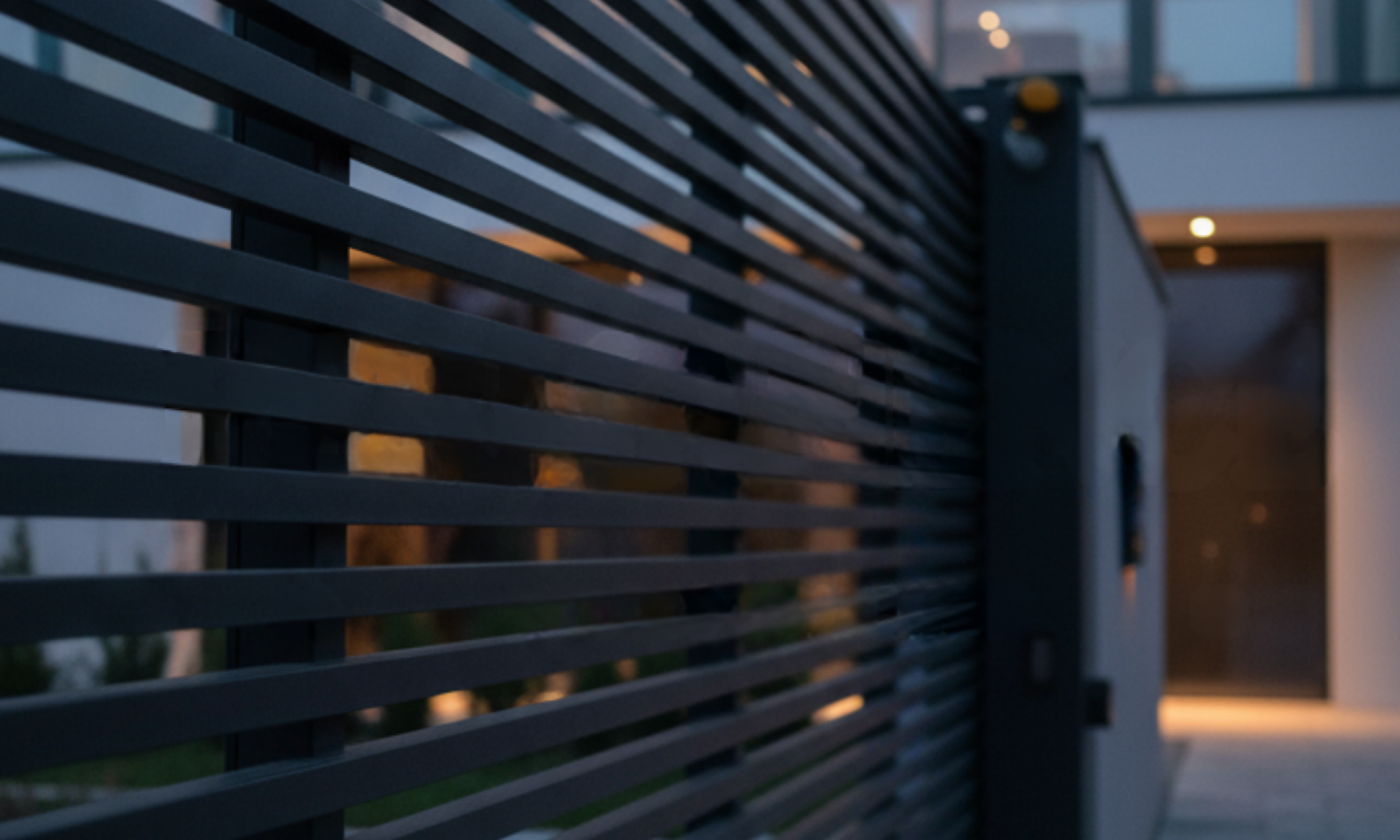
The gate itself should remain properly engineered, with hinges, posts and fixings matched to its width and weight. Aluminium is a useful material for this type of project because it is lightweight compared with many steel alternatives, while still offering the strength needed for a substantial driveway or commercial entrance. Its powder-coated finish also avoids the regular painting, staining and corrosion management associated with timber and untreated metal.
Colour and style are still very much your choice. Whether the property calls for a sleek anthracite grey gate, a wood-effect finish or an ornate design, the slope should influence the engineering and detailing rather than limit the overall look.
Automation needs careful planning
An automated gate on a slope should never be specified as an afterthought. The operating equipment must be suited to the gate type, leaf size, opening angle and forces involved during travel.
For swing gates, the position and type of motor must work with the hinge geometry and available clearance. Underground motors can provide a discreet finish, while above-ground ram or articulated arm systems may be more practical depending on the posts and gate design. The best option depends on the site, not simply on appearance.
Safety devices are especially relevant where levels change. Photocells, safety edges and correctly configured force settings help the system respond to vehicles, people and obstructions. Drainage also matters around underground equipment and track systems, as standing water, debris and winter conditions can interfere with reliable use.
For a busy home, development or commercial entrance, consider how visitors will gain access before the gates are fitted. An intercom and controlled access system can be incorporated into the post, adjacent fencing or a separate pedestal. Planning this early avoids visible surface cabling and last-minute compromises.
The survey details that should not be missed
A gate installer will need more than the width between two posts. The most useful site information includes the clear opening width, post heights, driveway levels, the direction of travel, the intended opening direction and the space available on either side.
It is also worth identifying drainage channels, manhole covers, kerbs, retaining walls and changes in surface material. These features can affect foundations, tracks, motor placement and the best position for gate stops. If new posts are required, their foundations need to be designed for the ground conditions and the gate load, rather than simply set to match the line of the drive.
Where a gate is close to a public road, it should not open into a highway or obstruct a pavement. Local planning requirements can also apply in certain locations, including conservation areas and listed properties. Checking these points before committing to a design is far easier than changing a gate after manufacture.
A practical route to the right solution
The most successful sloping-gate projects begin with the site constraints, then select a gate design to suit. Trying to make a standard swing gate fit a steep drive can lead to unnecessary groundwork or a poor-looking result. Equally, choosing a sliding gate without a usable run-back area can create a different problem.
Aluminium Gates Direct can help customers assess whether a bespoke swing gate, sliding gate or combined gate and fencing layout is the most sensible option for the available space and budget. With nationwide supply and access to installation support, the aim is to provide a gate that looks right from the road and operates reliably long after fitting.
Before settling on a favourite design, arrange for the slope to be measured properly and discuss the intended use of the entrance. A gate that accommodates daily vehicles, visitors, automation and changing ground levels from the start will be a far better investment than one adapted to the site at the last minute.