

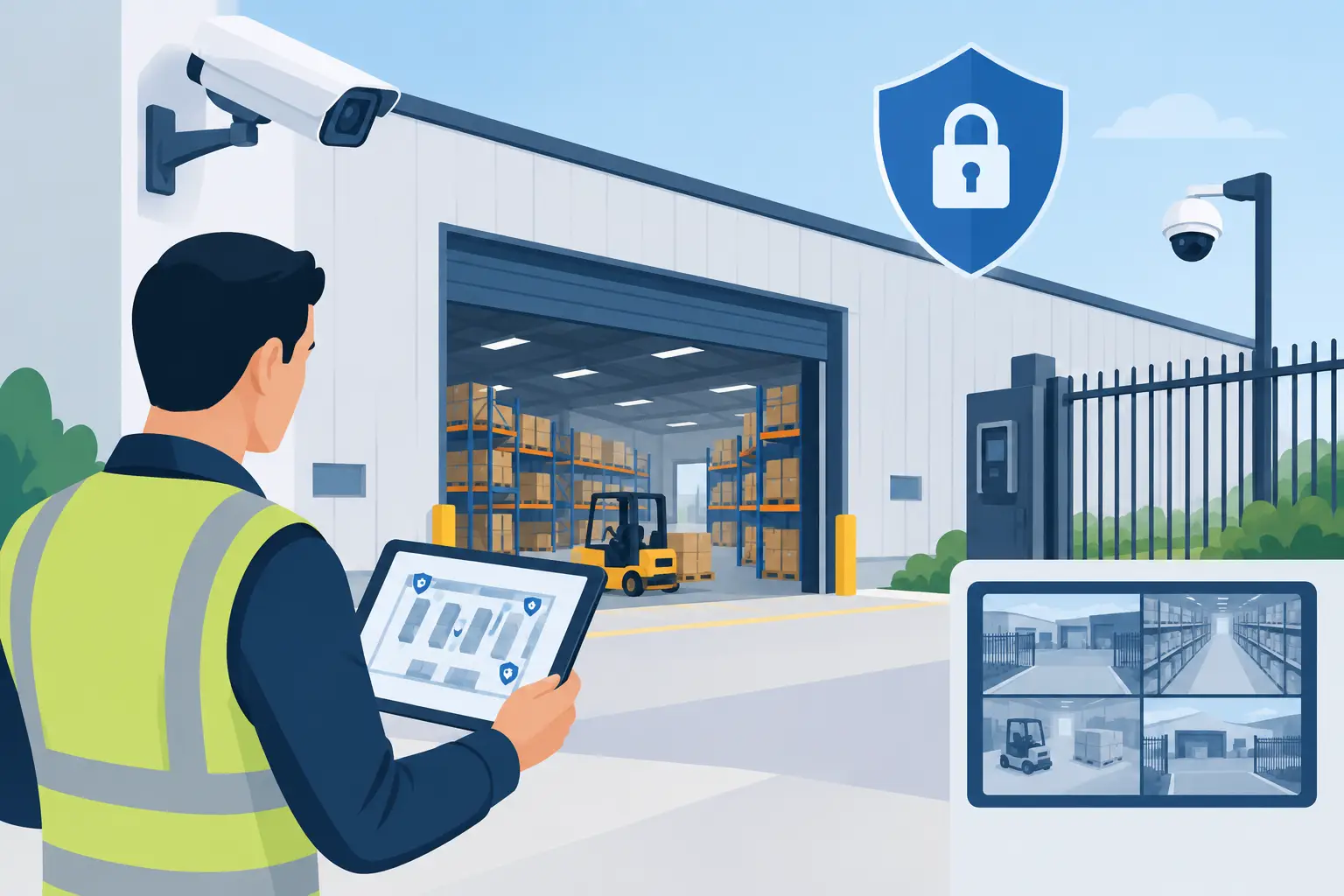
A warehouse security upgrade should begin at the perimeter, not at the office door. If vehicles, contractors or unauthorised visitors can reach loading areas without challenge, cameras and alarms are left reacting to a problem rather than helping prevent it. The right combination of fencing, gates and controlled access gives site managers a clearer view of who enters, where they go and when they leave.
For UK warehouses, the best solution is rarely a single product. Security needs to account for the layout of the site, vehicle movements, operating hours, neighbouring properties and the value of stock held inside. A well-planned perimeter should protect the premises while keeping deliveries, staff access and emergency procedures practical.
Start with the risks on your site
Every site has weak points. A warehouse beside a public road may need stronger frontage control, while a unit on an industrial estate may be more exposed at the rear boundary or around a service yard. Before choosing a gate or access system, look at how the site is actually used throughout the day and after closing.
Consider where lorries wait, where staff park, whether pedestrians share a vehicle entrance and how often the gate must open. A gate that looks substantial but creates queues at a busy loading bay can encourage unsafe workarounds. Equally, an entrance that is convenient for regular deliveries but open to anyone outside working hours leaves a clear gap in the perimeter.
It is also worth reviewing the condition of existing fencing, posts, walls and gate foundations. Replacing a gate without addressing a damaged boundary simply moves the weak point a few metres along. A site survey helps establish the opening size, ground levels, drainage, power availability and the clear space needed for the gate to operate safely.
Choose commercial gates for traffic and space
The choice between a sliding gate and a swing gate often comes down to available space and the type of traffic using the entrance. Both can form part of an effective warehouse security upgrade when specified correctly.
A sliding gate is usually a practical choice for wider entrances, frequent vehicle movements and sites where the gate must remain within the line of the boundary. It does not swing into a road or yard, which can be useful where space is tight. Cantilever sliding systems can also avoid a track across the driveway, reducing disruption from dirt, grit and standing water. However, they need sufficient run-back space beside the opening.
Swing gates can suit narrower openings or premises with adequate space inside the boundary. They offer a smart, clear entrance and can be a cost-effective option for lower-traffic sites. The ground must be level enough for reliable operation, and the gate leaves need room to open without obstructing parking bays, footpaths or delivery routes.
Aluminium commercial gates offer a strong, low-maintenance alternative to traditional timber and many steel designs. They do not rust, are lighter to automate and can be manufactured in a range of solid, slatted or decorative styles. For a warehouse, a more closed design can limit views into the yard, while a slatted arrangement may provide security without making the frontage feel overly enclosed. The appropriate specification depends on the security requirement, wind exposure and the desired site appearance.
Make access control part of the gate design
A gate only improves security when access is managed consistently. Manual keys can be suitable for a small site with a limited number of authorised users, but they become difficult to control when staff change, contractors attend or multiple shifts operate. Lost keys and copied keys can leave uncertainty long after they have gone missing.
Automated gates allow access rules to be set around the way a warehouse operates. Staff may use remote controls, keypads, fobs or mobile-enabled systems, while regular delivery drivers can be admitted by a member of staff. An intercom provides a direct point of contact for visitors and gives the person responsible for access the opportunity to verify who is at the entrance before opening it.
Akuvox intercom systems can be particularly useful where staff are not stationed at the gate. Video calling allows a receptionist, manager or authorised team member to identify a visitor and release the entrance where appropriate. This is more practical than leaving gates open during the day simply because nobody is available to walk across the yard.
Access control should be matched to the level of risk. A smaller warehouse with daytime operations may need a straightforward automated gate and video intercom. A high-value storage facility, multi-tenant site or premises operating overnight may require separate pedestrian access, time-based permissions and a process for recording visitors. Technology helps, but staff need clear procedures for using it.
Do not overlook pedestrian routes
Many warehouses focus on vehicle gates and forget that a side path, staff entrance or gap beside the loading area may offer an easier route onto the premises. A dedicated pedestrian gate helps keep people separate from moving vehicles and avoids the unsafe practice of staff walking through an automated vehicle entrance.
Pedestrian gates can be integrated with the same fencing and gate style to create a consistent perimeter. They can also carry their own keypad, fob reader or intercom. On sites with frequent visitors, clear signage and a defined route from the entrance to reception reduce confusion and make it easier to spot anyone who is where they should not be.
Emergency access must remain part of the design. Gates should be installed with appropriate safety equipment, release arrangements and controls that suit the site’s fire and evacuation procedures. These details should be considered before installation, not added as an afterthought when the system is already in place.
Specify for reliability, not just first cost
The cheapest gate is not always the lowest-cost option over its working life. Warehouse entrances are exposed to rain, frost, vehicle fumes, daily use and occasional impact. A poorly matched gate or automation system can soon require repairs, create downtime and frustrate staff who depend on it.
Aluminium is valued for being lightweight, durable and low maintenance. It will not require the regular painting and treatment associated with timber, and it avoids the corrosion concerns that can affect untreated or damaged steel. That said, no gate is maintenance-free in the sense that it can be ignored. Hinges, tracks, safety devices, motors and control equipment should be inspected and serviced in line with usage and manufacturer guidance.
Automation should be selected for the size, weight and expected duty cycle of the gate. A warehouse gate opening a few times each day has different demands from one serving a busy distribution yard. Allowing for future growth is sensible too. If deliveries are expected to increase, choose a system capable of supporting the likely level of use rather than replacing the operator prematurely.
Plan installation around the working site
Security improvements must be installed without creating unnecessary disruption. For warehouses with daily deliveries, timing matters. A phased installation or a planned temporary access arrangement can keep the site operating while foundations, posts, gates and automation are completed.
Professional installation also matters for safety and long-term performance. Gate alignment, post stability, electrical work and safety features all affect how reliably the system works. A gate that is correctly manufactured but poorly installed may drag, fail to close properly or put strain on the automation.
At Aluminium Gates Direct, commercial customers can choose from made-to-order and readymade gate options, with guidance on the most suitable design, automation and access control arrangement. Installation support through a trusted partner network can make it easier to coordinate the project wherever the site is located in the UK.
A better perimeter supports a better-run warehouse
The aim is not to make a warehouse feel inaccessible to legitimate staff, drivers and visitors. It is to make entry controlled, visible and reliable. When the perimeter reflects how the site genuinely operates, security becomes part of the daily routine rather than an obstacle to it.
Before committing to a design, gather accurate opening measurements, photographs of the entrance and details of the traffic using it. A short conversation with a gate specialist can then turn those practical details into a warehouse security upgrade that protects the premises, suits the budget and continues to work well as the business grows.