
A commercial gate has to do more than mark a boundary. It may need to control vehicle movements at a busy depot, protect equipment at a construction site, manage visitor access at offices or improve the appearance of a residential development. The best commercial gate options are therefore the ones that suit the site’s daily traffic, available space, security requirements and long-term maintenance budget – not simply the tallest or heaviest design.
For many UK businesses and property managers, aluminium offers a particularly practical starting point. It is strong yet lightweight, will not rust like untreated steel and does not require the regular staining, painting or repair associated with timber. Combined with the right automation and access control, an aluminium gate can provide a professional, dependable entrance without creating an ongoing maintenance burden.
Start with how the entrance will be used
Before choosing a gate style, consider who uses the entrance and how often. A low-traffic staff car park has different needs from a logistics yard with regular van and lorry movements. The width of the opening, gradient of the driveway, road position and space behind or beside the gate all affect what can be installed safely.
Security should also be defined clearly. Some sites require a visible deterrent and controlled visitor entry; others need a more secure perimeter to reduce unauthorised vehicle access outside working hours. A gate should complement the wider boundary treatment, including fencing, railings, walls, lighting and any existing CCTV, rather than operate as an isolated feature.
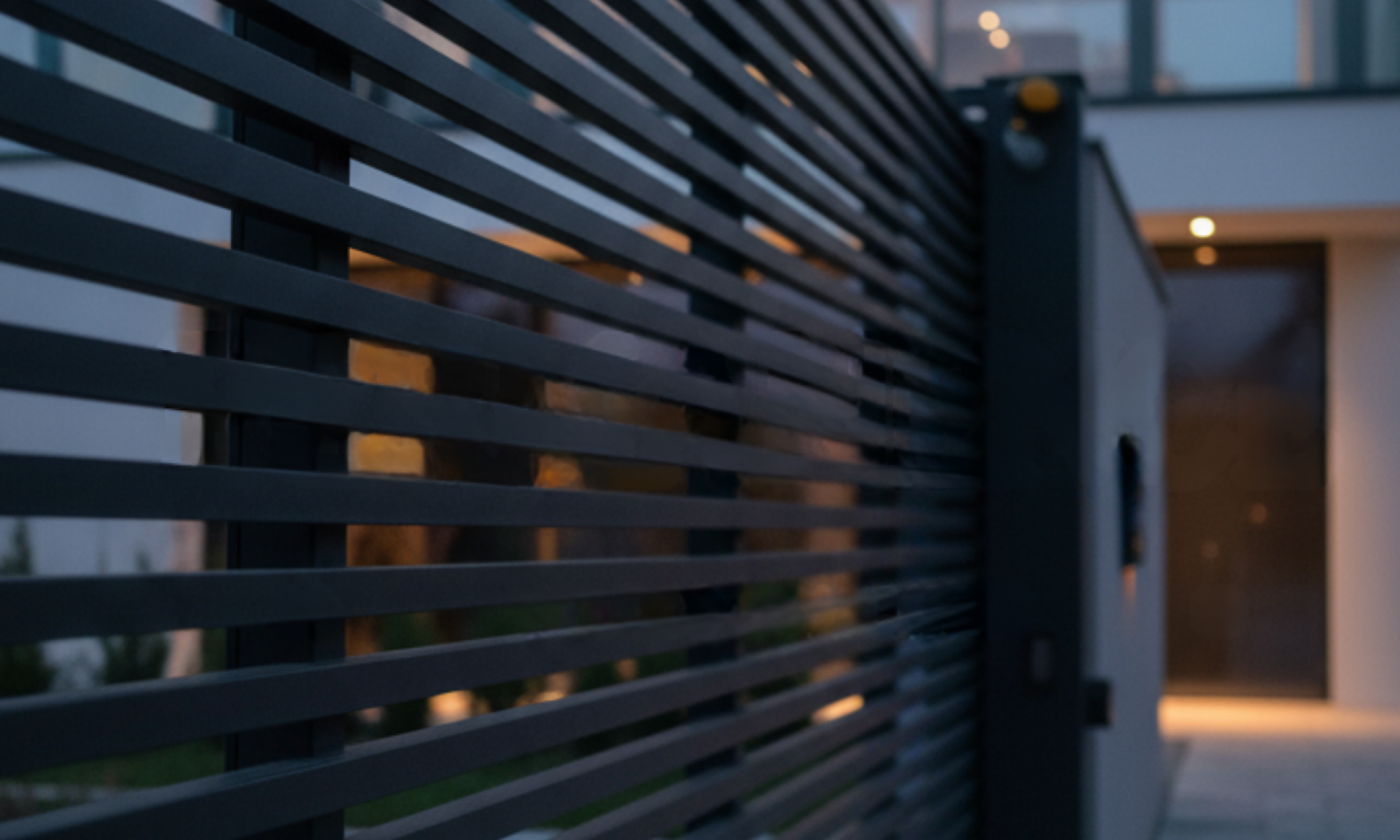
Appearance still matters. A clean, well-specified entrance gives visitors, tenants and customers confidence in the site. Aluminium gates are available in contemporary slatted, solid-panel and decorative designs, with a broad choice of powder-coated colours. This makes it possible to meet practical access requirements while keeping the frontage consistent with the building or brand setting.
Best commercial gate options by site layout
Sliding gates for busy or restricted entrances
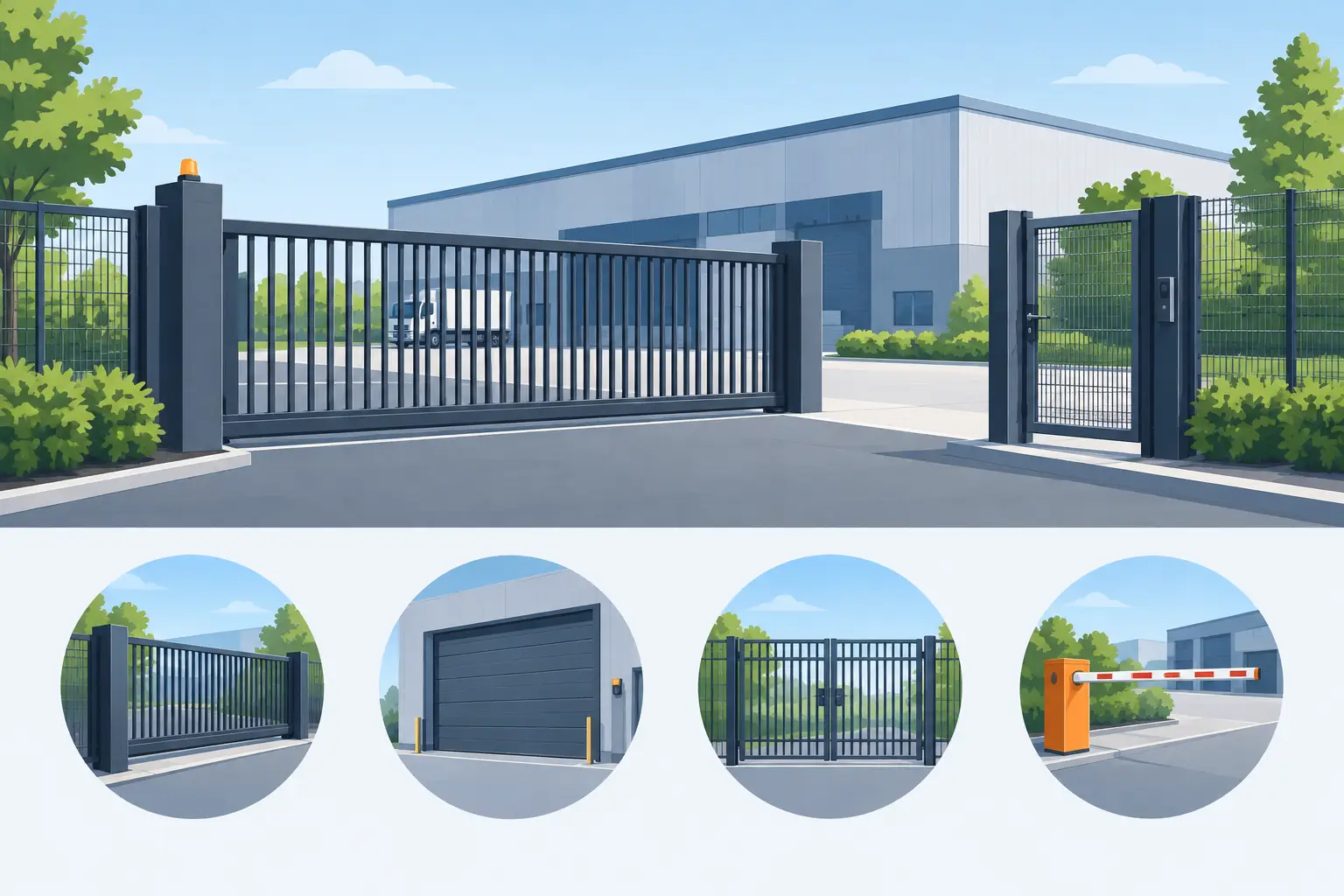
Sliding gates are often the strongest choice for commercial entrances with frequent vehicle movements or limited swing space. Rather than opening into the drive or out towards the road, the gate travels horizontally along the fence line. This can make them well suited to industrial estates, commercial yards, flat developments and sites where vehicles need a clear route through the opening.
A cantilever sliding gate is supported above ground and does not rely on a track across the driveway. That can be useful where debris, leaves, mud or uneven surfaces could affect a tracked system. Tracked sliding gates can also work effectively, but the track needs to be kept clear as part of routine site maintenance.
The trade-off is that a sliding gate needs sufficient run-back space to one side of the opening. On a constrained frontage, the required length may rule it out. Sliding systems also need properly designed foundations, posts and automation, especially for wide openings or solid privacy panels that are exposed to wind.
Swing gates for straightforward access and presentation
Swing gates remain a popular commercial option for offices, private parking areas, smaller yards and managed developments. They can be supplied as single-leaf or double-leaf gates, opening inwards where the site layout allows. Double gates are often a cost-effective way to cover wider entrances without needing the side clearance of a sliding gate.
For lower-use entrances, a manual swing gate may be suitable. In most commercial settings, however, automation offers a better experience for authorised users and reduces the temptation for staff to leave gates open. Aluminium is especially helpful here because its lighter weight places less demand on hinges, posts and gate motors than many comparable steel designs.
Swing gates do require a clear opening arc. They should never open across a public pavement or carriageway, and a sloping drive can complicate the installation. If a vehicle regularly stops close to the entrance, a sliding arrangement may be more practical.
Pedestrian gates for controlled foot access
A vehicle gate should not be the only route for staff, visitors or contractors on foot. A matching pedestrian gate provides a safer, more convenient access point and can be integrated with an intercom, keypad, card reader or proximity control.
Separating pedestrian and vehicle movements is particularly valuable at schools, warehouses, offices and multi-unit sites. It helps prevent people from walking through an automated vehicle entrance and gives the site manager clearer control over who can enter. A self-closing pedestrian gate may be appropriate where the perimeter must remain secure throughout the day.
Telescopic and bi-folding gates where speed is critical
Where there is limited run-back space but a fast opening cycle is needed, telescopic or bi-folding commercial gates may be considered. Telescopic sliding gates use multiple leaves that slide together, reducing the side space needed compared with a single-leaf sliding gate. Bi-folding gates fold as they open and can clear an entrance quickly.
These systems can be effective for high-demand sites, but they involve more moving parts and require careful specification, installation and servicing. They are not automatically the best answer for every site. A conventional sliding or swing gate can be simpler and more economical where opening speed is not the deciding factor.
Choosing aluminium for a commercial entrance
The material of the gate affects both performance and whole-life cost. Aluminium does not corrode in the same way as steel, making it a strong choice for exposed UK locations, coastal areas and entrances that receive regular rain and road spray. Its powder-coated finish is designed to retain a smart appearance with simple periodic cleaning.
The lower weight of aluminium can also make large gates easier to automate and helps reduce strain on operating components. That does not mean specification can be overlooked. Gate frames, infill panels, posts, hinges, rollers and foundations must all be matched to the opening width, gate height, wind exposure and operating method.
Privacy is another consideration. Solid or closely spaced aluminium panels can screen parking areas, bins or equipment, while slatted designs allow airflow and create a more open look. On a windy site, more open infill can reduce wind loading. A specialist supplier can advise on the balance between privacy, security and the practical demands placed on the gate structure.
Automation and access control should be planned together
Automation turns a physical barrier into a controlled entrance. The appropriate system depends on the people using it and the level of oversight required. A staff-only car park may use remote controls, fobs or keypads. A commercial premises with regular deliveries may benefit from an intercom that lets reception verify a visitor before releasing the gate.
Akuvox intercom systems can provide a useful option for sites that want video calling and managed entry from a suitable internal device. For larger or more sensitive premises, access control may be combined with timed permissions, credentials for different user groups and integration with the wider security approach.
Safety is not an optional extra. Automated gates must be designed and installed with suitable safety measures to reduce trapping, crushing, impact and entrapment risks. Depending on the arrangement, this may include photocells, safety edges, warning signage, appropriate controls and a manual release method for power failures. Commercial operators should also be inspected and maintained at suitable intervals, particularly on entrances with heavy daily use.
Specify for the site, not just the opening size
A gate quotation is more useful when it reflects the full project rather than only the width between two posts. The supplier or installer will normally need to understand the clear opening, desired height, ground levels, surface condition, available power supply, use of the entrance and preferred access controls. Photos and a basic site plan can help identify issues early.
For new developments, bringing the gate specification into the design process early can avoid expensive changes later. Space for gate travel, safe vehicle waiting areas, cable routes, drainage and foundations should be considered alongside landscaping and fencing. A gate that looks right on a drawing can become difficult to operate if a parked vehicle, retaining wall or change in level interferes with its movement.
There is also a choice between readymade and bespoke commercial gates. Readymade options can suit standard openings and timescales, while bespoke aluminium gates give greater freedom over dimensions, infill style, colour and matching pedestrian access. The right route depends on whether speed, budget or a precise architectural finish is the main priority.
Get practical advice before committing
The most successful commercial gate projects begin with a realistic view of how the site operates each day. A well-chosen aluminium sliding, swing or pedestrian gate can improve security, access and presentation for years, provided the design, automation and safety features are properly matched to the location.
If you are comparing options, speak to a specialist with your opening dimensions, site photographs and access requirements to hand. Aluminium Gates Direct can help you work through suitable gate styles, bespoke possibilities, automation and installation support, so the finished entrance feels considered from the first vehicle through it.