
A broken boundary usually shows up too late – after a delivery has gone missing, vehicles have accessed the wrong area, or staff have started raising concerns about site safety. A good commercial perimeter security guide starts with that reality. Perimeter security is not just about putting a gate at the entrance. It is about controlling access, protecting people and assets, and making sure the whole boundary works as one system.
For commercial sites, the right solution depends on what you need the perimeter to do every day. A warehouse has different pressures from a school, business park, depot or mixed-use development. Vehicle movements, pedestrian access, operating hours, appearance, budget and maintenance all matter. That is why the best results usually come from specifying the full perimeter properly rather than treating gates, fencing and access control as separate purchases.
What commercial perimeter security needs to achieve
At a basic level, commercial perimeter security has three jobs. It needs to deter opportunistic access, control authorised entry, and present the site professionally. If one of those is missing, the perimeter can quickly become a weak point.
Deterrence is often underestimated. A boundary that looks poorly defined or easy to breach sends the wrong message. Clear lines, well-designed gates and consistent fencing make it obvious where access is and who is supposed to use it. That alone can reduce casual trespass and out-of-hours misuse.
Control is the next step. On many sites, the question is not whether people can enter, but whether the right people can enter at the right times. That may mean separating vehicle access from pedestrian routes, limiting entry to certain hours, or using intercom and automation systems to manage deliveries and visitors without leaving gates open.
Presentation matters too. For offices, residential developments, schools and customer-facing premises, perimeter security is part of the site frontage. It should look considered rather than purely defensive. This is often where aluminium becomes a practical choice, because it offers strength, clean design and long-term durability without the upkeep associated with timber or the corrosion risk that can come with untreated steel.
A commercial perimeter security guide to the key components
The most effective perimeter schemes work because each element supports the others. If the gate is strong but the adjacent fencing is weak, the boundary is only as secure as its easiest point of failure. The same applies if access control is advanced but the entrance layout encourages tailgating or confusion.
Gates
Commercial gates do the heaviest visible work in most perimeter systems. They manage access, set the tone for the site and often carry the burden of daily use. The first decision is usually between swing gates and sliding gates.
Swing gates can be a good fit where there is enough internal clearance and vehicle flow is manageable. They suit many offices, flat developments and lower-volume commercial entrances. Sliding gates are often better for sites where space is limited, traffic is heavier, or a more controlled access point is required. They can also be a sensible option where gradients make swing operation less practical.
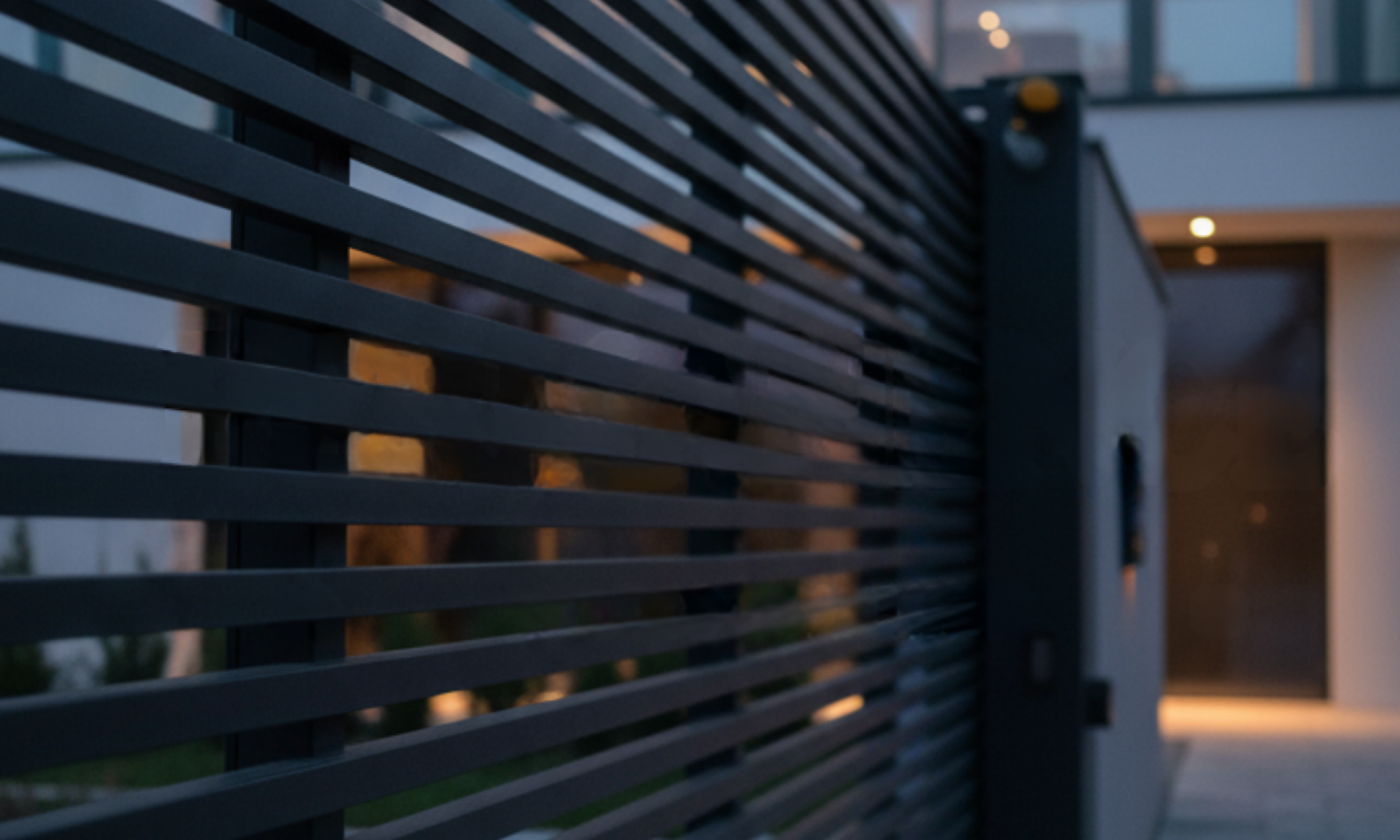
Material choice matters here. Aluminium gates are especially useful for commercial settings because they are lightweight yet strong, and they require very little maintenance over time. That lower operating weight can also benefit automation performance and reduce strain on components compared with heavier alternatives.
Fencing and railings
Fencing should match the gate in both function and specification. A perimeter with mismatched heights, inconsistent infill or weak returns can create obvious vulnerabilities. For some sites, railings are the right choice where visibility and appearance are priorities. In higher-security settings, more enclosed or taller systems may be more appropriate.
The right answer depends on what you are trying to prevent. If the aim is to mark boundaries and discourage unauthorised entry, a simpler system may be enough. If you are protecting stock, equipment or restricted operational areas, a more defensive specification is usually needed.
Access control and intercoms
Physical security only goes so far without controlled entry. Automation and intercom systems allow a site to operate safely without relying on gates being manually opened or left unsecured. For commercial buyers, this is often where convenience and security meet.
An intercom system can help reception teams, site managers or residents verify visitors before granting access. Automation helps ensure gates close properly after use and reduces the temptation to prop entrances open during busy periods. The right setup depends on usage levels, user types and whether you need keypad, fob, app-based or remote management options.
Start with a site assessment, not a product list
One of the most common mistakes in perimeter projects is choosing products too early. A smarter approach is to assess how the site actually functions. That means looking at who needs access, how often, by what route and at what times.
For example, a trade yard with regular HGV movements will need a different entrance layout from a private car park serving office staff. A school may need strict separation between staff vehicles, visitors and pedestrian pupils. A residential block may prioritise reliable remote access and a clean, high-end appearance.
It also helps to consider the less obvious details. Is there enough run-back space for a sliding gate? Will a swing gate interfere with parking or circulation? Is the ground level suitable for automation equipment? Will delivery drivers understand where to stop and request entry? Practical questions like these often determine whether a perimeter works smoothly or becomes a daily frustration.
Balancing security, maintenance and budget
Every commercial project has constraints, and budget is usually one of them. The key is to think beyond upfront cost. A lower-cost perimeter may look attractive on paper but become more expensive if it needs frequent maintenance, repainting, repairs or component replacement.
This is where aluminium has a clear advantage for many buyers. It does not rust in the same way as steel, it is easier to maintain than timber, and it keeps its appearance well over time. For developers and site managers, that can mean fewer ongoing headaches and a more predictable long-term spend.
That said, there is no single right specification for every project. Some sites need a fully bespoke solution because access widths, aesthetics or operational requirements are unusual. Others are better served by a readymade gate system that delivers the right level of performance without stretching the budget unnecessarily. Good advice should help you find the right fit rather than push you towards over-specification.
Why bespoke design can make commercial sites work better
Commercial projects rarely fit neatly into standard sizes. Entrances may be wider than average, boundary lines may be awkward, or planning and visual requirements may shape what is possible. In those cases, bespoke design is not a luxury. It is often the most practical route to getting the perimeter right.
A bespoke gate and fencing package can improve both function and appearance. It allows the entrance to be sized correctly for vehicle use, aligned with the architecture of the site and matched to the level of privacy or visibility required. For customer-facing businesses and new developments, that design consistency can make a real difference to first impressions.
Just as importantly, a tailored approach can avoid compromises that create operational issues later. A gate that is slightly too narrow, too heavy, or poorly positioned may still work, but it will not work well.
Installation and aftercare matter more than many buyers expect
Even the best perimeter products can underperform if they are installed badly or specified without enough technical support. Foundations, levels, hinge posts, automation setup and safety features all need to be right. Commercial buyers should also think about who will support the project if adjustments are needed after installation.
This is why many customers value working with a specialist supplier that can support product selection and connect installation through an experienced network. Aluminium Gates Direct works with customers across the UK on projects that range from straightforward gate replacements to fully integrated perimeter schemes, helping buyers match the right products to their site, budget and usage.
Aftercare should not be overlooked either. Low-maintenance does not mean no-maintenance. Gates and automation systems still benefit from checks, servicing and sensible use. Planning for that from the start helps protect the investment.
Choosing the right commercial perimeter security guide for your site
If you are reviewing options for a commercial site, the best place to start is with the day-to-day reality of the entrance and boundary. Think about who uses it, what needs protecting, how the site should look and how much maintenance you want to take on over the years.
From there, the right perimeter usually becomes clearer. Some sites need the clean efficiency of an automated sliding gate and integrated intercom. Others need a cost-conscious combination of strong fencing and manual access points. Many need a balance of security, appearance and durability rather than a maximum-security approach.
The best perimeter security is the kind that feels considered from every angle – practical for staff, clear for visitors, dependable over time and appropriate for the site it protects. If your boundary is due for an upgrade, it is worth treating it as a complete system rather than a single product purchase. That is usually where better decisions, and better long-term results, begin.