
A bespoke gate should fit more than the opening between two posts. It needs to suit how you arrive home, who uses the entrance, the level of privacy you want and, crucially, the conditions on site. Knowing how to order bespoke gates properly means resolving those practical details before manufacturing begins, rather than trying to correct them after delivery.
For a driveway, garden entrance or commercial perimeter, aluminium is often the sensible starting point. It is lightweight, strong, corrosion-resistant and does not require the regular sanding, painting or staining associated with timber. The bespoke process then gives you the freedom to specify the size, layout, colour, infill style and access controls around the property rather than settling for a near match.
How to order bespoke gates: begin with the site
The best gate designs start with accurate information, not a catalogue image. A gate can look excellent in isolation but prove unsuitable if the driveway rises sharply, there is limited room to open the leaves, or the existing pillars are not capable of carrying the weight and movement of an automated system.
Measure the clear opening at the bottom, middle and top. Openings are not always square, particularly on older properties, and the smallest measurement may determine the usable gate width. Record the height you want from finished ground level, then check whether the ground slopes across or through the opening. A swing gate needs sufficient clearance at the lowest point of its arc; a sliding gate needs a clear run-back area to one side.
Photographs are equally useful. Take images looking towards and away from the entrance, showing the posts or pillars, the driveway surface, nearby walls, services and any change in level. For sliding gates, include the full length of the proposed travel area. This gives the supplier or installation partner the context that measurements alone cannot provide.
If there is any doubt about structural suitability, arrange a site survey. This is particularly worthwhile for wide driveway gates, automated gates, gates fixed to existing masonry or commercial entrances with regular traffic. A survey can identify whether new steel or aluminium posts, reinforced foundations, drainage work or a different opening method would be more appropriate.
Choose the opening style before the appearance
Bespoke aluminium gates can be made as single pedestrian gates, bi-folding designs, double swing gates or sliding gates. Each has a place, and the right choice depends on the entrance rather than simply personal preference.
Double swing gates are a familiar, attractive option where there is enough level space inside the property for the leaves to open. They can create a traditional or contemporary frontage and work well for many domestic driveways. However, an outward-opening gate may require additional consideration near a public pavement or road, while steep driveways can restrict the available clearance.
A sliding gate is often better where space behind the entrance is limited or where a driveway slopes upwards. It travels sideways rather than into the property, but it needs room beside the opening for the gate to park when open. Cantilever sliding systems can be useful where a track across the driveway would be impractical, although they typically require more run-back space and a carefully designed supporting structure.
For pedestrian access, think about daily use. A separate matching side gate may be more convenient than opening a large driveway gate for visitors, bins or deliveries. On a commercial site, it may also help separate foot traffic from vehicle movements and make access control easier to manage.
Match the design to privacy, security and the property
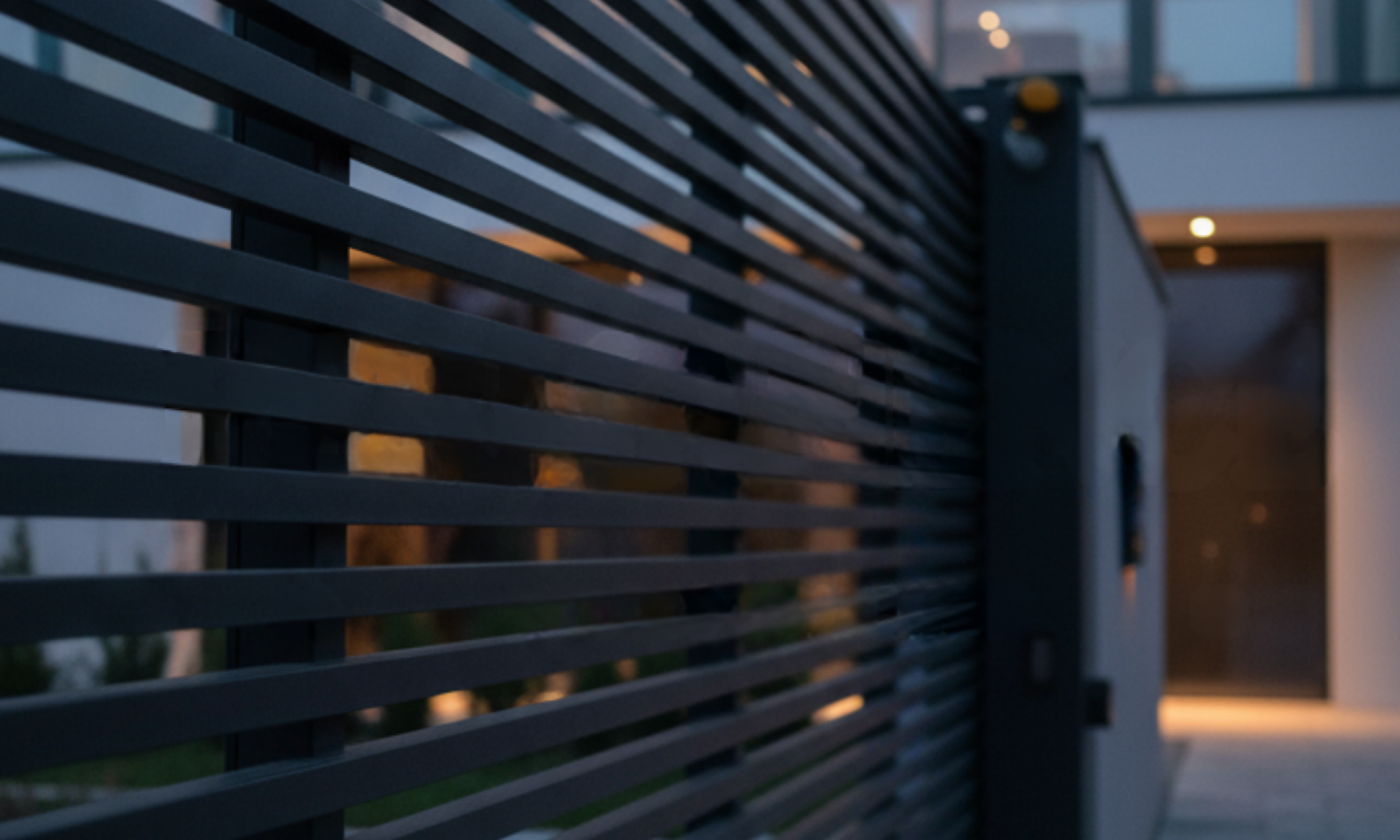
Once the operating style is clear, the visual design becomes a more productive conversation. Aluminium offers considerable flexibility, from clean horizontal slats and solid privacy panels to vertical bars, decorative inserts and more ornate designs. The question is not simply which style looks best, but what the gate needs to do.
A closely boarded or solid-panelled design gives greater privacy and can soften views from the road into a garden or driveway. It may be the right choice for a property on a busy street. Open slatted and bar designs allow more light and visibility, which can be preferable where sightlines are important or where a more open boundary is wanted. The spacing and orientation of slats can make a meaningful difference to both appearance and privacy.
Colour should be considered alongside window frames, doors, fencing and railings. Popular anthracite and black finishes provide a modern look, while bespoke powder-coated colours can help the gate sit naturally within a period property or a defined architectural scheme. Powder coating gives aluminium a durable finish, but it is still worth choosing a colour that will remain appealing as the property evolves.
Do not overlook the gate frame, posts, hinges and latch position. These details affect strength, day-to-day use and the finished look. A well-specified aluminium gate should feel substantial without placing unnecessary load on posts and automation equipment.
Plan automation and access control early
Automation works best when it is built into the specification from the outset. Retrofitting is possible in some cases, but early planning avoids compromises around hinge geometry, underground cabling, safety devices and control equipment.
Decide who needs access and how they will use the gate. A simple remote-control system may suit a private driveway. A keypad, proximity fob, GSM calling system or Akuvox intercom may be more suitable where visitors, deliveries, multiple residents or staff need controlled entry. Video intercoms can provide an added level of reassurance by allowing occupants to identify visitors before granting access.
Every automated gate must be designed with safety in mind. That includes suitable safety edges, photocells, force settings, emergency release arrangements and controls positioned away from moving parts. The exact requirements vary with the gate type and site, which is another reason to involve a knowledgeable supplier and experienced installer at the quotation stage.
Power supply is often one of the first practical questions. Find out where the electrical feed will come from, how cables will be protected and whether groundwork is required before installation. If the entrance is some distance from the property, this can affect both programme and cost. Solar-powered options may suit certain lower-use locations, but they depend on the site, available light and the demands of the automation system.
Give enough detail for a clear bespoke quotation
A useful quotation should make it easy to understand what is included. When requesting one, provide your opening measurements, preferred gate type, approximate height, design references, colour preference and whether automation or intercom access is required. State whether you need supply only or support with installation.
It also helps to explain the intended use. A family driveway used several times a day needs a different specification from a gated development, warehouse entrance or garden side gate. Commercial and shared-access sites may need more durable duty ratings, controlled entry credentials and clearer arrangements for pedestrians.
Ask for clarity on the gate leaves, frame, posts, hinges or track system, locking, automation equipment, safety accessories, delivery and installation. If groundwork, electrical works, removal of existing gates or brickwork alterations are not included, knowing this early lets you plan the wider project properly. The lowest initial price is not always the best value if important elements have been left out.
At Aluminium Gates Direct, bespoke projects can be discussed around the property, budget and intended use, with nationwide installation support available through trusted partners. A direct conversation before ordering is often the quickest way to establish whether a made-to-measure solution or a readymade option is the better fit.
Approve drawings and specifications carefully
Before manufacturing starts, review the final drawing or specification line by line. Confirm the overall width and height, leaf split for double gates, direction of opening, hinge side, infill design, post arrangement, colour and any automation preparation. Check that the drawing reflects the view from the correct side of the gate, especially where slats, handles, letterboxes or decorative features have a front and back.
This stage matters because bespoke products are made specifically for your site. Changes after fabrication has started may cause delays or additional cost. A few careful minutes spent comparing the approved drawing with your site measurements can prevent much larger problems later.
If an installer is involved, make sure they receive the final specification too. They need to know the weight, fixing requirements, cable routes, operating direction and automation plan before arriving on site. Good coordination is particularly valuable where builders, electricians, landscapers and driveway contractors are working around the same entrance.
Prepare for delivery and installation
Bespoke gates are usually manufactured to order, so lead times will vary with the design, finish, season and level of project complexity. Use that period to complete foundations, posts, electrical ducts, driveway finishes and any walling work required. Avoid laying a final surface too early if cable runs or ground tracks are still needed.
On delivery day, ensure there is safe access for unloading and a dry, secure area for components if installation is not immediate. Once fitted, automated gates should be commissioned, safety checked and demonstrated. Keep the manuals, remotes, release key and any intercom instructions somewhere accessible.
A properly specified aluminium gate is a long-term improvement to the security and appearance of a property. Bring clear measurements, honest site information and a practical wish list to the first conversation, and the ordering process becomes far more straightforward.