
A garden gate can look straightforward until the measurements are taken and the finished gate arrives a little too wide, too short or awkward against a slope. That is why knowing how to measure for garden gates properly matters before you choose a style, material or opening type. A few careful checks at the start can save time, extra cost and fitting problems later.
For homeowners, builders and trade buyers alike, the goal is simple – get a gate that fits the opening, works smoothly and looks right on the property. The best approach is to measure the actual opening rather than guess from an old gate, and to take those measurements with the gate posts, hinges, latch position and ground levels in mind.
How to measure for garden gates without guesswork
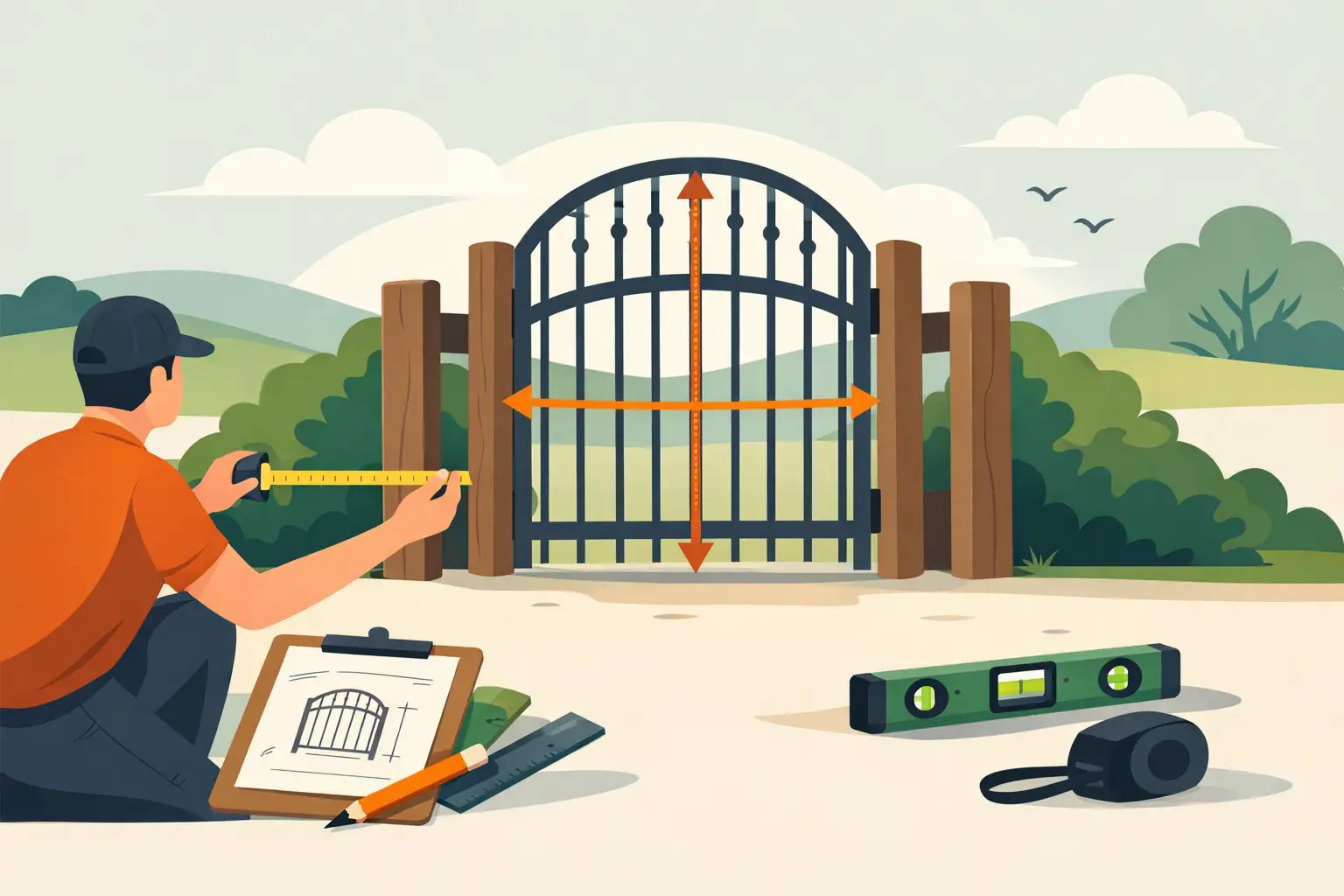
Start with the opening itself. If there is no gate in place yet, measure the clear distance between the inside faces of the posts, walls or pillars where the gate will sit. Take that width in millimetres, not centimetres, as this gives a more precise basis for manufacture or selection.
If you are replacing an existing gate, do not rely on the old gate size alone. Existing gates are often undersized to allow for warped timber, worn hinges or uneven posts. Measure the opening independently, then compare that figure with the current gate only as a reference.
Width should be checked in three places – near the top, middle and bottom of the opening. This matters because many openings are not perfectly square. Brick piers can taper slightly, timber posts can shift over time and older boundaries are rarely exact. Use the narrowest width as your working measurement unless a supplier advises otherwise.
Height needs the same care. Measure from the finished ground level up to the desired top of gate, and take this on both sides of the opening. If the ground slopes, record the difference. A gate installed across a level threshold behaves differently from one fitted over a rising path, uneven paving or soft garden ground.
The measurements that matter most
When customers ask how to measure for garden gates, they often focus only on the opening width. In practice, there are several dimensions that affect the final fit.
Opening width
This is the clear structural gap between the supports. For a single garden gate, it is usually the main starting point. For a pair of gates, measure the full width between posts and note whether you want equal leaves or one active leaf and one fixed or secondary leaf.
Gate height
This is not always the same as fence height. Some customers prefer the gate to line through with adjacent fencing. Others want a slightly taller gate for privacy or security, or a lower gate at the side of a property to keep the front aspect more open. Measure to the practical finished height, not simply to the top of a nearby panel.
Post sizes and positions
If posts are already in place, note their dimensions and material. If posts are still to be installed, that changes the measuring process slightly, as the finished opening can be planned around the gate rather than the other way round. This can be useful when ordering bespoke aluminium gates, as it allows better control over proportions and fitting tolerances.
Ground clearance
A gate needs enough clearance at the bottom to open freely. Gravel, block paving, grass and sloping paths all affect this. Too little clearance and the gate may catch. Too much and you may be left with an unattractive gap or reduced privacy. The right allowance depends on the site and the gate style.
Check the site, not just the tape measure
A technically correct width can still lead to problems if the site conditions are ignored. Before ordering, stand in the opening and look at how the gate will actually operate.
Ask yourself which way the gate should open. Inward opening is common for residential side gates, but the available space inside the boundary matters. If there is a step, raised patio, parked car area or uneven path behind the gate, the opening arc needs checking. Outward opening may be possible in some settings, but not where it interferes with public footpaths or access.
Also look at the hinge side. The structure carrying the gate must be sound enough for the gate weight and frequent use. Aluminium has a real advantage here because it is lightweight as well as strong, which reduces strain on posts and hardware compared with heavier materials. Even so, the fixing point still needs to be stable and suitable.
Latch position is another detail people often leave until later. If the gate is fitted between brick piers, for example, make sure there is enough practical space for the latch, keep and any lock or access control hardware.
Measuring openings on a slope
Sloping ground is one of the most common reasons for ordering delays or installation adjustments. If the path rises across the gate opening, a standard square-bottomed gate may not clear the ground once it begins to swing. That does not mean the project is a problem, but it does mean the slope must be measured clearly.
Place a straight edge or string line across the opening and measure the change in ground level from one side to the other. Then check how much clearance is needed at the high point and low point. In some cases, a gate with increased underclearance will work. In others, a raked bottom or an alternative hinge setup may be more appropriate.
It depends on how steep the slope is, the width of the gate and the direction of opening. A narrow pedestrian gate over a slight fall is very different from a wider side access gate opening across sharply rising paving. This is where accurate site details help a supplier recommend the right solution rather than forcing a standard fit into an awkward opening.
Single gates, pairs and made-to-measure options
For a simple side gate, measuring is usually straightforward once the opening and levels are confirmed. Pair gates need a little more planning. You will need the full opening width, but also a decision on leaf split, meeting point and whether a centre stop is needed.
Readymade gates can be a good fit where the opening closely matches standard sizes and the site is relatively straightforward. Bespoke gates are often the better choice where dimensions are unusual, where visual proportion matters or where the property needs a more tailored finish.
That is especially relevant with aluminium. Because the material is durable, low maintenance and available in a wide range of designs, many customers want the measurements to support both function and appearance. A gate that fits perfectly but looks too squat or too narrow for the opening may still feel like the wrong choice. Good measuring supports both the practical side and the finished look.
Common measuring mistakes to avoid
The most common mistake is measuring the old gate instead of the opening. The second is taking just one width measurement and assuming the posts are parallel. The third is forgetting to allow for fittings, clearances and ground movement.
Another issue is measuring before the groundworks are finished. If paving, resin, gravel grids or a new path level are still to come, your current height and clearance figures may change. It is usually better to measure from the final intended ground level rather than what is there mid-project.
Customers also sometimes overlook whether the posts are plumb. If a timber post leans slightly, the opening may appear wider than it really is in one section. Measuring at several points helps reveal this.
Finally, avoid rounding too generously. A few millimetres can matter with gate manufacturing and installation. Record exact figures and note anything unusual rather than smoothing it out.
What to have ready before you ask for a quote
A good quote starts with good information. Ideally, have the opening width at top, middle and bottom, the intended gate height, the direction of opening and a note on the ground surface. If the site is sloped, include the level change. If posts already exist, note their size and material.
Photos can also help identify details that dimensions alone do not show, such as returns on brick piers, awkward hinges from a previous gate or restricted space behind the opening. For projects involving automation, intercoms or commercial access control, the surrounding layout becomes even more important.
This is where a specialist supplier adds value. The right advice is not only about selling a gate in a given size. It is about making sure the measurement suits the gate type, the fixing method and the way the gate will be used every day. At Aluminium Gates Direct, that practical support is part of helping customers choose the right solution rather than the nearest option.
If you are unsure about a measurement, pause before ordering. A careful recheck now is far easier than correcting a gate that has been made to the wrong size, and a well-measured opening gives you the best chance of a gate that fits cleanly, works properly and looks right for years to come.