

Commercial Access Control Trends for UK Sites

Commercial Access Control Trends for UK Sites

A gate can look secure yet still leave a site exposed if access is managed with a shared remote control, an outdated keypad code or a reception team trying to verify every visitor manually. The most useful commercial access control trends are therefore not just about new technology. They are about giving site managers clearer control over who enters, when they enter and what happens when access needs to change.

For warehouses, offices, flat developments, schools, compounds and trade premises, the right system needs to work reliably in poor weather, suit the daily traffic on site and remain manageable long after installation. Below are the developments shaping commercial gate and access decisions across the UK, along with the practical questions worth asking before specifying a system.

Commercial access control trends changing site security

Mobile credentials are reducing reliance on keys and fobs

Physical keys are difficult to control once they have been copied or passed between staff. Fobs are easier to manage, but they can still be lost, retained by former employees or used without a clear record of who has them.

Mobile credentials allow authorised users to open a gate or door using a smartphone, commonly through Bluetooth, an app or a digital pass. Access can be issued, amended or withdrawn without collecting a key or arranging a new fob. This is particularly helpful for multi-site businesses, managed developments and contractors who only need access for a defined period.

Mobile access is not automatically the right answer for every location. Some teams prefer fobs for shared vehicles, workers without company smartphones or sites where phone use is restricted. A sensible specification can support more than one credential type, so permanent staff, visitors and contractors are not forced into the same method.

Video intercoms are becoming a central entry point

Commercial sites increasingly want more than an audio call button at the gate. Video intercom systems let staff see and speak to visitors before releasing access, whether they are at reception, in an office or, with the appropriate set-up, away from the property.

This can make a meaningful difference where deliveries are frequent or a reception desk is not staffed throughout the day. A driver can be checked before a sliding or swing gate is opened, while the call record gives managers greater visibility of visitor activity.

Intercom choice should reflect the environment. A small office may only need a simple internal monitor, whereas a gated development or busy commercial yard may benefit from multiple call points, app-based answering and clear camera coverage at vehicle height. Akuvox intercom systems are one option for projects that need this level of connected control, but the gate position, network connection and user requirements must be considered together rather than treated as separate purchases.

Access systems are being connected to gates, barriers and doors

A standalone automated gate is useful, but it delivers more control when it forms part of a joined-up access plan. The same authorised credential can be used to enter a vehicle gate, open a pedestrian gate and access a building or secure area. Managers can then apply different permissions to different people instead of relying on one universal code.

This approach is especially relevant on sites with separate staff parking, delivery yards, bin stores, plant areas or tenant entrances. It can also help control out-of-hours access, allowing a contractor through a pedestrian entrance without giving unrestricted vehicle access to the whole site.

The physical perimeter still matters. An access control panel cannot compensate for an undersized gate, weak fencing or a layout that lets people bypass the intended entrance. Aluminium gates and matching perimeter solutions can provide a strong, low-maintenance boundary while accommodating automation, safety devices and access equipment from the outset.

Cloud management is improving day-to-day administration

Cloud-managed access control allows authorised administrators to manage users, permissions and activity records through a secure online platform rather than only from a panel on site. For property managers and organisations with several locations, this can reduce unnecessary visits and speed up routine changes.

The advantage is control, not complexity. A manager should be able to add a new employee, remove a leaver and set time-based access without needing specialist knowledge for every adjustment. Audit trails can also help investigate a reported incident or confirm when a contractor arrived.

However, cloud access depends on suitable connectivity and sensible account management. Ask who owns the administrator account, who will retain access if a managing agent changes and how permissions are protected. Strong passwords, multi-factor authentication and regular software updates are basic requirements, not optional extras.

Visitor access is becoming more planned and less improvised

A growing number of sites are moving away from the familiar routine of leaving a gate open for deliveries or giving out a code that is never changed. Temporary passes, scheduled access windows and video verification offer a more controlled alternative.

This is valuable for builders’ merchants, storage yards, office parks and developments where several contractors may attend in one week. A visitor can receive access only for the agreed date and time, while a delivery driver can use an intercom to request entry when they arrive. The precise method depends on the site, but the aim is consistent: make legitimate access easy without turning the perimeter into an open invitation.

Cyber security now belongs in the specification

As gate automation, intercoms and access systems become connected, cyber security has become a practical purchasing issue. An internet-connected device should not be installed with its default password left in place or treated as fit-and-forget equipment.

Choose equipment from established manufacturers with a clear update process, use unique credentials and restrict administrator access to the people who genuinely need it. If cameras or access logs identify individuals, data handling must also be considered. UK GDPR responsibilities may apply, particularly around the purpose of monitoring, retention periods and who can view recorded information.

This need not make a project difficult. It simply means involving the person responsible for IT or data protection early, rather than after cables have been run and equipment has been commissioned.

Why physical gate design still sets the standard

Technology receives most of the attention, but commercial access control is only as dependable as the entrance it is fitted to. A gate must be correctly sized for vehicle movements, adequately supported and designed for the duty cycle expected. A busy site with regular lorry deliveries places very different demands on automation than a small private car park.

Sliding gates are often a good choice where space behind the entrance is limited or where vehicle movements are frequent. Swing gates can suit sites with sufficient clear space and may offer a particular architectural look. Pedestrian gates should be planned alongside vehicle access, not added as an afterthought, so staff and visitors have a safe, controlled route on foot.

Aluminium is well suited to many commercial settings because it is lightweight, strong and does not require the ongoing painting and corrosion treatment associated with some traditional materials. The reduced maintenance burden is useful for property managers responsible for keeping entrances presentable as well as secure. Bespoke sizing, infill styles and colours also make it easier to match the gate to fencing, railings and the wider development.

Specifying the right system for your site

Start with how the entrance is actually used. Consider the number of daily users, peak arrival times, vehicle types, delivery arrangements, visitor volume and whether access is needed outside normal working hours. A system that works perfectly for ten staff may cause delays for a site with shift changes and constant deliveries.

Next, decide what level of control is genuinely needed. A keypad may be appropriate for a low-risk, small team, provided codes are changed regularly. A video intercom may be more useful where visitors arrive unpredictably. Mobile credentials or managed fobs are often stronger choices when permissions change frequently. The best answer is usually proportionate to the risk, not simply the most feature-rich option.

Safety should be included from the first discussion. Automated gates require suitable safety measures, clear operating areas and professional installation. Consider emergency release arrangements, obstacle detection, visibility at the entrance and how pedestrians are kept separate from moving vehicles. Ongoing inspection and maintenance are equally important, particularly where gates operate many times each day.

Finally, appoint suppliers and installers who can support the whole project. Aluminium Gates Direct can help commercial buyers select gates, fencing, automation and intercom options that fit the site, budget and intended use, with nationwide installation support available through trusted partners. Clear drawings, cable requirements and access equipment choices before installation help prevent costly changes later.

A well-planned entrance should feel straightforward for authorised people and difficult to exploit for everyone else. Start with the traffic, risks and daily routines on your site, then build the gate, automation and access controls around them. That is how an investment in perimeter security continues to work long after the first opening cycle.
How Aluminium Gates for Slopes Should Be Planned

How Aluminium Gates for Slopes Should Be Planned

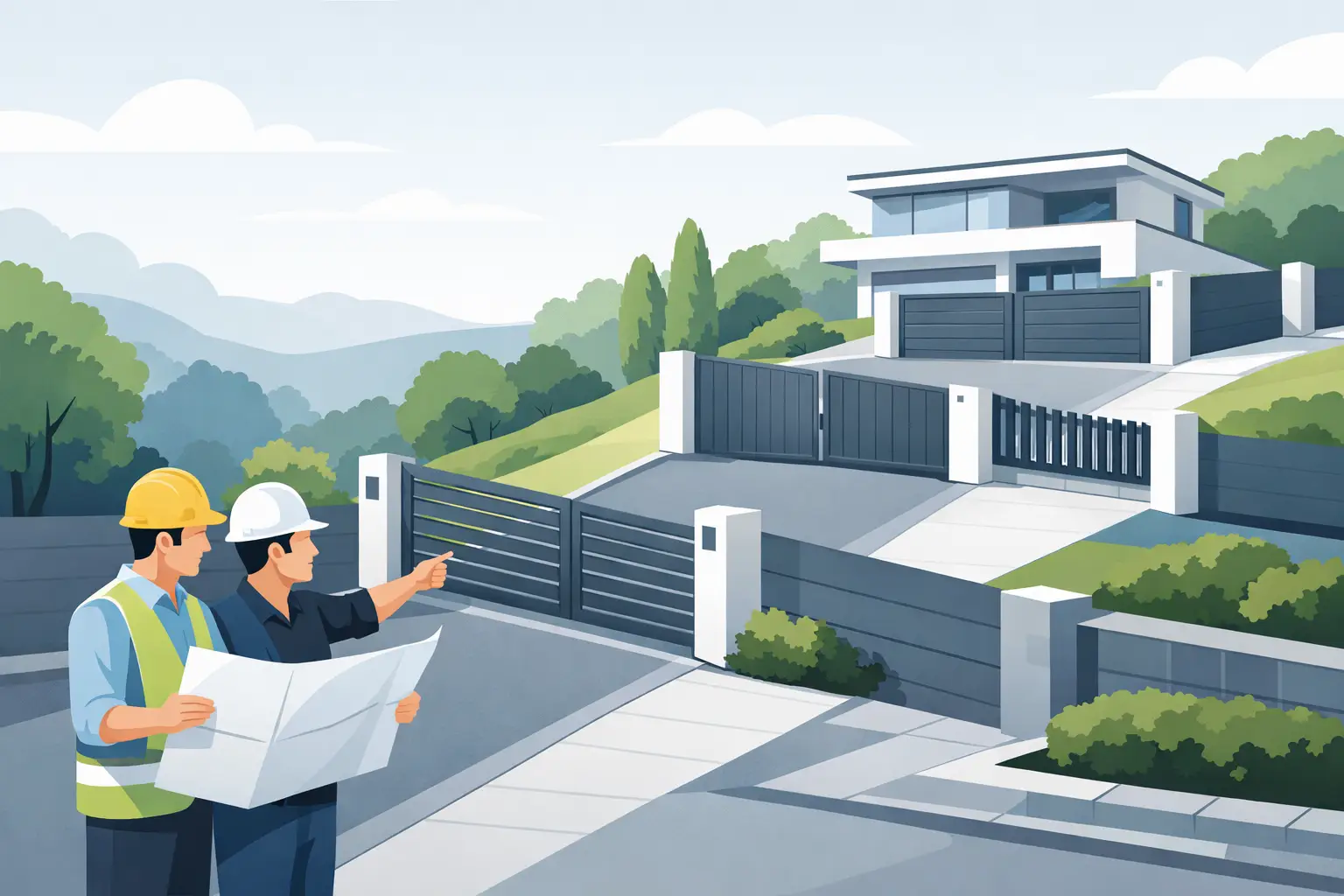
A sloping driveway can make an otherwise straightforward gate project far more technical. Aluminium gates for slopes need more than attractive panels and correctly sized posts: the direction of the gradient, opening space and gate type all affect whether the finished entrance works safely every day.

The good news is that a slope does not rule out a smart, low-maintenance aluminium gate. It simply means the gate should be designed around the site rather than treated as a standard opening. A proper survey at the outset will prevent problems such as leaves catching the ground, uneven gaps, difficult operation or an automation system working harder than it should.

Start with the direction of the slope

Not all slopes create the same challenge. The key question is whether the drive rises or falls in the direction the gate will open, or whether it slopes across the width of the entrance.

A driveway that slopes up or down away from the gate line affects the clearance beneath a swinging leaf. As the gate travels through its arc, its bottom edge may strike the surface on the uphill side. On a falling drive, a large gap can appear beneath the gate when it is closed. Both situations can affect appearance, privacy, security and the suitability of the gate for children or pets.

A gradient running across the entrance creates a different set of decisions. One side of the opening sits higher than the other, so the gate, posts and infill need to be set out carefully to avoid awkward-looking gaps. A made-to-measure design can use raked rails, stepped sections or adjusted ground levels to give a deliberate, well-finished result.

Before choosing a style, measure the gradient over the full gate opening and along the route where the gate will travel. Photographs are useful, but accurate levels give a gate supplier and installer the information needed to recommend a workable arrangement.

Choosing aluminium gates for slopes

The right opening method usually has the greatest influence on the final design. Swing gates, sliding gates and pedestrian gates can all work on sloping sites, but each has limitations worth understanding before an order is placed.

Swing gates on a rising or falling driveway

A pair of swing gates is often the preferred choice for a residential driveway because it creates a traditional entrance and does not require a long run-back area. However, swing leaves need sufficient clearance from the ground throughout their movement.

Where the drive rises towards the property, gates may be arranged to open towards the lower side, provided there is enough space and this does not create an issue with the road or pavement. In some cases, changing the level immediately inside the entrance is the cleanest solution. This may involve creating a flatter apron, regrading a small section of driveway or using carefully planned thresholds.

If the ground cannot be altered, a bespoke gate may be made with a higher bottom rail or a raked profile. This can preserve clearance, although it may leave a greater gap beneath part of the gate. It is a trade-off between ground clearance and the degree of enclosure required.

For a double-leaf driveway gate, it is also vital to allow for the central meeting point, hinges and any drop bolts. A minor difference in ground level can become obvious once two leaves meet in the middle, particularly with horizontal slatted designs where lines need to remain visually consistent.

Sliding gates and sloping sites

Sliding gates avoid the swinging arc that causes clearance problems on steep drives. They can be an excellent option when there is limited room behind the gates or when the driveway rises immediately inside the boundary.

That said, a sliding gate needs a suitable route alongside the opening. A tracked gate requires a level, stable track area, while a cantilever sliding gate needs a longer clear run-back zone and substantial support structure. A slope along this route may need groundwork and levelling before installation.

Sliding systems can offer a tidy, modern finish and work particularly well with automation, but they are not automatically the answer to every incline. The available side space, surface condition, drainage and existing boundary features all need checking first.

Pedestrian gates on sloping ground

Garden and side-access gates can be easier to accommodate, but they still need sensible clearances and a safe threshold. A pedestrian gate should not leave a trip hazard at the bottom of a steep path, nor should it have a gap large enough to compromise security.

A stepped section of fencing beside the gate can often manage a changing boundary level more neatly than trying to force every rail to follow the gradient. For contemporary aluminium fencing and gates, this can look intentional rather than improvised.

Bespoke design makes the difference

Readymade aluminium gates suit level, standard-sized openings well. On a slope, bespoke manufacture is often the better route because the frame, infill pattern and ground clearances can be considered together.

For example, horizontal aluminium slats can be raked to follow the line of a slope, or sections can be stepped to keep selected lines level. Vertical infill can be more forgiving visually on uneven ground, while solid or privacy-style panels may need closer attention to avoid a pronounced wedge-shaped gap beneath the gate.

The gate itself should remain properly engineered, with hinges, posts and fixings matched to its width and weight. Aluminium is a useful material for this type of project because it is lightweight compared with many steel alternatives, while still offering the strength needed for a substantial driveway or commercial entrance. Its powder-coated finish also avoids the regular painting, staining and corrosion management associated with timber and untreated metal.

Colour and style are still very much your choice. Whether the property calls for a sleek anthracite grey gate, a wood-effect finish or an ornate design, the slope should influence the engineering and detailing rather than limit the overall look.

Automation needs careful planning

An automated gate on a slope should never be specified as an afterthought. The operating equipment must be suited to the gate type, leaf size, opening angle and forces involved during travel.

For swing gates, the position and type of motor must work with the hinge geometry and available clearance. Underground motors can provide a discreet finish, while above-ground ram or articulated arm systems may be more practical depending on the posts and gate design. The best option depends on the site, not simply on appearance.

Safety devices are especially relevant where levels change. Photocells, safety edges and correctly configured force settings help the system respond to vehicles, people and obstructions. Drainage also matters around underground equipment and track systems, as standing water, debris and winter conditions can interfere with reliable use.

For a busy home, development or commercial entrance, consider how visitors will gain access before the gates are fitted. An intercom and controlled access system can be incorporated into the post, adjacent fencing or a separate pedestal. Planning this early avoids visible surface cabling and last-minute compromises.

The survey details that should not be missed

A gate installer will need more than the width between two posts. The most useful site information includes the clear opening width, post heights, driveway levels, the direction of travel, the intended opening direction and the space available on either side.

It is also worth identifying drainage channels, manhole covers, kerbs, retaining walls and changes in surface material. These features can affect foundations, tracks, motor placement and the best position for gate stops. If new posts are required, their foundations need to be designed for the ground conditions and the gate load, rather than simply set to match the line of the drive.

Where a gate is close to a public road, it should not open into a highway or obstruct a pavement. Local planning requirements can also apply in certain locations, including conservation areas and listed properties. Checking these points before committing to a design is far easier than changing a gate after manufacture.

A practical route to the right solution

The most successful sloping-gate projects begin with the site constraints, then select a gate design to suit. Trying to make a standard swing gate fit a steep drive can lead to unnecessary groundwork or a poor-looking result. Equally, choosing a sliding gate without a usable run-back area can create a different problem.

Aluminium Gates Direct can help customers assess whether a bespoke swing gate, sliding gate or combined gate and fencing layout is the most sensible option for the available space and budget. With nationwide supply and access to installation support, the aim is to provide a gate that looks right from the road and operates reliably long after fitting.

Before settling on a favourite design, arrange for the slope to be measured properly and discuss the intended use of the entrance. A gate that accommodates daily vehicles, visitors, automation and changing ground levels from the start will be a far better investment than one adapted to the site at the last minute.

How to Order Bespoke Gates Without Costly Mistakes

How to Order Bespoke Gates Without Costly Mistakes

A bespoke gate should fit more than the opening between two posts. It needs to suit how you arrive home, who uses the entrance, the level of privacy you want and, crucially, the conditions on site. Knowing how to order bespoke gates properly means resolving those practical details before manufacturing begins, rather than trying to correct them after delivery.

For a driveway, garden entrance or commercial perimeter, aluminium is often the sensible starting point. It is lightweight, strong, corrosion-resistant and does not require the regular sanding, painting or staining associated with timber. The bespoke process then gives you the freedom to specify the size, layout, colour, infill style and access controls around the property rather than settling for a near match.

How to order bespoke gates: begin with the site

The best gate designs start with accurate information, not a catalogue image. A gate can look excellent in isolation but prove unsuitable if the driveway rises sharply, there is limited room to open the leaves, or the existing pillars are not capable of carrying the weight and movement of an automated system.

Measure the clear opening at the bottom, middle and top. Openings are not always square, particularly on older properties, and the smallest measurement may determine the usable gate width. Record the height you want from finished ground level, then check whether the ground slopes across or through the opening. A swing gate needs sufficient clearance at the lowest point of its arc; a sliding gate needs a clear run-back area to one side.

Photographs are equally useful. Take images looking towards and away from the entrance, showing the posts or pillars, the driveway surface, nearby walls, services and any change in level. For sliding gates, include the full length of the proposed travel area. This gives the supplier or installation partner the context that measurements alone cannot provide.

If there is any doubt about structural suitability, arrange a site survey. This is particularly worthwhile for wide driveway gates, automated gates, gates fixed to existing masonry or commercial entrances with regular traffic. A survey can identify whether new steel or aluminium posts, reinforced foundations, drainage work or a different opening method would be more appropriate.

Choose the opening style before the appearance

Bespoke aluminium gates can be made as single pedestrian gates, bi-folding designs, double swing gates or sliding gates. Each has a place, and the right choice depends on the entrance rather than simply personal preference.

Double swing gates are a familiar, attractive option where there is enough level space inside the property for the leaves to open. They can create a traditional or contemporary frontage and work well for many domestic driveways. However, an outward-opening gate may require additional consideration near a public pavement or road, while steep driveways can restrict the available clearance.

A sliding gate is often better where space behind the entrance is limited or where a driveway slopes upwards. It travels sideways rather than into the property, but it needs room beside the opening for the gate to park when open. Cantilever sliding systems can be useful where a track across the driveway would be impractical, although they typically require more run-back space and a carefully designed supporting structure.

For pedestrian access, think about daily use. A separate matching side gate may be more convenient than opening a large driveway gate for visitors, bins or deliveries. On a commercial site, it may also help separate foot traffic from vehicle movements and make access control easier to manage.

Match the design to privacy, security and the property

Once the operating style is clear, the visual design becomes a more productive conversation. Aluminium offers considerable flexibility, from clean horizontal slats and solid privacy panels to vertical bars, decorative inserts and more ornate designs. The question is not simply which style looks best, but what the gate needs to do.

A closely boarded or solid-panelled design gives greater privacy and can soften views from the road into a garden or driveway. It may be the right choice for a property on a busy street. Open slatted and bar designs allow more light and visibility, which can be preferable where sightlines are important or where a more open boundary is wanted. The spacing and orientation of slats can make a meaningful difference to both appearance and privacy.

Colour should be considered alongside window frames, doors, fencing and railings. Popular anthracite and black finishes provide a modern look, while bespoke powder-coated colours can help the gate sit naturally within a period property or a defined architectural scheme. Powder coating gives aluminium a durable finish, but it is still worth choosing a colour that will remain appealing as the property evolves.

Do not overlook the gate frame, posts, hinges and latch position. These details affect strength, day-to-day use and the finished look. A well-specified aluminium gate should feel substantial without placing unnecessary load on posts and automation equipment.

Plan automation and access control early

Automation works best when it is built into the specification from the outset. Retrofitting is possible in some cases, but early planning avoids compromises around hinge geometry, underground cabling, safety devices and control equipment.

Decide who needs access and how they will use the gate. A simple remote-control system may suit a private driveway. A keypad, proximity fob, GSM calling system or Akuvox intercom may be more suitable where visitors, deliveries, multiple residents or staff need controlled entry. Video intercoms can provide an added level of reassurance by allowing occupants to identify visitors before granting access.

Every automated gate must be designed with safety in mind. That includes suitable safety edges, photocells, force settings, emergency release arrangements and controls positioned away from moving parts. The exact requirements vary with the gate type and site, which is another reason to involve a knowledgeable supplier and experienced installer at the quotation stage.

Power supply is often one of the first practical questions. Find out where the electrical feed will come from, how cables will be protected and whether groundwork is required before installation. If the entrance is some distance from the property, this can affect both programme and cost. Solar-powered options may suit certain lower-use locations, but they depend on the site, available light and the demands of the automation system.

Give enough detail for a clear bespoke quotation

A useful quotation should make it easy to understand what is included. When requesting one, provide your opening measurements, preferred gate type, approximate height, design references, colour preference and whether automation or intercom access is required. State whether you need supply only or support with installation.

It also helps to explain the intended use. A family driveway used several times a day needs a different specification from a gated development, warehouse entrance or garden side gate. Commercial and shared-access sites may need more durable duty ratings, controlled entry credentials and clearer arrangements for pedestrians.

Ask for clarity on the gate leaves, frame, posts, hinges or track system, locking, automation equipment, safety accessories, delivery and installation. If groundwork, electrical works, removal of existing gates or brickwork alterations are not included, knowing this early lets you plan the wider project properly. The lowest initial price is not always the best value if important elements have been left out.

At Aluminium Gates Direct, bespoke projects can be discussed around the property, budget and intended use, with nationwide installation support available through trusted partners. A direct conversation before ordering is often the quickest way to establish whether a made-to-measure solution or a readymade option is the better fit.

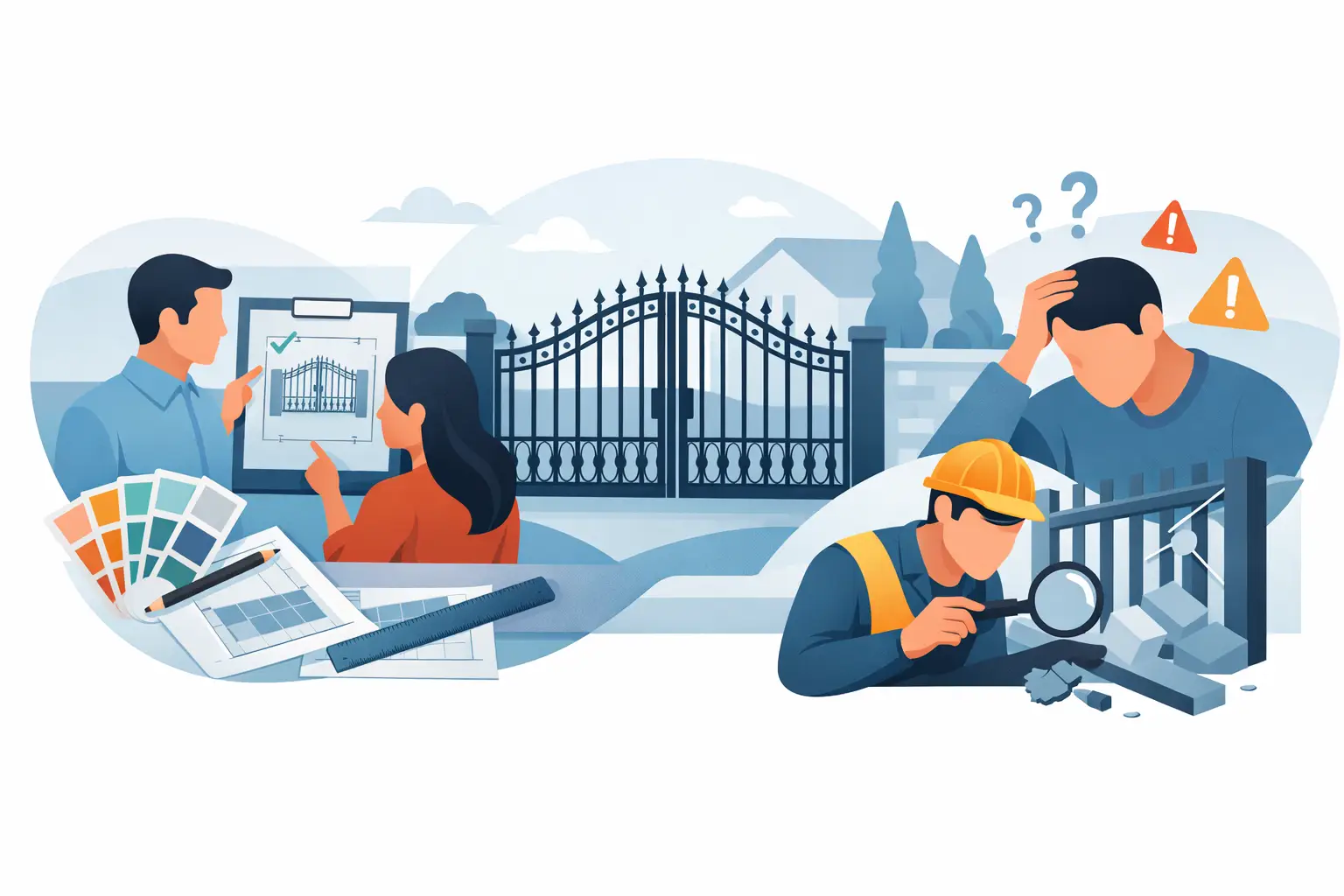
Approve drawings and specifications carefully

Before manufacturing starts, review the final drawing or specification line by line. Confirm the overall width and height, leaf split for double gates, direction of opening, hinge side, infill design, post arrangement, colour and any automation preparation. Check that the drawing reflects the view from the correct side of the gate, especially where slats, handles, letterboxes or decorative features have a front and back.

This stage matters because bespoke products are made specifically for your site. Changes after fabrication has started may cause delays or additional cost. A few careful minutes spent comparing the approved drawing with your site measurements can prevent much larger problems later.

If an installer is involved, make sure they receive the final specification too. They need to know the weight, fixing requirements, cable routes, operating direction and automation plan before arriving on site. Good coordination is particularly valuable where builders, electricians, landscapers and driveway contractors are working around the same entrance.

Prepare for delivery and installation

Bespoke gates are usually manufactured to order, so lead times will vary with the design, finish, season and level of project complexity. Use that period to complete foundations, posts, electrical ducts, driveway finishes and any walling work required. Avoid laying a final surface too early if cable runs or ground tracks are still needed.

On delivery day, ensure there is safe access for unloading and a dry, secure area for components if installation is not immediate. Once fitted, automated gates should be commissioned, safety checked and demonstrated. Keep the manuals, remotes, release key and any intercom instructions somewhere accessible.

A properly specified aluminium gate is a long-term improvement to the security and appearance of a property. Bring clear measurements, honest site information and a practical wish list to the first conversation, and the ordering process becomes far more straightforward.

Bespoke Gate Design Examples for UK Homes

Bespoke Gate Design Examples for UK Homes

A 3.6-metre driveway with sloping ground, an existing stone wall and limited room for opening leaves is not a job for an off-the-shelf gate. This is where bespoke gate design examples become genuinely useful: they show how dimensions, privacy, access and property style can work together rather than compete.

A made-to-measure aluminium gate gives you far more choice than simply selecting a colour and width. You can adjust the rail layout, infill style, gate height, opening arrangement, hardware and access-control specification to suit the site. The right answer depends on how the gate will be used every day, not just how it looks from the road.

Bespoke gate design examples that solve real briefs

Contemporary horizontal slatted driveway gates

Horizontal slatted gates are a popular choice for newer homes, renovated properties and clean-lined extensions. Their simple geometry suits aluminium particularly well, producing a neat, consistent finish without the warping, splitting or regular repainting associated with timber.

For a customer who wants privacy without making the frontage feel closed in, wider gaps between slats can soften the appearance and allow light through. Closer-spaced slats, or a solid infill arrangement, create greater screening for a drive overlooked by neighbours or passing traffic. A darker powder-coated finish, such as anthracite grey or black, often works well with modern windows, doors and roof details.

On a wide entrance, the same design can be made as a pair of swing gates or a single sliding gate. Swing gates can give a traditional arrival feel, but they need clear space behind the entrance to open safely. A sliding gate is often the better option where the drive rises towards the house, a vehicle needs to park close to the entrance, or the opening is particularly wide.

Aluminium gates framed around traditional brick or stone

Bespoke does not have to mean ultra-modern. A property with reclaimed brick, natural stone piers or a period-style frontage may benefit from a gate that has a more traditional profile while retaining the practical advantages of aluminium.

For example, an arched-top driveway gate with vertical infill and decorative detailing can echo classic wrought-iron proportions. The design can be made to follow an existing wall line or sit comfortably between taller stone piers. A matching pedestrian gate can carry the same top rail and infill pattern, creating a considered entrance rather than two unrelated access points.

There is a balance to strike here. Highly ornate details can look excellent on the right property, but may feel out of place against a modest bungalow or a contemporary brick elevation. Photos of the house, walling, driveway and neighbouring features help establish whether the gate should be a focal point or a quieter part of the overall frontage.

Privacy gates for overlooked gardens and side entrances

A bespoke garden or side gate is often specified for a very practical reason: stopping people looking directly into a patio, bin store, utility area or side passage. A full-height aluminium gate with solid or close-boarded-style infill can offer a much more secure and private boundary than a standard timber panel.

The detail that matters most is not always visible from the front. A narrow side return may require a gate that opens outwards rather than inwards, or one that clears a downpipe, raised step or uneven paving. The latch position, hinge side and clearance beneath the gate all need to suit the actual route used by residents, deliveries and garden equipment.

Powder-coated aluminium is particularly suited to these hard-working locations. It does not need yearly staining or painting, and it stands up well to wet British weather. Occasional cleaning with mild soapy water is normally enough to keep the finish looking smart.

Statement entrance gates with integrated access control

For larger homes, private developments and commercial premises, the gate can become part of a wider access system. A bespoke sliding or swing gate may be paired with automation, safety devices and an intercom so that visitors can be screened before entry is granted.

An Akuvox intercom system can be positioned on a matching pedestal or incorporated alongside the gate within a purpose-built entrance panel. This can create a tidy result, particularly where there is no suitable existing pier. It also avoids adding an afterthought control box to a carefully designed gate.

The gate design should allow for the practical parts of automation from the outset. That includes the weight and construction of the leaves, cable routes, power supply, safety photocells, manual release access and the position of stops or track systems. Retrofitting automation can be possible, but planning it early usually gives a cleaner installation and clearer budget.

Commercial gates built around security and daily traffic

Commercial sites need a different conversation. A warehouse yard, flat development, school service entrance or office car park may require controlled access, a wider opening and a gate that can handle regular vehicle movements. The visual finish still matters, but reliability and safe operation take priority.

A cantilever sliding gate can suit a busy entrance where a ground track would be inconvenient or likely to collect debris. For a smaller staff car park, automated swing gates may provide an effective solution where the internal approach is level and there is adequate opening space. Pedestrian access should normally be considered separately, so people are not encouraged to pass through a vehicle gate.

Commercial bespoke designs can also coordinate with aluminium fencing, railings and access-control points. Matching the infill pattern and powder-coated colour across the perimeter gives a professional appearance while keeping the site boundary consistent.

Choosing the right layout before choosing the style

The most successful gate designs start with the site. Before settling on slats, panels or decorative features, establish the clear opening width, available depth, ground level and the direction vehicles approach from. A gate must have sufficient clearance to operate without catching on a slope, kerb or loose gravel.

For swing gates, consider where a car will wait while the gates open. Gates that open towards a public pavement can create obvious safety and compliance concerns, so inward opening is generally preferred where possible. On a steep or short driveway, sliding operation may remove the problem altogether.

Height is another decision with both visual and practical consequences. A taller gate improves privacy and can add a stronger sense of security, but it may reduce visibility when pulling out onto a road. It can also alter the character of the frontage. Where planning restrictions, conservation-area requirements or title covenants may apply, check these before finalising the specification.

Details that make a bespoke gate look properly finished

A bespoke aluminium gate should look intentional from every angle. Matching posts, hinges, handles, locks and infill alignment all make a difference. If the property has an existing wall, it is worth checking whether the structure is suitable for gate loading or whether dedicated posts will provide a safer, more reliable fixing point.

Colour choice deserves the same attention as the gate pattern. Black can give a crisp contrast against pale render, while anthracite grey sits naturally beside many contemporary frames and roof finishes. A bespoke powder-coated colour may be worthwhile where the gate needs to match a front door, cladding or architectural metalwork. The trade-off is usually a longer lead time than a standard colour.

Consider sightlines too. A fully solid driveway gate offers privacy, but it may conceal vehicles, children or pedestrians on the other side. Designs with controlled gaps, side vision panels or suitable set-back from the highway can help retain a safer view without compromising the overall look.

When readymade may be the better choice

Not every project needs a fully bespoke solution. If your opening is a standard size, the layout is straightforward and you need a gate quickly, a readymade aluminium gate can offer excellent value and a shorter route to installation. It can still provide the low-maintenance finish and durable construction many homeowners want.

Bespoke is most valuable when standard sizes would leave awkward gaps, when the ground or walling presents a challenge, or when you want the gate to coordinate with an existing fence, railing or access system. It is also the sensible choice for unusual opening widths, matching pedestrian gates and designs that need to meet a clear architectural brief.

At Aluminium Gates Direct, the starting point is a clear picture of your entrance, measurements and priorities. Share photographs, approximate dimensions and details of how the gate will be used, and it becomes much easier to recommend a design that is attractive, practical and priced for the project. A well-specified bespoke gate should make arriving home, securing the property and maintaining the entrance feel simpler for years to come.

Modern Driveway Gate Trends for UK Homes

Modern Driveway Gate Trends for UK Homes

A driveway gate has become far more than a boundary marker. The strongest modern driveway gate trends reflect how UK homeowners want to live: with better privacy, simpler access, stronger kerb appeal and less weekend maintenance. Aluminium is central to this shift because it offers the clean lines and made-to-measure flexibility of a contemporary gate without the ongoing treatment associated with timber or the weight and corrosion concerns that can come with steel.

The right trend is not necessarily the newest-looking design. It is the one that suits the property, the width and slope of the entrance, the desired level of privacy and how the gate will be used every day. For a family home, that may mean automation and a solid screen. For a rural driveway, it may mean a wider opening with a design that feels in keeping with the setting. For a development or commercial site, access control and dependable operation usually lead the specification.

Modern driveway gate trends shaping UK properties

Contemporary gate design is moving towards calm, purposeful finishes rather than excessive decoration. Homeowners are choosing gates that complement window frames, front doors, fencing and exterior cladding, creating a considered approach to the whole frontage.

Horizontal slats remain a leading choice

Horizontal slatted aluminium gates are one of the most requested contemporary styles. Their linear appearance suits new-build homes, renovated properties and extensions, while the spacing can be tailored to change the balance between openness and screening.

Closer slat spacing gives a more private, enclosed look. Wider gaps allow light and sightlines through the gate, which can make a smaller frontage feel less closed in. This is a useful distinction: a fully private design is not always the best choice where drivers need clear visibility when leaving the property.

Slatted gates also work well when matched with aluminium fencing or side panels. Continuing the same line and colour across the perimeter creates a tidy, integrated result rather than making the driveway entrance feel like a separate addition.

Solid and near-solid designs for privacy

Privacy is a major reason for replacing an older gate. Solid-panel and near-solid aluminium driveway gates offer a clean architectural finish, helping to screen cars, bins and the front of the property from the road.

This style is particularly effective on busy residential roads and at properties with short driveways. It can also provide a more substantial visual barrier without relying on ornate details. However, a solid gate will catch more wind than an open design, so the posts, foundations, hinges and automation must be selected with the exposure of the site in mind.

For many properties, a partially screened design offers the best compromise. A solid lower section with a more open upper detail can maintain privacy while reducing visual weight and allowing some airflow.

Anthracite grey is established, but colour choice is widening

Anthracite grey remains popular because it works with modern brickwork, render, composite cladding and aluminium windows. It has become a dependable choice rather than a passing fashion. Black finishes also continue to suit period homes and properties with darker joinery.

At the same time, homeowners are becoming more confident with colour. Bespoke aluminium gates can be powder coated in a wide selection of colours, allowing the gate to match existing architectural details rather than simply following the default grey. Deep green can sit comfortably in a rural setting, while muted bronze and brown tones can soften a contemporary design.

The practical point is to view colour against the property at different times of day. A shade that looks light on a small sample may appear much darker across a pair of full-height gates. A specialist supplier can help you consider the finish alongside the surrounding fencing, walls and hardware.

Smarter entrance control, without unnecessary complexity

Automation is now expected on many new driveway gate projects, but the trend is towards convenient, reliable control rather than technology for its own sake. Homeowners want to arrive in the rain, press a remote or use an approved access method, and enter without leaving the car.

Intercom systems are also increasingly specified from the start, particularly where deliveries and visitor access need managing. Video intercom options, including Akuvox systems, can allow a homeowner or site manager to see and speak to a visitor before opening the gate. For multi-occupancy developments and commercial premises, this can form part of a wider access-control plan.

Automation should be planned early, not added as an afterthought. Gate weight, leaf size, wind exposure, opening direction, power supply and safety devices all affect the right system. Lightweight aluminium has a clear advantage here: it places less demand on the operating equipment than a comparable heavy steel gate, while still providing strength and durability.

Swing or sliding gates: let the driveway decide

A pair of swing gates creates a traditional entrance layout with a modern finish. They are often an excellent option where there is sufficient level space inside the property for the leaves to open safely. Inward opening is generally preferred, as gates should not swing out across a public pavement or road.

Sliding gates are increasingly chosen for entrances with limited depth, steep inclines or large openings. They travel parallel to the boundary instead of swinging into the driveway, which can make better use of available space. They do require a suitable run-back area and carefully prepared ground, so they are not automatically the answer for every site.

The trend is not simply towards sliding gates. It is towards choosing the operating style that works reliably with the plot. A site assessment before ordering can avoid expensive changes later.

Made-to-measure design is replacing one-size-fits-all thinking

Standard-sized gates remain a sensible route for straightforward openings and controlled budgets. They can provide a smart, durable result quickly where the dimensions and layout allow. Yet more homeowners and developers are choosing bespoke aluminium gates because driveways rarely conform neatly to standard measurements.

Bespoke manufacture gives greater control over width, height, infill style, colour and arrangement. It can also help resolve practical details, such as sloping ground, uneven walls, a need for matching pedestrian access or an unusually wide entrance. The visual benefit is significant: a gate proportioned to the opening looks intentional, whereas an ill-fitting gate can make even a premium product look compromised.

This does not mean every project needs the most elaborate option. The right approach depends on the site and budget. A well-selected readymade gate may be ideal for a simple replacement, while a made-to-order solution is often better where appearance, automation or complex dimensions are priorities.

Low-maintenance materials are now a design priority

Modern gate buyers are looking beyond appearance on installation day. They want a finish that continues to look good without regular sanding, staining or repainting. This is one of the clearest reasons aluminium has become such a popular choice for driveway entrances.

Quality powder-coated aluminium is designed for year-round outdoor use and does not rust like untreated steel or rot like timber. Routine care is usually straightforward: washing the gate with mild soapy water and a soft cloth removes surface dirt and helps keep the finish looking its best. The moving parts and automation system should still be checked and serviced as recommended, particularly on gates that operate several times a day.

Low maintenance should not be confused with no planning. Correct installation matters just as much as material choice. Posts, foundations, hinges, tracks and safety equipment need to be suited to the gate design and site conditions if the entrance is to operate smoothly over time.

Security that does not look industrial

A secure gate no longer has to give a home the appearance of a fortress. Current designs combine taller panels, reduced gaps, secure latching and controlled entry with refined profiles and coordinated finishes. The aim is a boundary that feels private and reassuring while still enhancing the property.

For commercial sites, the requirements can be more demanding. Gate usage frequency, vehicle types, access permissions, pedestrian safety and the wider perimeter all need consideration. A sliding aluminium gate with automation, access control and matching fencing may be suitable, but the specification should always be led by how the site operates rather than by appearance alone.

For homeowners, it is equally sensible to consider what happens when the gate is closed, open or unavailable during a power interruption. A clear conversation about manual release, visitor access and safe operation gives far more confidence than choosing an operator solely on price.

Choose a gate that belongs to the property

The best contemporary driveway gates do not compete with the house. They echo its lines, respect the practical limits of the driveway and make arriving home easier. Whether the preference is a striking horizontal slat design, a private solid-panel gate or a tailored automated entrance, start with the site and the daily routine. Aluminium Gates Direct can help match the style, sizing and access options to a solution that will continue to look right long after the initial trend has moved on.

Gate Automation Costs: What UK Buyers Pay

Gate Automation Costs: What UK Buyers Pay

A driveway gate that opens at the touch of a remote, keypad or phone can make arriving home feel simpler and make access control far more practical. But gate automation costs are not just the price of a motor. The gate type, site conditions, power supply, safety equipment and access controls all affect the final budget.

For a reliable system, it pays to look at the whole project rather than choosing automation as an afterthought. A correctly specified operator should suit the gate’s weight, width, usage level and opening style, while the installation must account for safety, foundations and everyday use.

What do gate automation costs include?

A typical automated gate project has several connected elements: the gates themselves, automation equipment, installation, electrical work and access control. Some properties need only a straightforward pair of swing gates with remote controls. Others require a sliding gate, intercom system, vehicle detection and significant groundwork.

As a broad guide, automation equipment alone may start from around £700 to £1,500 for a quality domestic setup, depending on the gate configuration and controls selected. A fully installed automation package can often fall between £2,000 and £5,000 or more. This is separate from the cost of the gates, posts, brickwork or any substantial landscaping and groundwork.

These ranges are useful for early budgeting, not a substitute for a site-specific quotation. A lightweight aluminium driveway gate has very different requirements from a long, solid gate at the entrance to a busy commercial premises.

The biggest factors affecting the price

Swing or sliding gate automation

Swing gates are a popular option for residential driveways. They normally use one motor per leaf, with either underground operators or above-ground articulated or ram-style units. Above-ground systems are generally more accessible for servicing and can be a practical, cost-conscious choice. Underground motors provide a cleaner appearance but usually cost more because of excavation, drainage and installation complexity.

Sliding gates need a track and rollers, or a cantilever arrangement where the gate travels without a ground track across the opening. They use a single motor but require room for the gate to slide back fully when open. Although sliding automation can be an excellent choice for sloping driveways or wide entrances, the supporting groundworks and track requirements can increase the overall cost.

The right choice depends on the available space, driveway gradient, gate design and how vehicles approach the entrance. It is not always sensible to choose the cheapest automation type if it does not work well with the site.

Gate size, weight and construction

Automation should be selected for the actual gate, rather than a generic opening width. Wide gates, tall privacy panels and locations exposed to strong winds place greater demands on motors, hinges and supporting posts. A motor may move a gate comfortably in calm conditions but struggle if the gate has a large solid surface and is exposed to wind.

This is one reason aluminium is a strong option for automated gates. It combines strength with a lower weight than many traditional materials, reducing the load placed on automation components. Aluminium also will not rust and does not need regular painting or staining, which helps keep the gate looking smart without creating extra maintenance around the automation system.

Bespoke gates may involve a higher initial outlay than standard sizes, but they can make automation easier to specify correctly. A gate designed around the opening, posts and intended operating method avoids compromises later in the project.

Groundworks, posts and power supply

Site preparation is often the area that catches buyers by surprise. Automation needs secure, accurately positioned posts or pillars, stable foundations, suitable hinge alignment and a safe route for cables. Existing posts may be suitable, but they need checking before any motor is ordered.

A mains electrical supply is usually the preferred option for dependable daily operation. The distance from the house or consumer unit to the gate can affect labour and materials, especially where cables must pass under driveways, paths or landscaped areas. Your installer may also need to allow for isolators, protective devices and any electrical certification required for the work.

Solar-powered automation can be useful where bringing mains power to the gate would be disruptive or expensive. However, it is not a universal answer. Panel position, shade from trees or buildings, local weather, gate usage and battery capacity all need consideration. For a frequently used entrance or a shaded site, mains power may be the more dependable long-term choice.

Safety equipment and compliant installation

An automatic gate is a moving machine, not simply a manual gate with a remote control added. It must be installed and configured with the right safety measures for the site and its users.

Photocells are commonly used to detect an obstruction in the gate opening. Depending on the design and risk assessment, additional measures can include safety edges, warning lights, force limitation and emergency release arrangements. A qualified installer will assess pinch points, crushing zones, pedestrian access and the possibility of children or visitors entering the gate’s operating area.

Trying to reduce gate automation costs by omitting safety equipment is a false economy. The correct protection helps prevent injury, reduces the chance of damage to vehicles or gates and supports a system that can be used confidently every day.

Access controls: from remotes to video entry

Remote fobs are normally the most basic access method and are often included in an automation package. A keypad is useful for family members, trusted visitors or tradespeople, while a vehicle loop can trigger the gate for cars exiting the property without requiring a remote.

Intercoms add another layer of convenience and security. Audio systems allow visitors to call from the entrance, while video intercoms let occupants see who is there before granting access. App-connected systems can be particularly useful for deliveries, properties with multiple residents or sites managed remotely.

The cost depends on the number of call points, internal monitors, wiring requirements and whether the system needs to connect to an existing network. For a home, a simple keypad and remotes may be all that is needed. For a flat development, office, school or commercial yard, a more advanced intercom and controlled-access setup may be justified.

Budgeting for a new gate and automation together

When planning a project, separate the budget into clear parts: gate supply, automation equipment, installation, electrical work, groundwork and access controls. This makes it easier to compare quotations fairly and see what is included.

A low initial figure may not include cabling, safety devices, post work, commissioning or removal of an old gate. Equally, a higher quotation may include a more suitable motor, better safety provision and all the preparation needed for a dependable installation. Ask whether the price covers programming, handover and instructions for using the manual release in a power cut.

For homeowners, it is also worth considering the cost over the life of the gate. A well-made aluminium gate avoids the repeated repainting, rust treatment and timber repairs associated with some alternatives. Combined with correctly matched automation, that can make the overall investment more predictable.

When is a higher-spec system worth it?

Not every driveway requires premium access control, but some situations benefit from spending more at the start. A long or heavily used driveway, a shared entrance, a property left empty regularly or a commercial site with frequent vehicle movements may need stronger equipment and more advanced controls.

Higher-cycle motors are designed for more frequent opening and closing. They can be a sensible investment where multiple households, staff or deliveries use the entrance throughout the day. Likewise, a video intercom may offer better value than repeated trips to the gate or reliance on temporary access arrangements.

For a straightforward domestic entrance used a few times daily, a carefully specified standard system may be entirely appropriate. The key is matching the equipment to real use, not paying for features that will never be needed.

Questions to ask before accepting a quotation

Before committing, ask what motor type is proposed and why it suits your gate. Confirm whether the quotation includes photocells, safety edges where required, remotes, control boards, cabling, electrical connection and commissioning. It is also sensible to ask how the gate will be released manually during a power failure and what ongoing servicing is recommended.

If the gates have not yet been selected, discuss automation at the same time as the gate design. Aluminium Gates Direct can help customers consider gate style, size, access requirements and installation support together, so the finished entrance is practical as well as attractive.

The best automated gate is rarely the one with the lowest headline price. It is the one designed around your entrance, installed with proper safety measures and simple enough to work reliably every time you come home.